Department of Radiology (Z.S., J. Li, W.P., T.J., Q.L., J. Lu), Changhai Hospital, Naval Medical University, Shanghai, China.
Department of Radiology, University of Cambridge, United Kingdom (Z.S., Z.M., Z.T.).
Stroke. 2020 Jul;51(7):2161-2169. doi: 10.1161/STROKEAHA.120.029062. Epub 2020 Jun 17.
Intracranial atherosclerosis is one of the main causes of stroke, and high-resolution magnetic resonance imaging provides useful imaging biomarkers related to the risk of ischemic events. This study aims to evaluate differences in histogram features between culprit and nonculprit intracranial atherosclerosis using high-resolution magnetic resonance imaging.
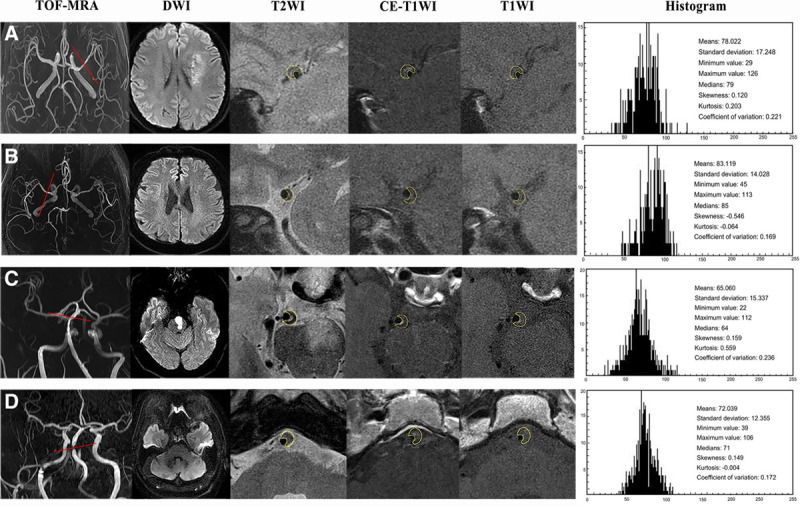
Two hundred forty-seven patients with intracranial atherosclerosis who underwent high-resolution magnetic resonance imaging sequentially between January 2015 and December 2016 were recruited. Quantitative features, including stenosis, plaque burden, minimum luminal area, intraplaque hemorrhage, enhancement ratio, and dispersion of signal intensity (coefficient of variation), were analyzed based on T2-, T1-, and contrast-enhanced T1-weighted images. Step-wise regression analysis was used to identify key determinates differentiating culprit and nonculprit plaques and to calculate the odds ratios (ORs) with 95% CIs.
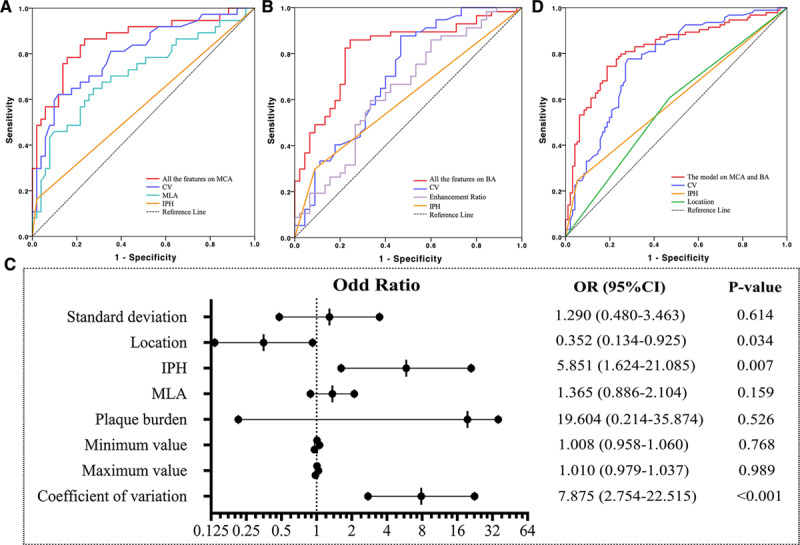
In total, 190 plaques were identified, of which 88 plaques (37 culprit and 51 nonculprit) were located in the middle cerebral artery and 102 (57 culprit and 45 nonculprit) in the basilar artery. Nearly 90% of culprit lesions had a degree of luminal stenosis of <70%. Multiple logistic regression analyses showed that intraplaque hemorrhage (OR, 16.294 [95% CI, 1.043-254.632]; =0.047), minimum luminal area (OR, 1.468 [95% CI, 1.032-2.087]; =0.033), and coefficient of variation (OR, 13.425 [95% CI, 3.987-45.204]; <0.001) were 3 significant features in defining culprit plaques in middle cerebral artery. The enhancement ratio (OR, 9.476 [95% CI, 1.256-71.464]; =0.029), intraplaque hemorrhage (OR, 2.847 [95% CI, 0.971-10.203]; =0.046), and coefficient of variation (OR, 10.068 [95% CI, 2.820-21.343]; <0.001) were significantly associated with plaque type in basilar artery. Coefficient of variation was a strong independent predictor in defining plaque type for both middle cerebral artery and basilar artery with sensitivity, specificity, and accuracy being 0.79, 0.80, and 0.80, respectively.
Features characterized by high-resolution magnetic resonance imaging provided complementary values over luminal stenosis in defined lesion type for intracranial atherosclerosis; the dispersion of signal intensity in histogram analysis was a particularly effective predictive parameter.
颅内动脉粥样硬化是中风的主要原因之一,高分辨率磁共振成像提供了与缺血事件风险相关的有用成像生物标志物。本研究旨在使用高分辨率磁共振成像评估罪魁祸首和非罪魁祸首颅内动脉粥样硬化斑块之间的直方图特征差异。
2015 年 1 月至 2016 年 12 月期间,连续招募了 247 例接受高分辨率磁共振成像的颅内动脉粥样硬化患者。基于 T2、T1 和对比增强 T1 加权图像,分析了定量特征,包括狭窄程度、斑块负荷、最小管腔面积、斑块内出血、增强比和信号强度分布(变异系数)。采用逐步回归分析来确定区分罪魁祸首和非罪魁祸首斑块的关键决定因素,并计算 95%置信区间的优势比(OR)。
共发现 190 个斑块,其中 88 个斑块(37 个罪魁祸首和 51 个非罪魁祸首)位于大脑中动脉,102 个斑块(57 个罪魁祸首和 45 个非罪魁祸首)位于基底动脉。近 90%的罪魁祸首病变的管腔狭窄程度<70%。多因素逻辑回归分析显示,斑块内出血(OR,16.294 [95%CI,1.043-254.632];=0.047)、最小管腔面积(OR,1.468 [95%CI,1.032-2.087];=0.033)和变异系数(OR,13.425 [95%CI,3.987-45.204];<0.001)是确定大脑中动脉罪魁祸首斑块的 3 个重要特征。增强比(OR,9.476 [95%CI,1.256-71.464];=0.029)、斑块内出血(OR,2.847 [95%CI,0.971-10.203];=0.046)和变异系数(OR,10.068 [95%CI,2.820-21.343];<0.001)与基底动脉斑块类型显著相关。变异系数是定义大脑中动脉和基底动脉斑块类型的独立强预测因子,其敏感性、特异性和准确性分别为 0.79、0.80 和 0.80。
高分辨率磁共振成像特征在定义颅内动脉粥样硬化病变类型方面提供了比管腔狭窄更具互补价值的信息;直方图分析中的信号强度分布是一种特别有效的预测参数。