Proteomics Resource Unit, Obesity Research Center, College of Medicine, King Saud University, P.O. Box 2925 (98), Riyadh 11461, Saudi Arabia.
Department of Medicine, College of Medicine and king Saud Medical City, King Saud University, P.O. Box 2925 (98), Riyadh 11461, Saudi Arabia.
Molecules. 2020 Jun 19;25(12):2831. doi: 10.3390/molecules25122831.
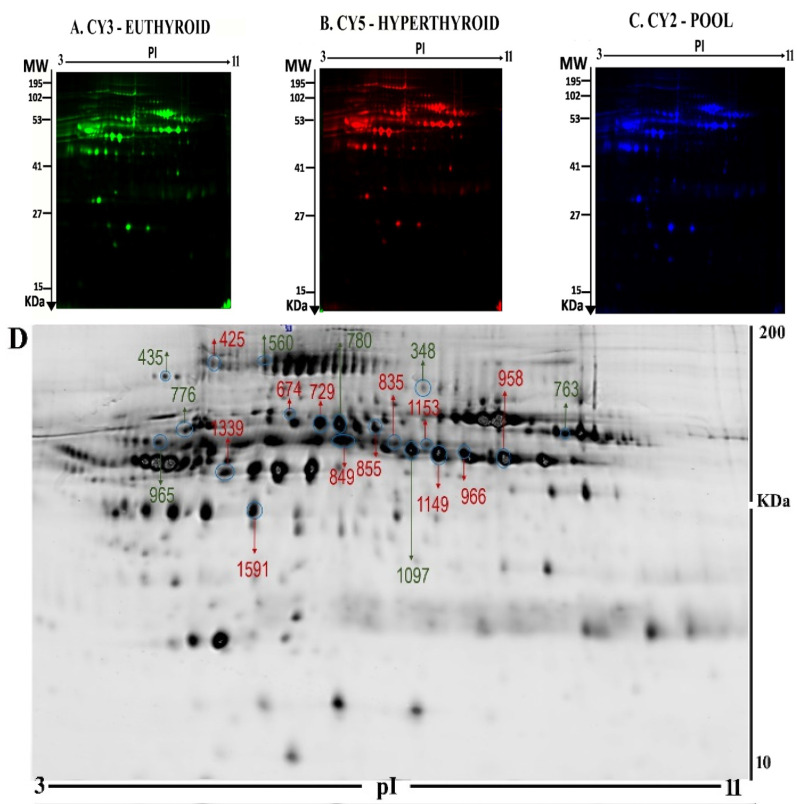
Thyroid hormones critically modulate body homeostasis and haemostasis by regulating energy and metabolism. Previous studies have focused on individual pathways or proteins that are affected by increases in thyroid hormone levels, while an overall plasma proteomic signature of this increased level is lacking. Herein, an integrated untargeted proteomic approach with network analysis was used to identify changes in circulating proteins in the plasma proteome between hyperthyroid and euthyroid states. Plasma from 10 age-matched subjects at baseline (hyperthyroid) and post treatment with carbimazole (euthyroid) was compared by difference gel electrophoresis (DIGE) and matrix-assisted laser desorption/ionization time of flight (MALDI TOF) mass spectrometry (MS). A total of 20 proteins were identified with significant difference in abundance (analysis of variance (ANOVA) test, ≤ 0.05; fold-change ≥ 1.5) between the two states (12 increased and 8 decreased in abundance in the hyperthyroid state). Twelve protein spots corresponding to ten unique proteins were significantly more abundant in the hyperthyroid state compared with the euthyroid state. These increased proteins were haptoglobin (HP), hemopexin (HPX), clusterin (CLU), apolipoprotein L1 (APOL1), alpha-1-B glycoprotein (A1BG), fibrinogen gamma chain (FGG), Ig alpha-1 chain C region (IGHA1), complement C6 (C6), leucine rich alpha 2 glycoprotein (LRG1), and carboxypeptidase N catalytic chain (CPN1). Eight protein spots corresponding to six unique proteins were significantly decreased in abundance in the hyperthyroid samples compared with euthyroid samples. These decreased proteins were apolipoprotein A1 (APOA1), inter-alpha-trypsin inhibitor heavy chain 4 (ITIH4), plasminogen (PLG), alpha-1 antitrypsin (SERPINA1), fibrinogen beta chain (FGB), and complement C1r subcomponent (C1R). The differentially abundant proteins were investigated by ingenuity pathway analysis (IPA). The network pathway identified related to infectious disease, inflammatory disease, organismal injury and abnormalities, and the connectivity map focused around two central nodes, namely the nuclear factor kappa-light-chain-enhancer of activated B cells (NF-κB) and p38 mitogen-activated protein kinase (MAPK) pathways. The plasma proteome of patients with hyperthyroidism revealed differences in the abundance of proteins involved in acute phase response signaling, and development of a hypercoagulable and hypofibrinolytic state. Our findings enhance our existing knowledge of the altered proteins and associated biochemical pathways in hyperthyroidism.
甲状腺激素通过调节能量和代谢来严格调节身体的内稳态和止血作用。先前的研究集中在受甲状腺激素水平升高影响的单个途径或蛋白质上,而缺乏这种升高水平的整体血浆蛋白质组学特征。在此,使用集成的无靶向蛋白质组学方法和网络分析来鉴定甲状腺功能亢进和甲状腺功能正常状态之间血浆蛋白质组中循环蛋白的变化。通过差异凝胶电泳(DIGE)和基质辅助激光解吸/电离时间飞行(MALDI TOF)质谱(MS)比较了 10 名年龄匹配的受试者在基线(甲状腺功能亢进)和卡比马唑治疗后(甲状腺功能正常)的血浆。用方差分析(ANOVA)检验鉴定出 20 种蛋白质在两种状态下的丰度存在显着差异(≤0.05;倍数变化≥1.5)(甲状腺功能亢进状态下 12 种增加,8 种减少)。在甲状腺功能亢进状态下与甲状腺功能正常状态相比,12 个蛋白质斑点对应于 10 个独特蛋白质的丰度显着增加。这些增加的蛋白质是触珠蛋白(HP),血红素结合蛋白(HPX),聚集素(CLU),载脂蛋白 L1(APOL1),α-1-B 糖蛋白(A1BG),纤维蛋白原γ链(FGG),免疫球蛋白α-1 链 C 区(IGHA1),补体 C6(C6),富含亮氨酸的α2 糖蛋白(LRG1)和羧肽酶 N 催化链(CPN1)。在甲状腺功能亢进样本中,与甲状腺功能正常样本相比,8 个蛋白质斑点对应于 6 个独特蛋白质的丰度显着降低。这些减少的蛋白质是载脂蛋白 A1(APOA1),α-1 胰蛋白酶抑制剂重链 4(ITIH4),纤溶酶原(PLG),α-1 抗胰蛋白酶(SERPINA1),纤维蛋白原β链(FGB)和补体 C1r 亚成分(C1R)。通过 ingenuity 途径分析(IPA)研究差异丰富的蛋白质。网络途径确定与传染病,炎症性疾病,机体损伤和异常有关,连通性图集中在两个中心节点周围,即核因子 kappa-轻链增强子的 B 细胞(NF-κB)和 p38 丝裂原激活蛋白激酶(MAPK)途径。甲状腺功能亢进症患者的血浆蛋白质组揭示了涉及急性期反应信号转导以及形成高凝和低纤维蛋白溶解状态的蛋白质丰度的差异。我们的发现增强了我们对甲状腺功能亢进症中改变的蛋白质和相关生化途径的现有认识。