Laboratory of Molecular Biology, Center for Cancer Research, National Cancer Institute, National Institutes of Health, Bethesda, MD 20892-4264, USA.
Biomolecules. 2020 Jun 20;10(6):934. doi: 10.3390/biom10060934.
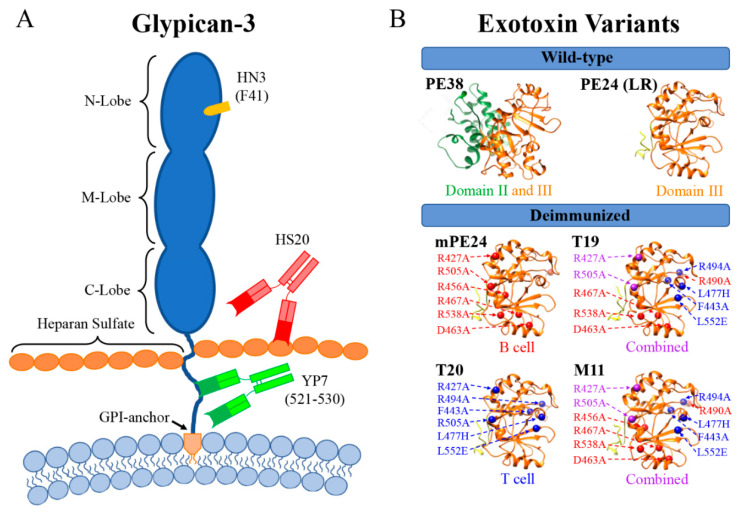
Hepatocellular carcinoma (HCC) accounts for most liver cancers and represents one of the deadliest cancers in the world. Despite the global demand for liver cancer treatments, there remain few options available. The U.S. Food and Drug Administration (FDA) recently approved Lumoxiti, a CD22-targeting immunotoxin, as a treatment for patients with hairy cell leukemia. This approval helps to demonstrate the potential role that immunotoxins can play in the cancer therapeutics pipeline. However, concerns have been raised about the use of immunotoxins, including their high immunogenicity and short half-life, in particular for treating solid tumors such as liver cancer. This review provides an overview of recent efforts to develop a glypican-3 (GPC3) targeting immunotoxin for treating HCC, including strategies to deimmunize immunotoxins by removing B- or T-cell epitopes on the bacterial toxin and to improve the serum half-life of immunotoxins by incorporating an albumin binding domain.
肝细胞癌 (HCC) 占大多数肝癌,并代表了世界上最致命的癌症之一。尽管全球对肝癌治疗有需求,但仍然可用的选择很少。美国食品和药物管理局 (FDA) 最近批准了 Lumoxiti,一种靶向 CD22 的免疫毒素,作为治疗毛细胞白血病患者的药物。这一批准有助于证明免疫毒素在癌症治疗药物研发方面的潜在作用。然而,人们对免疫毒素的使用提出了一些担忧,包括其高免疫原性和半衰期短,特别是用于治疗肝癌等实体肿瘤。这篇综述提供了对最近开发针对 GPC3 的免疫毒素治疗 HCC 的努力的概述,包括通过去除细菌毒素上的 B 细胞或 T 细胞表位来使免疫毒素脱免疫以及通过结合白蛋白结合结构域来提高免疫毒素的血清半衰期的策略。