Sekizuka Tsuyoshi, Kuramoto Sanae, Nariai Eri, Taira Masakatsu, Hachisu Yushi, Tokaji Akihiko, Shinohara Michiyo, Kishimoto Tsuyoshi, Itokawa Kentaro, Kobayashi Yusuke, Kadokura Keisuke, Kamiya Hajime, Matsui Tamano, Suzuki Motoi, Kuroda Makoto
Pathogen Genomics Center, National Institute of Infectious Diseases, Tokyo, Japan.
Ishikawa Prefectural Institute of Public Health and Environmental Science, Kanazawa, Japan.
Front Microbiol. 2020 Jun 5;11:1316. doi: 10.3389/fmicb.2020.01316. eCollection 2020.
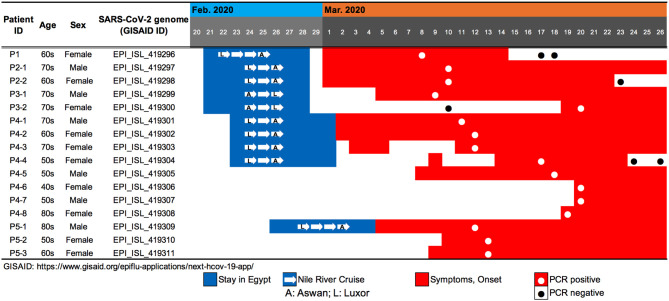
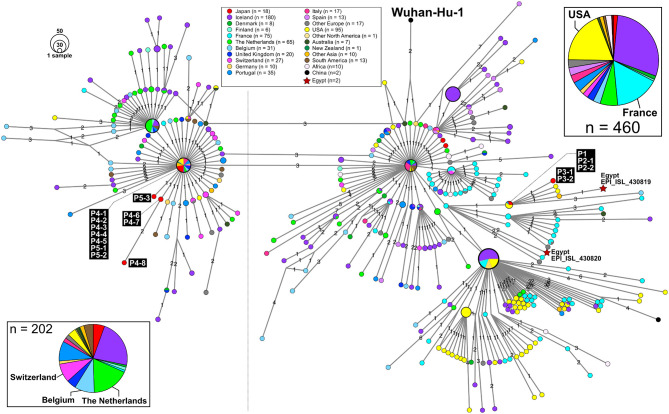
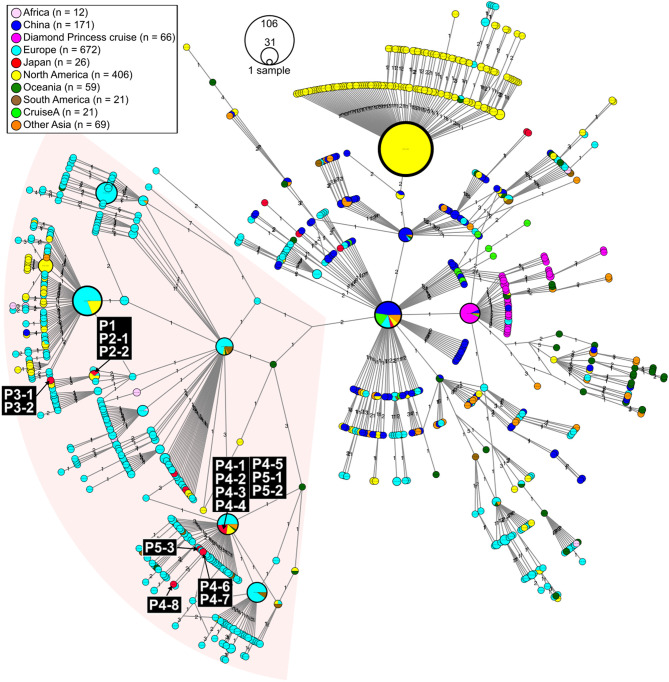
Japan has reported 26 cases of coronavirus disease 2019 (COVID-19) linked to cruise tours on the River Nile in Egypt between March 5 and 15, 2020. Here, we characterized the severe acute respiratory syndrome coronavirus 2 (SARS-CoV-2) genome of isolates from 10 travelers who returned from Egypt and from patients possibly associated with these travelers. We performed haplotype network analysis of SARS-CoV-2 isolates using genome-wide single-nucleotide variations. Our analysis identified two potential Egypt-related clusters from these imported cases, and these clusters were related to globally detected viruses in different countries.
日本报告了26例2019冠状病毒病(COVID-19)病例,这些病例与2020年3月5日至15日在埃及尼罗河上的游轮旅行有关。在此,我们对10名从埃及返回的旅行者以及可能与这些旅行者有关的患者所分离出的严重急性呼吸综合征冠状病毒2(SARS-CoV-2)基因组进行了特征分析。我们利用全基因组单核苷酸变异对SARS-CoV-2分离株进行了单倍型网络分析。我们的分析从这些输入性病例中识别出两个潜在的与埃及相关的聚类,并且这些聚类与在不同国家全球检测到的病毒有关。