Rojas-Estevez Paola, Urbina-Gómez David A, Ayala-Usma David A, Guayazan-Palacios Natalia, Mideros Maria Fernanda, Bernal Adriana J, Cardenas Martha, Restrepo Silvia
Laboratorio de Micología y Fitopatología, Facultad de Ingeniería, Universidad de los Andes, Colombia, Bogota.
Laboratorio de Biología Computacional y Ecología Microbiana, Universidad de los Andes, Colombia, Bogota.
Front Genet. 2020 Jun 9;11:579. doi: 10.3389/fgene.2020.00579. eCollection 2020.
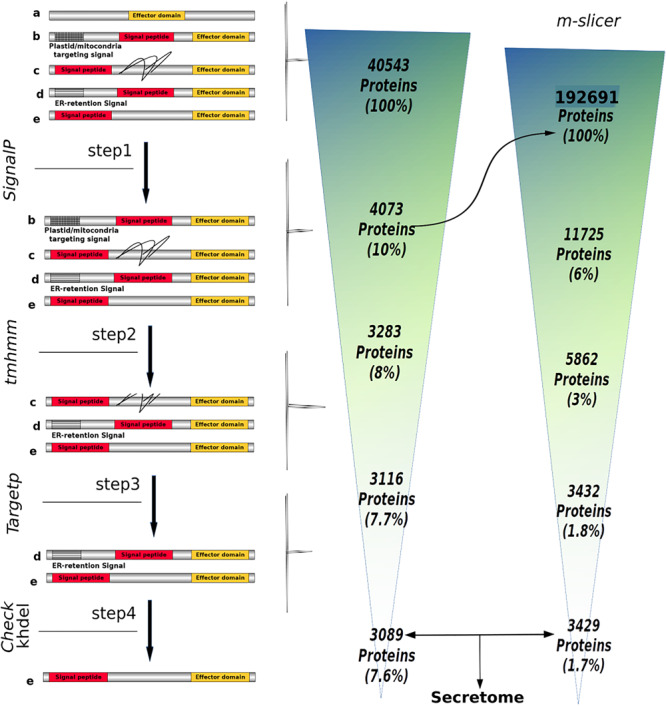
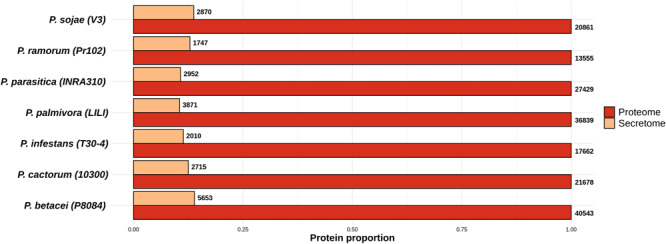
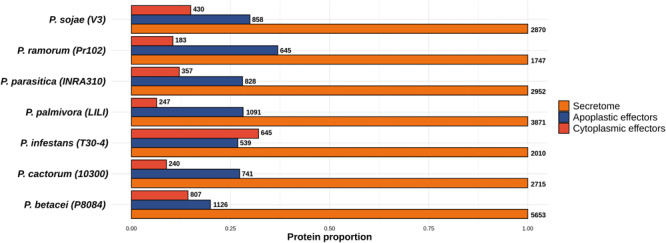
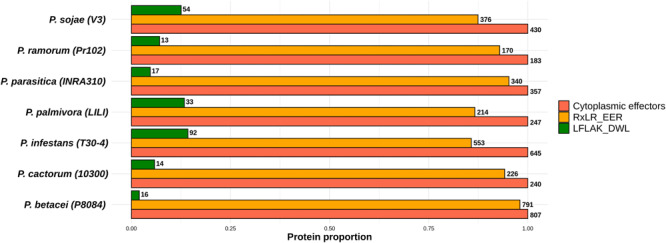
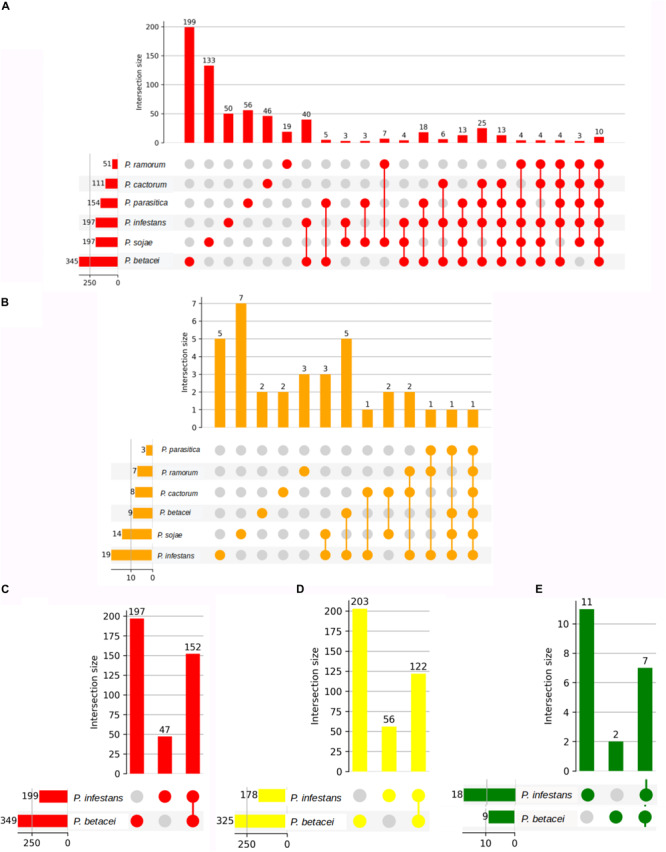
is an oomycete plant pathogen closely related to It infects tree tomato () in northern South America, but is, under natural conditions, unable to infect potatoes or tomatoes, the main hosts of its sister species . We characterized, and compared the effector repertoires of and other species. To this end, we used approaches to predict and describe the repertoire of secreted proteins in species and determine unique and core effectors. has the largest proteome and secretome of all species evaluated. We identified between 450 and 1933 candidate effector genes in , and genomes. The predicted secretome contains 5653 proteins, 1126 of which are apoplastic effectors and 807cytoplasmic effectors. Genes encoding cytoplasmic effectors include 791 genes with an RxLR domain (the largest number known so far in a species) and 16 with a Crinkler (CRN) domain. We detected homologs of previously described avirulence gene (Avr) present in spp., such as Avr1, Avr3b, Avr4, and Avrblb1, suggesting a high level of effector gene conservation among species. Nonetheless, fewer CRN effectors were obtained in compared to all other species analyzed. The comparison between and effector profiles shows unique features in that might be involved in pathogenesis and host preference. Indeed, 402 unique predicted effector genes were detected in , corresponding to 197 apoplastic effector genes, 203 RxLR cytoplasmic effector genes, and 2 effector genes with CRN domain. This is the first characterization of the effector profile of and the broadest comparison of predicted effector repertoires in the genus following a standardized prediction pipeline. The resultant putative effector repertoire provides a reasonable set of proteins whose experimental validation could lead to understand the specific virulence factors responsible for the host specificity of this species.
是一种卵菌纲植物病原体,与密切相关。它感染南美洲北部的树番茄(),但在自然条件下无法感染其姊妹物种的主要寄主马铃薯或番茄。我们对和其他物种的效应子库进行了表征和比较。为此,我们采用方法预测和描述物种中的分泌蛋白库,并确定独特效应子和核心效应子。在所评估的所有物种中,拥有最大的蛋白质组和分泌蛋白组。我们在、和基因组中鉴定出450至1933个候选效应子基因。预测的分泌蛋白组包含5653种蛋白质,其中1126种是质外体效应子,807种是细胞质效应子。编码细胞质效应子的基因包括791个具有RxLR结构域的基因(迄今为止在一个物种中已知数量最多)和16个具有卷曲螺旋(CRN)结构域的基因。我们检测到存在于物种中的先前描述的无毒基因(Avr)的同源物,如Avr1、Avr3b、Avr4和Avrblb1,这表明物种间效应子基因具有高度保守性。尽管如此,与所有其他分析的物种相比,中获得的CRN效应子较少。和效应子谱的比较显示了中可能参与致病和寄主偏好的独特特征。事实上,在中检测到402个独特的预测效应子基因,对应于197个质外体效应子基因、203个RxLR细胞质效应子基因和2个具有CRN结构域的效应子基因。这是对效应子谱的首次表征,也是按照标准化预测流程对该属预测效应子库进行的最广泛比较。由此产生的假定效应子库提供了一组合理的蛋白质,对其进行实验验证可能有助于了解导致该物种寄主特异性的特定毒力因子。