Faculty of Medicine, School of Pharmacy, The Chinese University of Hong Kong, Shatin, New Territories, Hong Kong SAR, Hong Kong.
Janssen Research and Development, Raritan, Princeton, New Jersey, USA.
Clin Transl Sci. 2020 Nov;13(6):1345-1354. doi: 10.1111/cts.12836. Epub 2020 Jul 17.
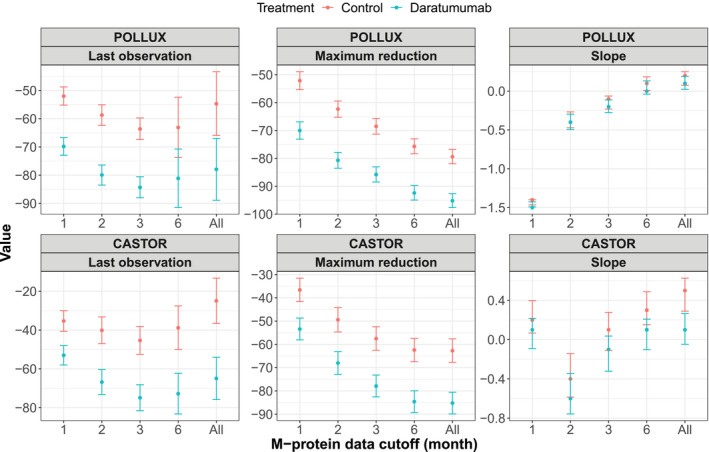
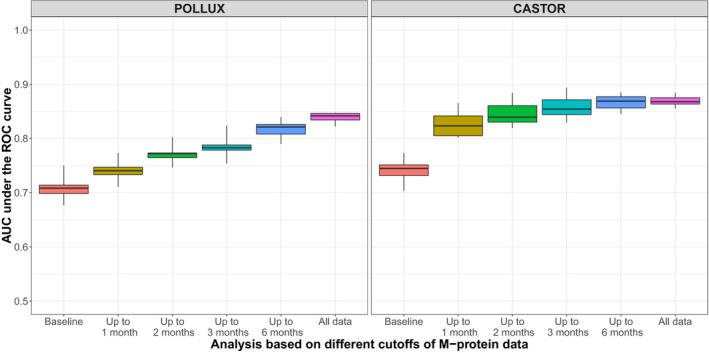
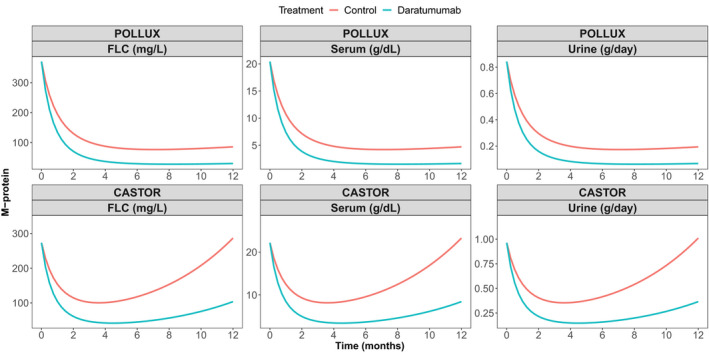
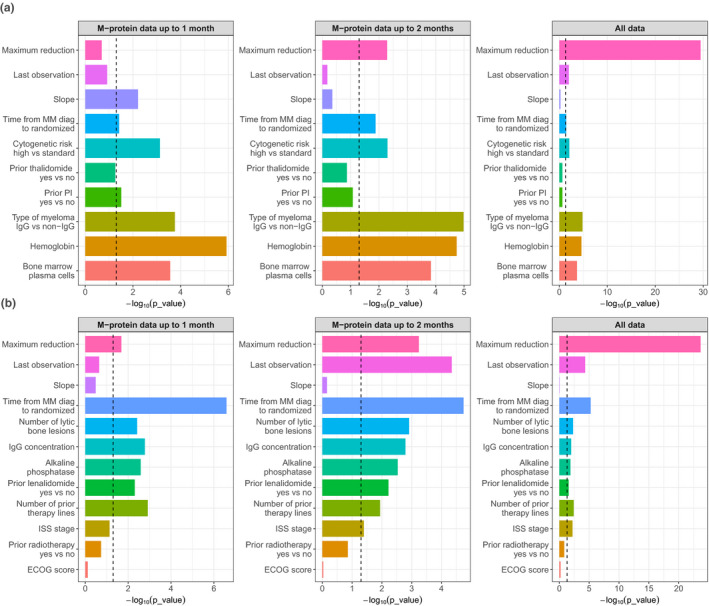
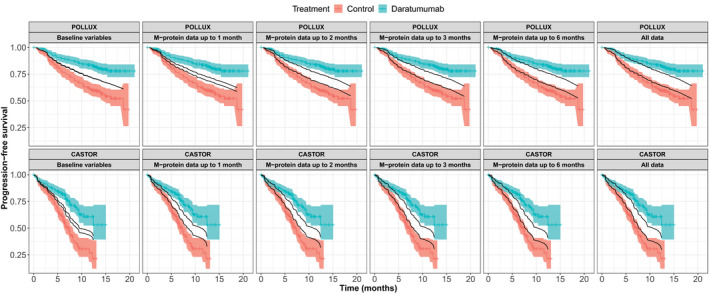
This study aimed to predict long-term progression-free survival (PFS) using early M-protein dynamic measurements in patients with relapsed/refractory multiple myeloma (MM). The PFS was modeled based on dynamic M-protein data from two phase III studies, POLLUX and CASTOR, which included 569 and 498 patients with relapsed/refractory MM, respectively. Both studies compared active controls (lenalidomide and dexamethasone, and bortezomib and dexamethasone, respectively) alone vs. in combination with daratumumab. Three M-protein dynamic features from the longitudinal M-protein data were evaluated up to different time cutoffs (1, 2, 3, and 6 months). The abilities of early M-protein dynamic measurements to predict the PFS were evaluated using Cox proportional hazards survival models. Both univariate and multivariable analyses suggest that maximum reduction of M-protein (i.e., depth of response) was the most predictive of PFS. Despite the statistical significance, the baseline covariates provided very limited predictive value regarding the treatment effect of daratumumab. However, M-protein dynamic features obtained within the first 2 months reasonably predicted PFS and the associated treatment effect of daratumumab. Specifically, the areas under the time-varying receiver operating characteristic curves for the model with the first 2 months of M-protein dynamic data were ~ 0.8 and 0.85 for POLLUX and CASTOR, respectively. Early M-protein data within the first 2 months can provide a prospective and reasonable prediction of future long-term clinical benefit for patients with MM.
本研究旨在通过复发/难治性多发性骨髓瘤(MM)患者早期 M 蛋白动态测量值预测无进展生存期(PFS)。该 PFS 模型基于两项 III 期研究(POLLUX 和 CASTOR)的动态 M 蛋白数据构建,其中分别纳入了 569 例和 498 例复发/难治性 MM 患者。这两项研究均比较了活性对照药物(来那度胺和地塞米松,以及硼替佐米和地塞米松)单药与联合达雷妥尤单抗的疗效。对纵向 M 蛋白数据中的 3 个 M 蛋白动态特征,在不同时间截止点(1、2、3 和 6 个月)进行了评估。采用 Cox 比例风险生存模型评估早期 M 蛋白动态测量值预测 PFS 的能力。单变量和多变量分析均表明,M 蛋白最大降低(即反应深度)是预测 PFS 的最具预测性因素。尽管具有统计学意义,但基线协变量对达雷妥尤单抗治疗效果的预测价值非常有限。然而,在最初 2 个月内获得的 M 蛋白动态特征可以合理地预测 PFS 及其与达雷妥尤单抗相关的治疗效果。具体而言,在包含前 2 个月 M 蛋白动态数据的模型中,POLLUX 和 CASTOR 的时间变化接收者操作特征曲线下面积分别约为 0.8 和 0.85。最初 2 个月内的早期 M 蛋白数据可以为 MM 患者的未来长期临床获益提供前瞻性、合理的预测。