Triticeae Research Institute, Sichuan Agricultural University, Chengdu, China.
Soil and Fertilizer Research Institute, Sichuan Academy of Agricultural Sciences, Chengdu, China.
PLoS One. 2020 Jun 25;15(6):e0234882. doi: 10.1371/journal.pone.0234882. eCollection 2020.
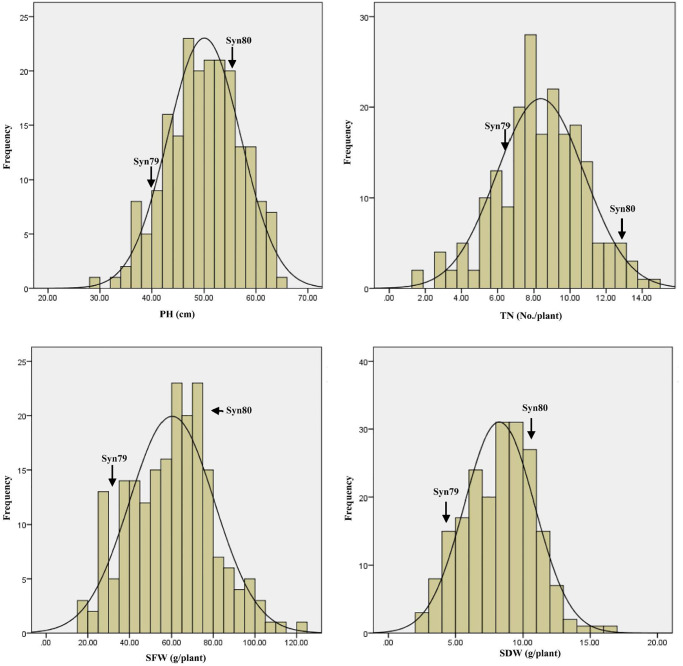
Strong early vigour plays a crucial role in wheat yield improvement by enhancing resource utilization efficiency. Synthetic hexaploid wheat (SHW) combines the elite genes of tetraploid wheat with Aegilops tauschii and has been widely used in wheat genetic improvement for its abundant genetic variation. The two SHWs Syn79 and Syn80 were derived from the crossing of the same tetraploid wheat DOY1 with two different Ae. tauschii accessions, AT333 and AT428, respectively. The Syn80 possessed better early vigour traits than Syn79, theretically caused by their D genome from Ae. tauschii. To dissect their genetic basis in a hexaploid background, 203 recombinant inbred lines (RILs) derived from the cross of Syn79 x Syn80 were developed to detect quantitative trait loci (QTL) for four early biomass related traits: plant height (PH), tiller number (TN), shoot fresh weight (SFW) and shoot dry weight (SDW) per plant, under five different environmental conditions. Determined from the data of SNP markers, two genome regions on 1DS and 7D were stably associated with the four early biomass related traits showing pleiotropic effects. Four stable QTLs QPh.saas-1DS, QTn.saas-1DS, QSfw.saas-1DS and QSdw.saas-1DS explaining 7.92, 15.34, 9.64 and 10.15% of the phenotypic variation, respectively, were clustered in the region of 1DS from AX-94812958 to AX-110910133. Meanwhile, QPh.saas-7D, QTn.saas-7D, QSfw.saas-7D and QSdw.saas-7D were flanked by AX-109917900 and AX-110605376 on 7D, explaining 16.12, 24.35, 15.25 and 13.37% of the phenotypic variation on average, respectively. Moreover, these genomic QTLs on 1DS and 7D enhancing biomass in the parent Syn80 were from Ae. tauschii AT428. These findings suggest that these two QTLs from Ae. tauschii can be expressed stably in a hexaploid background at the jointing stage and be used for wheat improvement.
早期活力强在提高小麦产量方面起着至关重要的作用,它可以提高资源利用效率。合成六倍体小麦(SHW)将四倍体小麦的优良基因与节节麦(Aegilops tauschii)结合在一起,由于其丰富的遗传变异,已被广泛用于小麦遗传改良。两个 SHW 品系 Syn79 和 Syn80 分别是由同一个四倍体小麦 DOY1 与两个不同的节节麦品系 AT333 和 AT428 杂交而来的。Syn80 具有比 Syn79 更好的早期活力性状,这理论上是由于其来自节节麦的 D 基因组所致。为了在六倍体背景下解析它们的遗传基础,我们从 Syn79 x Syn80 的杂交中开发了 203 个重组自交系(RIL),以检测四个与早期生物量相关的性状(株高(PH)、分蘖数(TN)、地上部鲜重(SFW)和地上部干重(SDW))在五个不同环境条件下的数量性状位点(QTL)。根据 SNP 标记的数据,两个位于 1DS 和 7D 上的基因组区域与四个早期生物量相关性状稳定相关,表现出多效性。四个稳定的 QTLs QPh.saas-1DS、QTn.saas-1DS、QSfw.saas-1DS 和 QSdw.saas-1DS 分别解释了表型变异的 7.92%、15.34%、9.64%和 10.15%,它们聚集在 1DS 区域,从 AX-94812958 到 AX-110910133。同时,QPh.saas-7D、QTn.saas-7D、QSfw.saas-7D 和 QSdw.saas-7D 被位于 7D 的 AX-109917900 和 AX-110605376 所包围,它们平均分别解释了表型变异的 16.12%、24.35%、15.25%和 13.37%。此外,这些在 1DS 和 7D 上增强亲本 Syn80 生物量的基因组 QTL 来自节节麦 AT428。这些发现表明,这两个来自节节麦的 QTL 可以在六倍体背景下在拔节期稳定表达,并可用于小麦改良。