Institute of Cytology and Genetics SB RAS, Novosibirsk, Russian Federation.
BMC Plant Biol. 2020 Oct 14;20(Suppl 1):310. doi: 10.1186/s12870-020-02536-8.
Threshability, rachis fragility and spike shape are critical traits for the domestication and evolution of wheat, determining the crop yield and efficiency of the harvest. Spelt factor gene Q controls a wide range of domestication-related traits in polyploid wheats, including those mentioned above. The main goal of the present study was to characterise the Q gene for uninvestigated accessions of wheats, including four endemics, and Aegilops accessions, and to analyze the species evolution based on differences in Q gene sequences.
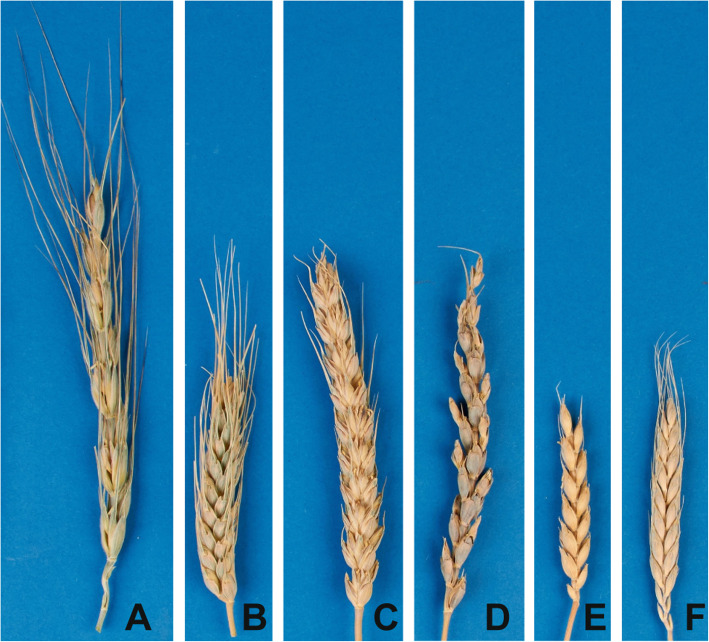
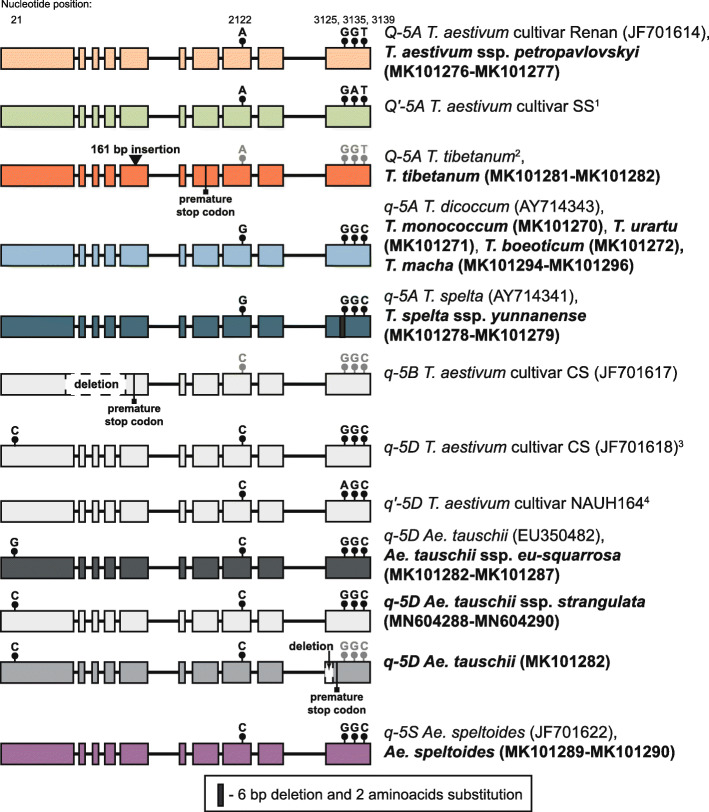
We have studied the spike morphology for 15 accessions of wheat species, including four endemics, namely Triticum macha, T. tibetanum, T. aestivum ssp. petropavlovskyi and T. spelta ssp. yunnanense, and 24 Aegilops accessions, which are donors of B and D genomes for polyploid wheat. The Q-5A, q-5D and q-5S genes were investigated, and a novel allele of the Q-5A gene was found in accessions of T. tibetanum (KU510 and KU515). This allele was similar to the Q allele of T. aestivum cv. Chinese Spring but had an insertion 161 bp in length within exon 5. This insertion led to a frameshift and premature stop codon formation. Thus, the T. tibetanum have spelt spikes, which is probably determined by the gene Tg, rather than Q. We determined the variability within the q-5D genes among hexaploid wheat and their D genome donor Aegilops tauschii. Moreover, we studied the accessions C21-5129, KU-2074, and K-1100 of Ae. tauschii ssp. strangulata, which could be involved in the origin of hexaploid wheats.
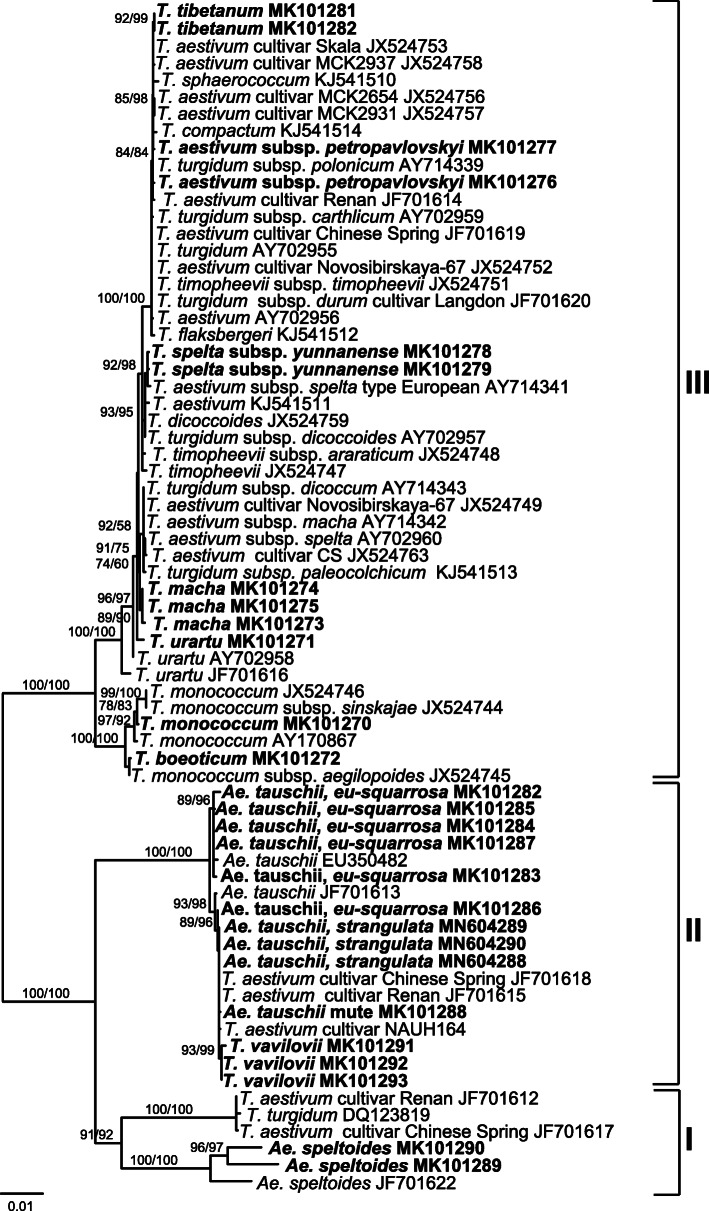
The variability and phylogenetic relationships of the Q gene sequences studied allowed us to clarify the relationships between species of the genus Triticum and to predict the donor of the D genome among the Ae. tauschii accessions. Ae. tauschii ssp. strangulata accessions C21-5129, KU-2074 and K-1100 are the most interesting among the analysed accessions, since their partial sequence of q-5D is identical to the q-5D of T. aestivum cv. Chinese Spring. This result indicates that the donor is Ae. tauschii ssp. strangulata but not Ae. tauschii ssp. tauschii. Our analysis allowed us to clarify the phylogenetic relationships in the genus Triticum.
易脱粒性、穗轴脆性和穗形是小麦驯化和进化的关键特征,决定了作物的产量和收获效率。斯佩尔特因子基因 Q 控制着多倍体小麦的一系列驯化相关特征,包括上述特征。本研究的主要目的是研究包括四个特有种在内的小麦未研究品种的 Q 基因,并根据 Q 基因序列的差异分析物种进化。
我们研究了包括四个特有种在内的 15 个小麦物种的穗形态,分别是 Triticum macha、T. tibetanum、T. aestivum ssp. petropavlovskyi 和 T. spelta ssp. yunnanense,以及 24 个 Aegilops 种,它们是多倍体小麦的 B 和 D 基因组的供体。研究了 Q-5A、q-5D 和 q-5S 基因,并在 T. tibetanum(KU510 和 KU515)的品种中发现了 Q-5A 基因的一个新等位基因。该等位基因与 T. aestivum cv. Chinese Spring 的 Q 等位基因相似,但在第 5 外显子中有一个 161bp 的插入。该插入导致移码和过早终止密码子的形成。因此,T. tibetanum 具有斯佩尔特穗,这可能是由基因 Tg 决定的,而不是 Q。我们确定了六倍体小麦及其 D 基因组供体 Aegilops tauschii 中 q-5D 基因的变异性。此外,我们研究了 Ae. tauschii ssp. strangulata 的 C21-5129、KU-2074 和 K-1100 品种,它们可能参与了六倍体小麦的起源。
所研究的 Q 基因序列的变异性和系统发育关系使我们能够澄清属间的关系小麦并预测 Ae. tauschii 品种中 D 基因组的供体。在所分析的品种中,Ae. tauschii ssp. strangulata 的 C21-5129、KU-2074 和 K-1100 品种最为有趣,因为它们的部分 q-5D 序列与 T. aestivum cv. Chinese Spring 的 q-5D 序列相同。这一结果表明供体是 Ae. tauschii ssp. strangulata,而不是 Ae. tauschii ssp. tauschii。我们的分析使我们能够澄清属间的系统发育关系。小麦。