Wei Rui, Zhao Libo, Kong Guanyi, Liu Xiang, Zhu Shengtao, Zhang Shutian, Min Li
Department of Gastroenterology, Beijing Friendship Hospital, Capital Medical University, National Clinical Research Center for Digestive Disease, Beijing Digestive Disease Center, Beijing Key Laboratory for Precancerous Lesion of Digestive Disease, Beijing, 100050 P. R. China.
Echo Biotech Co., Ltd, Beijing, 100010 P. R. China.
Biol Proced Online. 2020 Jun 23;22:12. doi: 10.1186/s12575-020-00125-5. eCollection 2020.
Circulating small extracellular vesicles (sEVs) and its associated proteins are of great interest in the early detection of many diseases. However, there is no gold standard for plasma sEVs isolation, especially for proteomic profiling which could be largely affected by contamination such as lipoproteins and plasma proteins. Previous studies suggested combinations of different sEVs isolation methods could improve the yield and purity of the isolated fractions. Nevertheless, there is no systematic evaluation of size-exclusion chromatography (SEC), ultracentrifugation (UC), and their combination in a proteomic perspective.
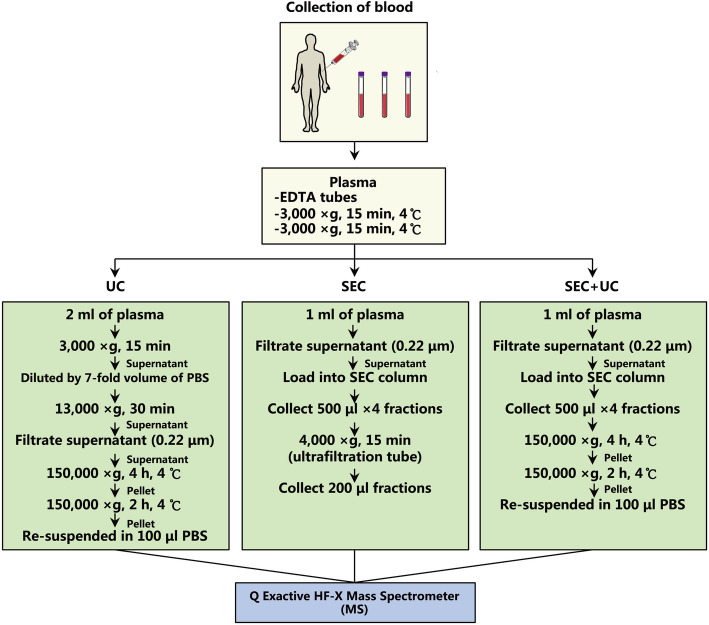
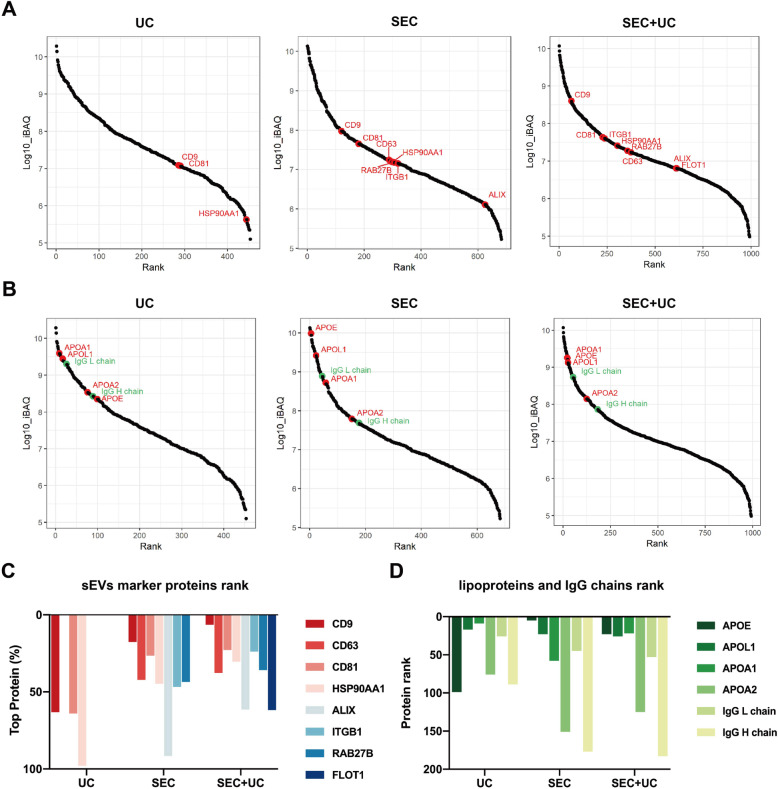
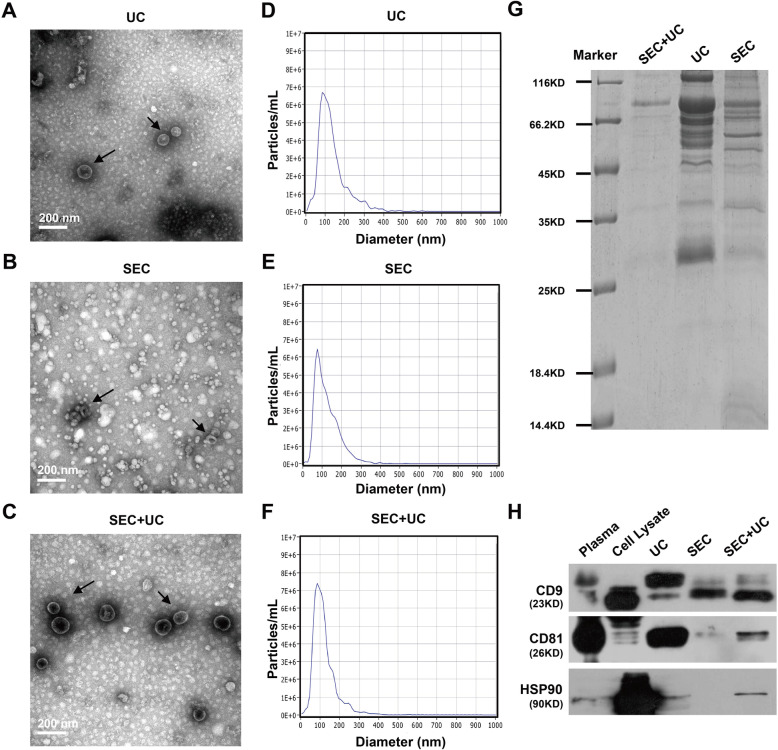
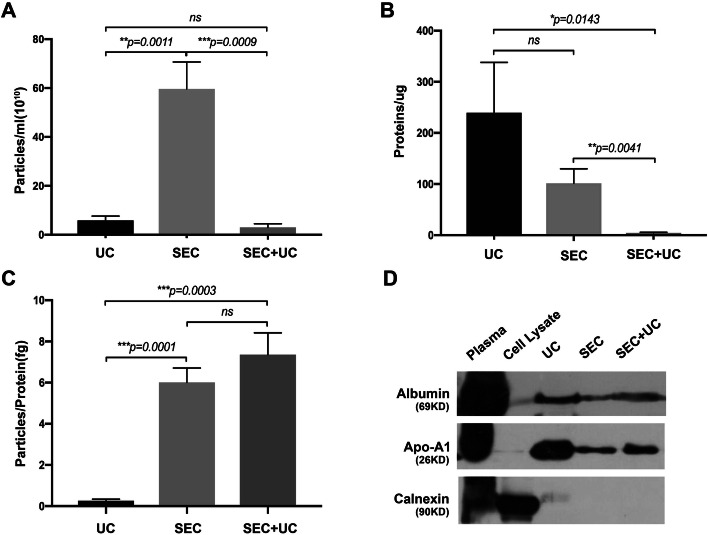
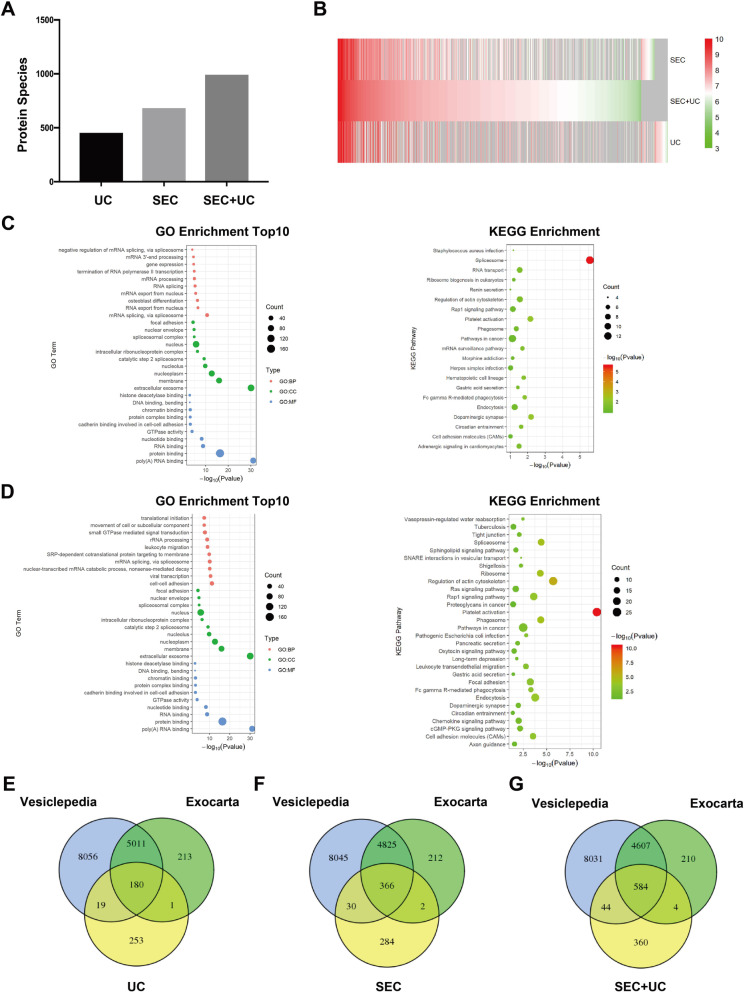
Plasma samples were collected from healthy individuals, and sEVs were separated by one-step SEC, one-step UC, and combining SEC with UC, respectively. Here we exhibited that the purity of sEVs was improved by SEC in contrast to traditional UC. Furthermore, by conducting a SEC procedure followed by UC, we separated sEVs with the highest purity. In the proteomic analysis, 992 protein species were identified in the plasma sEVs isolated by our novel separation method, of which several proteins are sEVs-associated proteins but hitherto never been identified in the previous studies and database, much more than plasma sEVs isolated by UC (453) or SEC (682) alone. As compared to Vesiclepedia and Exocarta databases, plasma sEVs isolated by the new procedure kept 584 previously identified sEVs-associated proteins and 360 other proteins that have not been detected before. Detailed analysis suggested that more kinds of sEVs biomarkers, such as CD9, ALIX, and FLOT1, could be identified in plasma sEVs isolated by the novel isolation method as compared to one-step UC/SEC. Furthermore, the lower abundance ranks of common contaminants, such as lipoproteins and IgG chains, in the sEVs fractions obtained by our new method as compared to one-step UC/SEC also demonstrated the purity of sEVs had been improved.
Combining SEC with UC could significantly improve the performance of mass spectrometry-based proteomic profiling in analyzing plasma-derived sEVs.
循环小细胞外囊泡(sEVs)及其相关蛋白在多种疾病的早期检测中备受关注。然而,血浆sEVs分离尚无金标准,尤其是蛋白质组分析,其可能在很大程度上受到脂蛋白和血浆蛋白等污染的影响。先前的研究表明,不同sEVs分离方法的组合可提高分离组分的产量和纯度。然而,从蛋白质组学角度对尺寸排阻色谱法(SEC)、超速离心法(UC)及其组合尚无系统评估。
收集健康个体的血浆样本,分别通过一步SEC、一步UC以及SEC与UC相结合的方法分离sEVs。我们在此表明,与传统UC相比,SEC提高了sEVs的纯度。此外,通过先进行SEC程序再进行UC,我们分离出了纯度最高的sEVs。在蛋白质组分析中,通过我们的新型分离方法分离的血浆sEVs中鉴定出992种蛋白质,其中几种蛋白质是sEVs相关蛋白,但此前在以往研究和数据库中从未被鉴定出来,这比单独通过UC(453种)或SEC(682种)分离的血浆sEVs要多得多。与Vesiclepedia和Exocarta数据库相比,通过新程序分离的血浆sEVs保留了584种先前鉴定的sEVs相关蛋白和360种以前未检测到的其他蛋白。详细分析表明,与一步UC/SEC相比,通过新型分离方法分离的血浆sEVs中可鉴定出更多种类的sEVs生物标志物,如CD9、ALIX和FLOT1。此外,与一步UC/SEC相比,我们新方法获得的sEVs组分中常见污染物(如脂蛋白和IgG链)的丰度排名更低,这也证明了sEVs的纯度得到了提高。
将SEC与UC相结合可显著提高基于质谱的蛋白质组分析在分析血浆来源sEVs中的性能。