Turner Natalie P, Abeysinghe Pevindu, Kwan Cheung Keith A, Vaswani Kanchan, Logan Jayden, Sadowski Pawel, Mitchell Murray D
Centre for Children's Health Research (CCHR), Queensland University of Technology (QUT), 62 Graham St., South Brisbane, QLD 4101, Australia.
Faculty of Health, School of Biomedical Sciences, Kelvin Grove Campus, Queensland University of Technology (QUT), Victoria Park Rd., Kelvin Grove, QLD 4059, Australia.
Proteomes. 2022 Jun 1;10(2):19. doi: 10.3390/proteomes10020019.
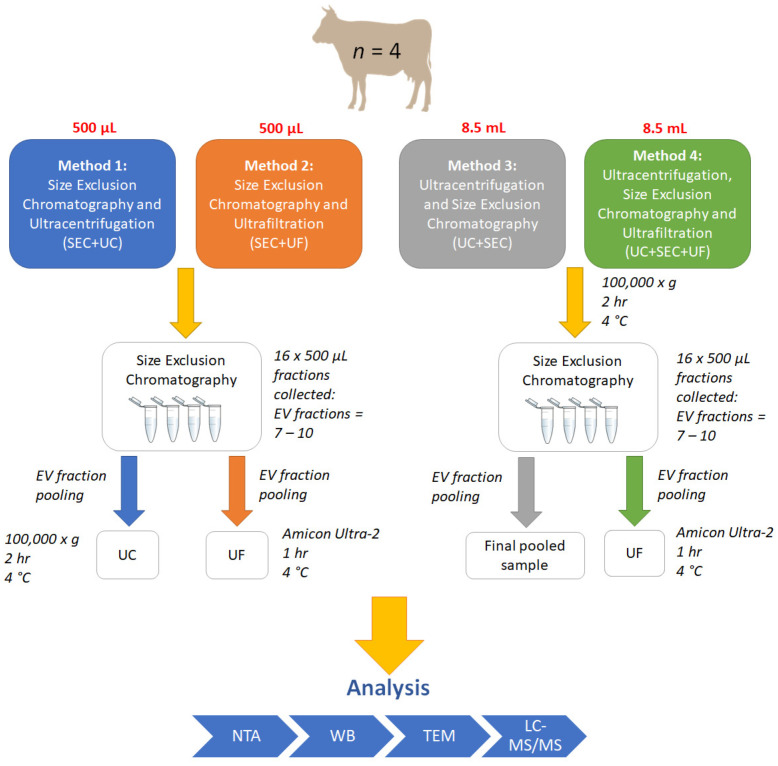
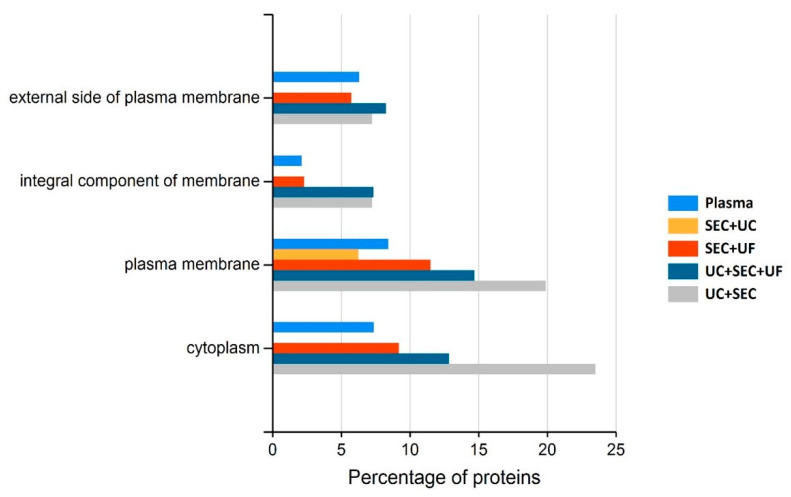
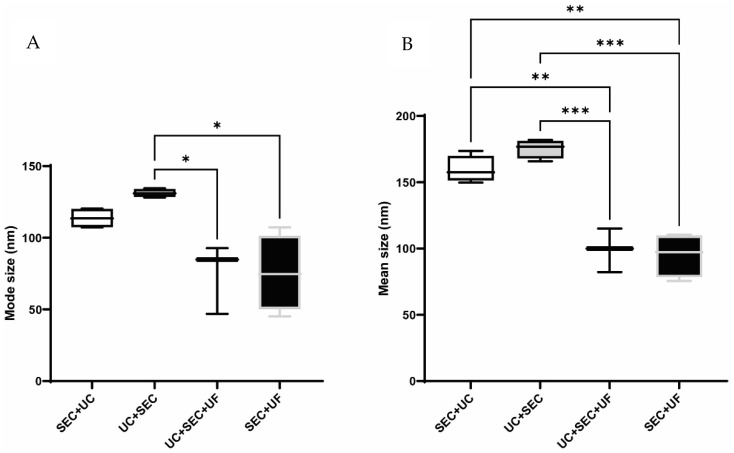
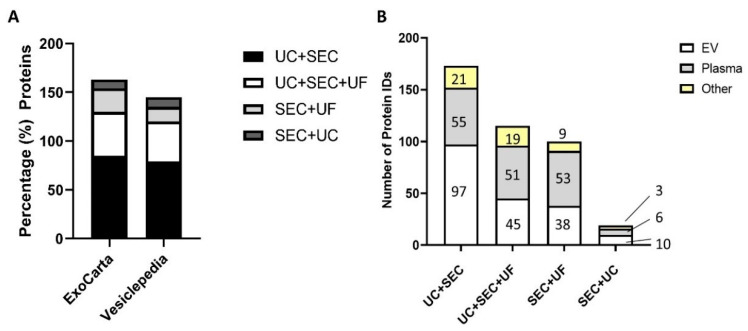
Proteomic analysis of small extracellular vesicles (sEVs) poses a significant challenge. A 'gold-standard' method for plasma sEV enrichment for downstream proteomic analysis is yet to be established. Methods were evaluated for their capacity to successfully isolate and enrich sEVs from plasma, minimise the presence of highly abundant plasma proteins, and result in the optimum representation of sEV proteins by liquid chromatography tandem mass spectrometry. Plasma from four cattle (Bos taurus) of similar physical attributes and genetics were used. Three methods of sEV enrichment were utilised: ultracentrifugation (UC), size-exclusion chromatography (SEC), and ultrafiltration (UF). These methods were combined to create four groups for methodological evaluation: UC + SEC, UC + SEC + UF, SEC + UC and SEC + UF. The UC + SEC method yielded the highest number of protein identifications (IDs). The SEC + UC method reduced plasma protein IDs compared to the other methods, but also resulted in the lowest number of protein IDs overall. The UC + SEC + UF method decreased sEV protein ID, particle number, mean and mode particle size, particle yield, and did not improve purity compared to the UC + SEC method. In this study, the UC + SEC method was the best method for sEV protein ID, purity, and overall particle yield. Our data suggest that the method and sequence of sEV enrichment strategy impacts protein ID, which may influence the outcome of biomarker discovery studies.
小细胞外囊泡(sEVs)的蛋白质组学分析面临重大挑战。用于下游蛋白质组学分析的血浆sEV富集的“金标准”方法尚未建立。对各种方法从血浆中成功分离和富集sEVs的能力、尽量减少高丰度血浆蛋白的存在以及通过液相色谱串联质谱法实现sEV蛋白的最佳表征能力进行了评估。使用了来自四头身体特征和遗传相似的牛(Bos taurus)的血浆。采用了三种sEV富集方法:超速离心(UC)、尺寸排阻色谱(SEC)和超滤(UF)。这些方法组合形成四组进行方法学评估:UC + SEC、UC + SEC + UF、SEC + UC和SEC + UF。UC + SEC方法产生的蛋白质鉴定(ID)数量最多。与其他方法相比,SEC + UC方法减少了血浆蛋白ID,但总体上蛋白质ID数量也是最少的。与UC + SEC方法相比,UC + SEC + UF方法降低了sEV蛋白ID、颗粒数量、平均和众数颗粒大小、颗粒产量,且未提高纯度。在本研究中,UC + SEC方法是sEV蛋白ID、纯度和总体颗粒产量方面的最佳方法。我们的数据表明,sEV富集策略的方法和顺序会影响蛋白质ID,这可能会影响生物标志物发现研究的结果。