Yang Zhen-Chong, Du Chao-Chao, Liu Li-Ting, Liang Yu-Jing, Tang Lin-Quan, Chen Qiu-Yan, Mai Hai-Qiang, Guo Shan-Shan
Sun Yat-sen University Cancer Center, State Key Laboratory of Oncology in South China, Collaborative Innovation Center for Cancer Medicine, Guangdong Key Laboratory of Nasopharyngeal Carcinoma Diagnosis and Therapy, Guangzhou, China; and Department of Nasopharyngeal Carcinoma, Sun Yat-sen University Cancer Center, Guangzhou, China.
Adv Radiat Oncol. 2022 Feb 3;7(3):100908. doi: 10.1016/j.adro.2022.100908. eCollection 2022 May-Jun.
Our purpose was to investigate the prognostic role of plasma Epstein-Barr virus (EBV) DNA levels in the middle of intensity modulated radiation therapy (IMRT).
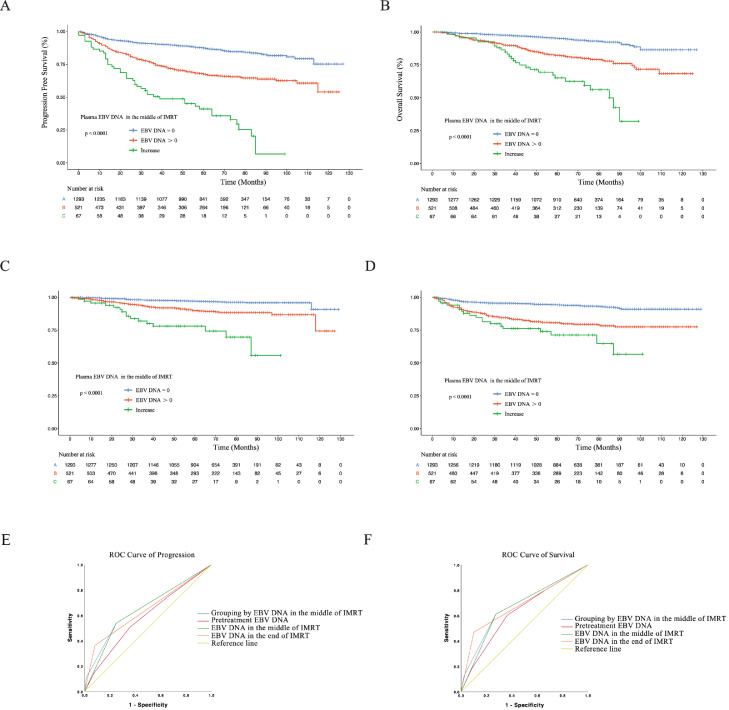
In total, 1881 patients with stage III-IVa tumors were included. The overall survival (OS) and progression-free survival (PFS) were calculated using the Kaplan-Meier method, and the differences were compared using the log-rank test. Receiver operating characteristic curve analysis was performed to analyze the diagnostic value of EBV DNA levels for tumor progression or death. Multivariate analyses using the Cox model were used to evaluate potential prognostic factors.
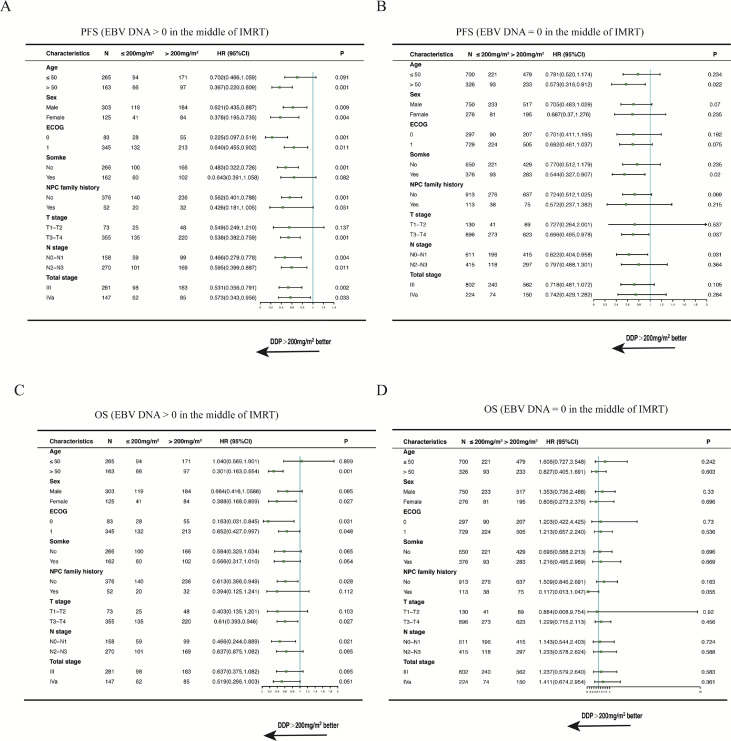
The positive predict value and negative predict value of plasma EBV DNA > 0 copies/mL in the middle of IMRT in predicting nasopharyngeal carcinoma progression was 37.4% and 85.5%, respectively. In patients with plasma EBV DNA level = 0 copies/mL, no significant differences in OS were observed between patients treated with 200 mg/m² cisplatin and those treated with >200 mg/m² cisplatin (5-year OS, 94.9% vs 94.4%; PFS, 81.5% vs 87.6%). However, those treated with >200 mg/m² cisplatin had higher PFS. In patients with plasma EBV DNA level > 0 copies/mL, patients treated with >200 mg/m² cisplatin displayed a favorable 5-year OS (84.6% vs 73.9%) and PFS (72.3% vs 54.8%) compared with those treated with 200 mg/m² cisplatin. Additionally, higher incidences of grade 3 and 4 adverse events were recorded in patients treated with >200 mg/m² cisplatin than in those treated with 200 mg/m² cisplatin.
Plasma EBV DNA > 0 copies/mL in the middle of IMRT suggests that higher doses of chemotherapy should be used. For concurrent chemoradiation therapy, >200 mg/m² cisplatin is recommended for patients with plasma EBV DNA level > 0 copies/mL in the middle of IMRT but not for patients with plasma EBV DNA level = 0 copies/mL considering the similar OS rates.
我们的目的是研究调强放射治疗(IMRT)中期血浆爱泼斯坦-巴尔病毒(EBV)DNA水平的预后作用。
总共纳入了1881例III-IVa期肿瘤患者。采用Kaplan-Meier方法计算总生存期(OS)和无进展生存期(PFS),并使用对数秩检验比较差异。进行受试者操作特征曲线分析以分析EBV DNA水平对肿瘤进展或死亡的诊断价值。使用Cox模型进行多变量分析以评估潜在的预后因素。
IMRT中期血浆EBV DNA>0拷贝/mL预测鼻咽癌进展的阳性预测值和阴性预测值分别为37.4%和85.5%。在血浆EBV DNA水平=0拷贝/mL的患者中,接受200mg/m²顺铂治疗的患者与接受>200mg/m²顺铂治疗的患者的OS无显著差异(5年OS,94.9%对94.4%;PFS,81.5%对87.6%)。然而,接受>200mg/m²顺铂治疗的患者PFS更高。在血浆EBV DNA水平>0拷贝/mL的患者中,与接受200mg/m²顺铂治疗的患者相比,接受>200mg/m²顺铂治疗的患者5年OS(84.6%对73.9%)和PFS(72.3%对54.8%)表现良好。此外,接受>200mg/m²顺铂治疗的患者3级和4级不良事件的发生率高于接受200mg/m²顺铂治疗的患者。
IMRT中期血浆EBV DNA>0拷贝/mL表明应使用更高剂量的化疗。对于同步放化疗,对于IMRT中期血浆EBV DNA水平>0拷贝/mL的患者,建议使用>200mg/m²顺铂,但考虑到OS率相似,对于血浆EBV DNA水平=0拷贝/mL的患者则不建议使用。