Key Laboratory of Carcinogenesis and Translational Research (Ministry of Education-Beijing), Department of Cancer Epidemiology, Peking University Cancer Hospital and Institute, Beijing, China.
Linqu County Public Health Bureau, Shandong, China.
JAMA Netw Open. 2020 Jun 1;3(6):e206628. doi: 10.1001/jamanetworkopen.2020.6628.
The associations of lifestyle factors with gastric cancer (GC) are still underexplored in populations in China. Long-term nutritional supplementation may prevent GC in high-risk populations, but the possible effect modification by lifestyle factors remains unknown.
To evaluate how lifestyle factors, including smoking, alcohol intake, and diet, may change the risk of GC incidence and mortality and whether the effects of vitamin and garlic supplementation on GC are associated with major lifestyle factors.
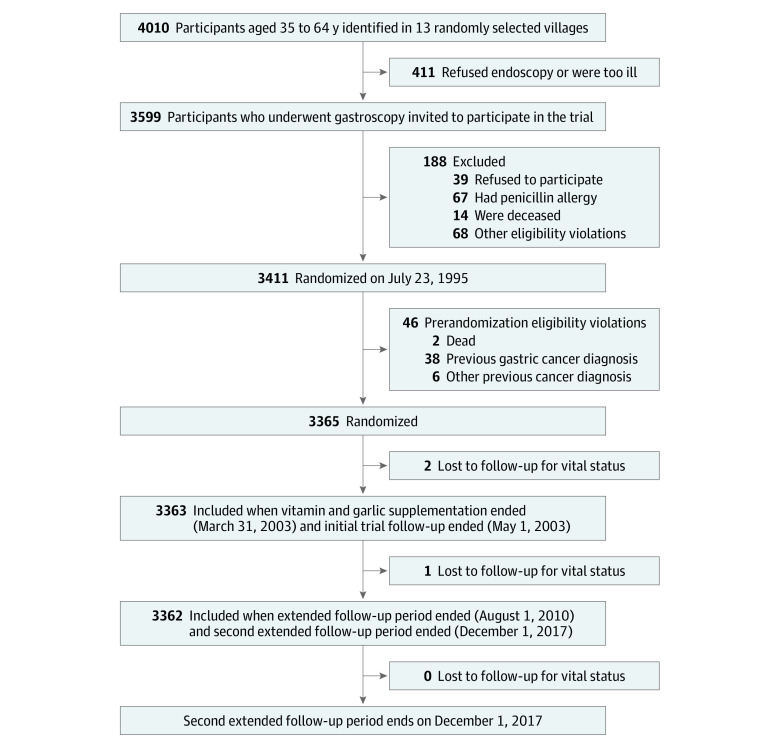
DESIGN, SETTING, AND PARTICIPANTS: This is a secondary analysis of the Shandong Intervention Trial, a masked, randomized, placebo-controlled trial that aimed to assess the effect of vitamin and garlic supplementations and Helicobacter pylori treatment on GC in a factorial design with 22.3 years of follow-up. The study took place in Linqu County, Shandong province, China, a high-risk area for GC. Data were collected from Jully 1995 to December 2017. Overall, 3365 participants aged 35 to 64 years identified in 13 randomly selected villages who agreed to undergo gastroscopy were invited to participate in the trial and were included in the analysis. Data analysis was conducted from March to May 2019.
Participants received vitamin and garlic supplementation for 7.3 years, H pylori treatment for 2 weeks (among participants with H pylori ), or placebo.
The primary outcomes were GC incidence and GC mortality (1995-2017). We also examined the progression of gastric lesions (1995-2003) as a secondary outcome.
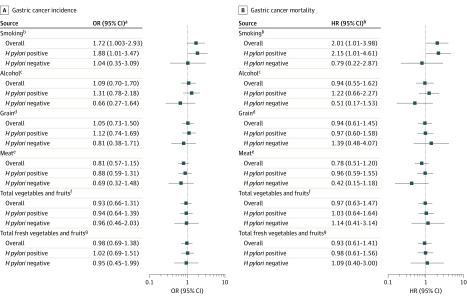
Of the 3365 participants (mean [SD] age, 47.1 [9.2] years; 1639 [48.7%] women), 1677 (49.8%) were randomized to receive active vitamin supplementation, with 1688 (50.2%) receiving placebo, and 1678 (49.9%) receiving active garlic supplementation, with 1687 (50.1%) receiving placebo. Overall, 151 GC cases (4.5%) and 94 GC deaths (2.8%) were identified. Smoking was associated with increased risk of GC incidence (odds ratio, 1.72; 95% CI, 1.003-2.93) and mortality (hazard ratio [HR], 2.01; 95% CI, 1.01-3.98). Smoking was not associated with changes to the effects of vitamin or garlic supplementation. The protective effect on GC mortality associated with garlic supplementation was observed only among those not drinking alcohol (never drank alcohol: HR, 0.33; 95% CI, 0.15-0.75; ever drank alcohol: HR, 0.92; 95% CI, 0.55-1.54; P for interaction = .03), and significant interactions were only seen among participants with H pylori (never drank alcohol: HR, 0.31; 95% CI, 0.12-0.78; ever drank alcohol: HR, 0.91; 95% CI, 0.52-1.60; P for interaction = .04). No significant interactions between vitamin supplementation and lifestyle factors were found.
In this secondary analysis of a randomized clinical trial, smoking was associated with an increased risk of GC incidence and mortality. Not drinking alcohol was associated with a stronger beneficial effect of garlic supplementation on GC prevention. Our findings provide new insights into lifestyle intervention for GC prevention, suggesting that mass GC prevention strategies may need to be tailored to specific population subgroups to maximize the potential beneficial effect.
ClinicalTrials.gov Identifier: NCT00339768.
重要性:生活方式因素与胃癌(GC)的关联在我国人群中仍未得到充分探索。长期营养补充可能会预防高危人群的 GC,但生活方式因素的可能影响尚不清楚。
目的:评估生活方式因素,包括吸烟、饮酒和饮食,如何改变 GC 发病率和死亡率的风险,以及维生素和大蒜补充剂对 GC 的影响是否与主要生活方式因素有关。
设计、地点和参与者:这是山东干预试验的二次分析,该试验是一项随机、安慰剂对照的试验,旨在评估维生素和大蒜补充剂以及幽门螺杆菌治疗对 GC 的影响,采用因子设计,随访时间为 22.3 年。该研究在山东省临朐县进行,这是 GC 的高发地区。数据收集于 1995 年 7 月至 2017 年 12 月。共有 13 个随机选择的村庄中确定的 3365 名年龄在 35 至 64 岁之间、同意接受胃镜检查的参与者被邀请参加试验,并纳入分析。数据分析于 2019 年 3 月至 5 月进行。
干预措施:参与者接受了为期 7.3 年的维生素和大蒜补充剂、2 周的幽门螺杆菌治疗(在有幽门螺杆菌的参与者中)或安慰剂。
主要结果和测量:主要结局是 GC 发病率和 GC 死亡率(1995-2017 年)。我们还检查了作为次要结局的胃病变进展情况(1995-2003 年)。
结果:在 3365 名参与者(平均[SD]年龄 47.1[9.2]岁;1639[48.7%]名女性)中,1677 名(49.8%)被随机分配接受活性维生素补充剂,1688 名(50.2%)接受安慰剂,1678 名(49.9%)接受活性大蒜补充剂,1687 名(50.1%)接受安慰剂。总体而言,发现了 151 例 GC 病例(4.5%)和 94 例 GC 死亡(2.8%)。吸烟与 GC 发病率(比值比,1.72;95%置信区间,1.003-2.93)和死亡率(风险比[HR],2.01;95%置信区间,1.01-3.98)的风险增加有关。吸烟与维生素或大蒜补充剂的作用变化无关。大蒜补充剂对 GC 死亡率的保护作用仅在不饮酒的人群中观察到(从不饮酒:HR,0.33;95%置信区间,0.15-0.75;曾经饮酒:HR,0.92;95%置信区间,0.55-1.54;P 交互作用=0.03),并且仅在有幽门螺杆菌的参与者中观察到显著的交互作用(从不饮酒:HR,0.31;95%置信区间,0.12-0.78;曾经饮酒:HR,0.91;95%置信区间,0.52-1.60;P 交互作用=0.04)。未发现维生素补充剂与生活方式因素之间存在显著的相互作用。
结论和相关性:在这项随机临床试验的二次分析中,吸烟与 GC 发病率和死亡率的增加有关。不饮酒与大蒜补充剂对 GC 预防的更强有益作用有关。我们的研究结果为 GC 预防的生活方式干预提供了新的见解,表明大规模 GC 预防策略可能需要针对特定人群亚组进行定制,以最大限度地发挥潜在的有益作用。
试验注册:ClinicalTrials.gov 标识符:NCT00339768。