Radiology, Manor Hospital, Walsall Healthcare NHS Trust, Moat Road, Walsall, West Midlands, WS2 9PS, UK.
Radiography (Lond). 2021 Feb;27(1):90-94. doi: 10.1016/j.radi.2020.06.010. Epub 2020 Jun 18.
The United Kingdom (UK) has experienced one of the worst initial waves of the COVID-19 pandemic. Clinical signs help guide initial diagnosis, though definitive diagnosis is made using the laboratory technique reverse transcription polymerase chain reaction (RT-PCR). The chest x-ray (CXR) is used as the primary imaging investigation in the United Kingdom (UK) for patients with suspected COVID-19. In some hospitals these CXRs may be reported by a radiographer.
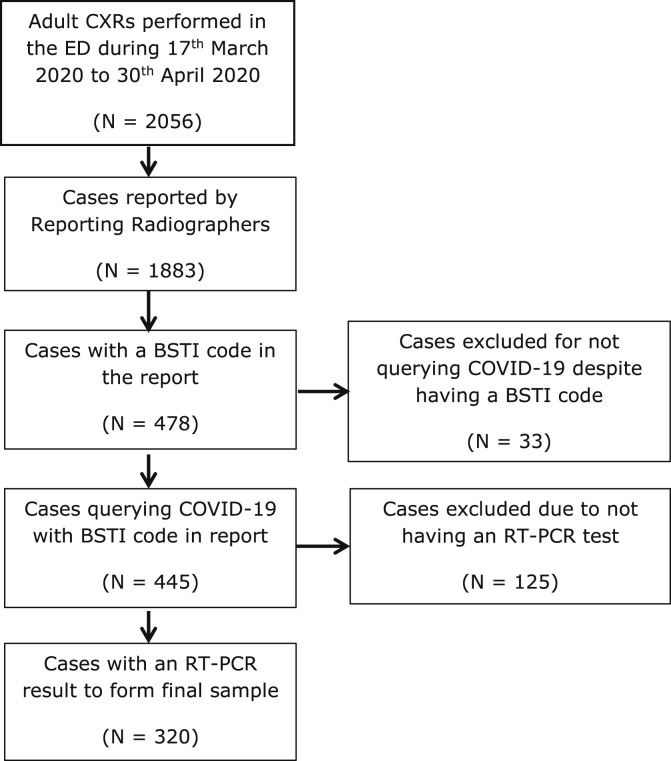
Retrospective review of CXR reports by radiographers for suspected COVID-19 patients attending the Emergency Department (ED) of a hospital in the UK. Interpretation and use of the British Society of Thoracic Imaging (BSTI) coding system was assessed. Report description and code use were cross-checked. Report and code usage were checked against the RT-PCR result to determine accuracy. Report availability was checked against the availability of the RT-PCR result. A confusion matrix was utilised to determine performance. The data were analysed manually using Excel.
Sample size was 320 patients; 54.1% male patients (n = 173), 45.9% female patients (n = 147). The correct code matched report descriptions in 316 of the 320 cases (98.8%). In 299 of the 320 cases (93.4%), the reports were available before the RT-PCR swab result. CXR sensitivity for detecting COVID-19 was 85% compared to 93% for the initial RT-PCR.
Reporting radiographers can adequately utilise and apply the BSTI classification system when reporting COVID-19 CXRs. They can recognise the classic CXR appearances of COVID-19 and those with normal appearances. Future best practice includes checking laboratory results when reporting CXRs with ambiguous appearances.
Utilisation of reporting radiographers to report CXRs in any future respiratory pandemic should be considered a service-enabling development.
英国(UK)经历了 COVID-19 大流行的最初浪潮之一。临床症状有助于指导初步诊断,尽管使用实验室技术逆转录聚合酶链反应(RT-PCR)进行明确诊断。胸部 X 光(CXR)是英国(UK)用于疑似 COVID-19 患者的主要影像学检查。在一些医院,放射技师可能会报告这些 CXR。
对英国一家医院急诊科(ED)疑似 COVID-19 患者的 CXR 报告进行回顾性审查。评估了放射技师对英国胸科影像学学会(BSTI)编码系统的解释和使用。报告描述和代码使用进行了交叉检查。根据 RT-PCR 结果检查报告和代码的使用情况,以确定准确性。根据 RT-PCR 结果的可用性检查报告的可用性。使用混淆矩阵确定性能。使用 Excel 手动分析数据。
样本量为 320 例;54.1%为男性患者(n=173),45.9%为女性患者(n=147)。正确的代码与 320 例中的 316 例报告描述(98.8%)相匹配。在 320 例中的 299 例(93.4%)中,报告在 RT-PCR 拭子结果之前可用。CXR 检测 COVID-19 的敏感性为 85%,而初始 RT-PCR 为 93%。
报告放射技师在报告 COVID-19 CXR 时可以充分利用和应用 BSTI 分类系统。他们可以识别 COVID-19 的典型 CXR 表现和正常表现。未来的最佳实践包括在报告具有模糊表现的 CXR 时检查实验室结果。
在任何未来的呼吸道大流行中,考虑利用报告放射技师报告 CXR 应被视为一项服务增强发展。