Department of Physical and Rehabilitation Medicine, Samsung Medical Center, Sungkyunkwan University School of Medicine, Seoul, Republic of Korea.
Department of Physical and Rehabilitation Medicine, Kangbuk Samsung Hospital, Sungkyunkwan University School of Medicine, 29 Saemunan-ro, Jongno-gu, Seoul, 03181, Republic of Korea.
Sci Rep. 2020 Jun 26;10(1):10498. doi: 10.1038/s41598-020-67601-6.
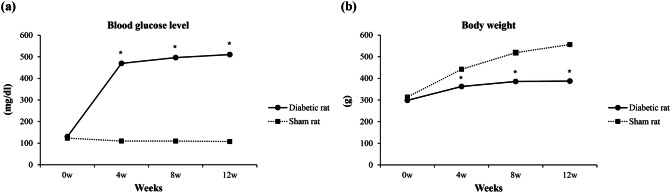
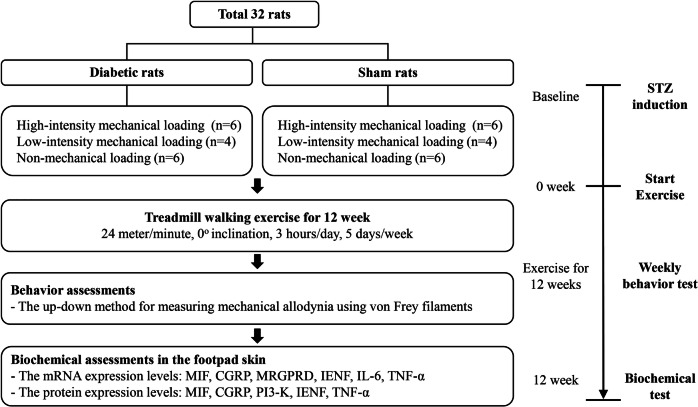
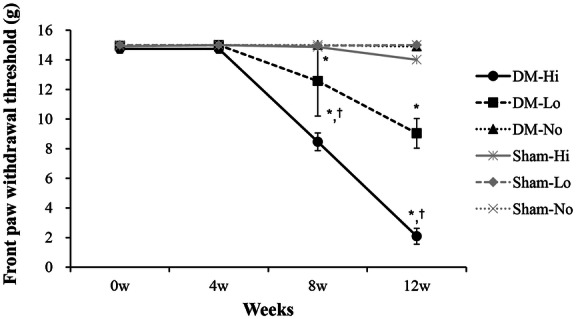
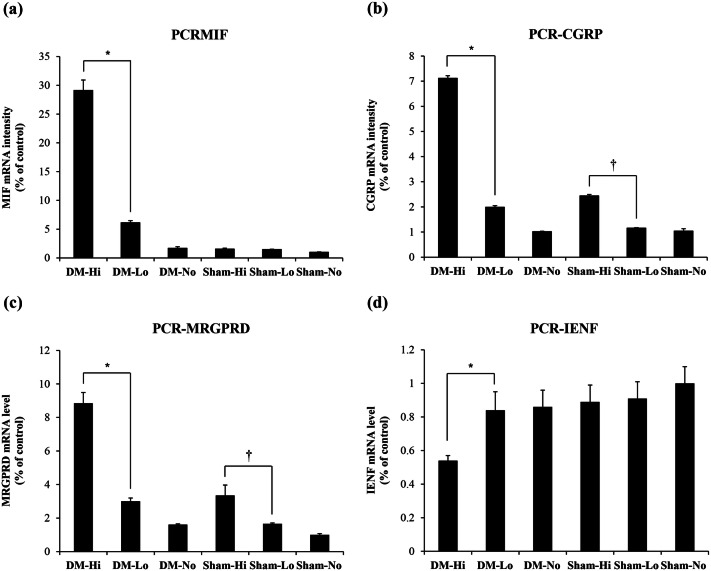
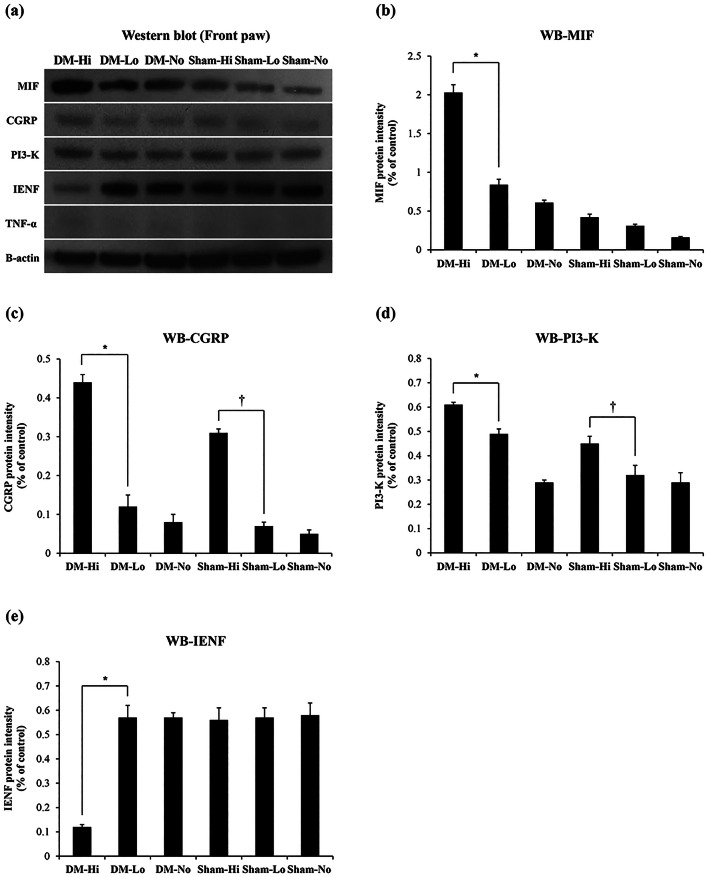
The harmful effects of excessive mechanical loading on diabetic neuropathy and the reason diabetic neuropathic symptoms are common in feet are unclear. In this study, the hind paw suspension treadmill exercise model was used in rats to investigate whether mechanical loading applied to the front paws precipitates neuropathic pain, especially in diabetic conditions. Thirty-two rats were divided into six groups according to the presence of diabetes (DM) and the intensity of mechanical loading applied to the front paws: DM-Hi (high-intensity); DM-Lo (low-intensity); DM-No (non-mechanical loading); Sham-Hi; Sham-Lo; and Sham-No. DM was induced by streptozotocin injection. For high-intensity or low-intensity mechanical loading, treadmill walking exercise was conducted with or without hind paw suspension, respectively. The mechanical withdrawal threshold of the front paw decreased significantly after 8 weeks only in the DM mechanical loading groups (DM-Hi and DM-Lo), and high-intensity loading more significantly decreased the front-paw withdrawal threshold than low-intensity loading. In the DM-Hi group only, macrophage migration inhibitory factor (MIF) increased significantly, and intra-epidermal nerve fibers (IENF) in the front paws decreased significantly. In diabetic conditions, mechanical overloading such as excessive walking is likely to precipitate mechanical allodynia and damage IENF¸ which could explain why diabetic neuropathic symptoms are common in feet. This finding might be related to up-regulation of intracellular signaling cascades such as MIF, rather than inflammatory processes.
过度机械负荷对糖尿病神经病变的有害影响以及糖尿病性神经病变症状为何常见于足部的原因尚不清楚。在这项研究中,我们使用大鼠后爪悬垂跑步机运动模型来研究前爪承受的机械负荷是否会引发神经病理性疼痛,尤其是在糖尿病的情况下。32 只大鼠根据是否患有糖尿病(DM)和前爪承受机械负荷的强度分为六组:DM-Hi(高强度);DM-Lo(低强度);DM-No(无机械负荷);Sham-Hi;Sham-Lo;Sham-No。DM 通过链脲佐菌素注射诱导。对于高强度或低强度的机械负荷,分别在有或无前爪悬垂的情况下进行跑步机行走运动。仅在 DM 机械负荷组(DM-Hi 和 DM-Lo)中,8 周后前爪的机械撤回阈值显著降低,高强度负荷比低强度负荷更显著地降低了前爪撤回阈值。仅在 DM-Hi 组中,巨噬细胞移动抑制因子(MIF)显著增加,前爪的表皮内神经纤维(IENF)显著减少。在糖尿病条件下,过度行走等过度机械负荷可能会引发机械性痛觉过敏并损害 IENF,这可以解释为什么糖尿病性神经病变症状常见于足部。这一发现可能与细胞内信号级联的上调有关,如 MIF,而不是炎症过程。