Laboratory for Biomolecular Structure and Function, Departemnt of Biotechnology, University of Rijeka, 51000, Rijeka, Croatia.
VIB-KU Leuven Center for Brain and Disease Research, 3000, Leuven, Belgium.
Sci Rep. 2020 Jun 26;10(1):10404. doi: 10.1038/s41598-020-67079-2.
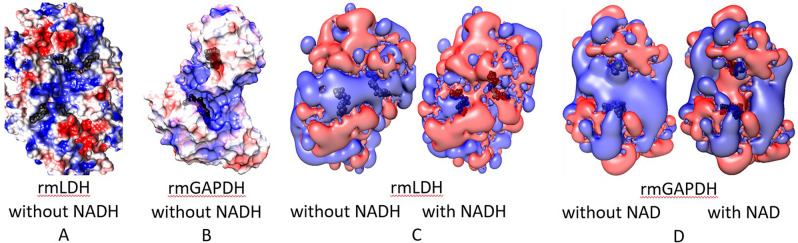
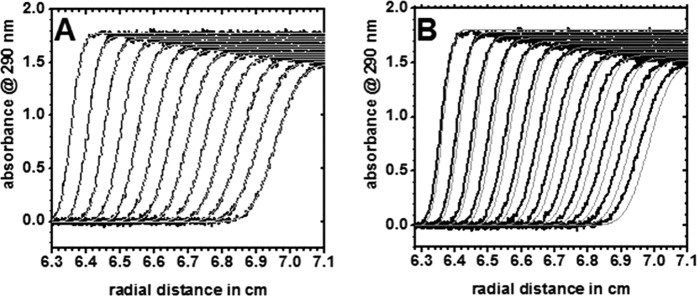
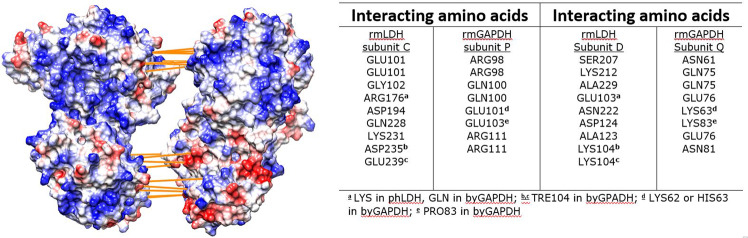
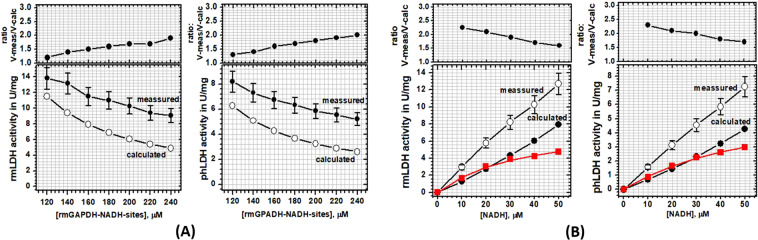
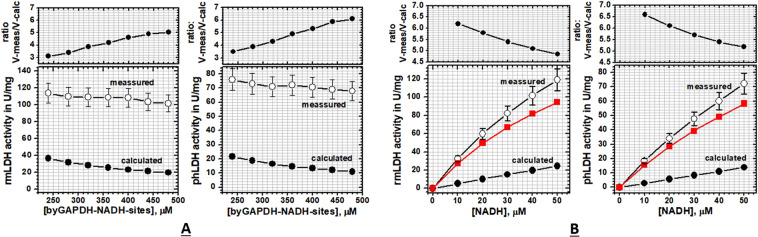
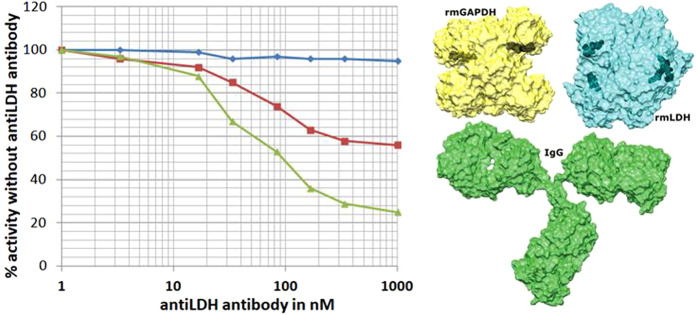
Substrate channeling studies have frequently failed to provide conclusive results due to poor understanding of this subtle phenomenon. We analyzed the mechanism of NADH-channeling from D-glyceraldehyde-3-phosphate dehydrogenase (GAPDH) to L-lactate Dehydrogenase (LDH) using enzymes from different cells. Enzyme kinetics studies showed that LDH activity with free NADH and GAPDH-NADH complex always take place in parallel. The channeling is observed only in assays that mimic cytosolic conditions where free NADH concentration is negligible and the GAPDH-NADH complex is dominant. Molecular dynamics and protein-protein interaction studies showed that LDH and GAPDH can form a leaky channeling complex only at the limiting NADH concentrations. Surface calculations showed that positive electric field between the NAD(H) binding sites on LDH and GAPDH tetramers can merge in the LDH-GAPDH complex. NAD(H)-channeling within the LDH-GAPDH complex can be an extension of NAD(H)-channeling within each tetramer. In the case of a transient LDH-(GAPDH-NADH) complex, the relative contribution from the channeled and the diffusive paths depends on the overlap between the off-rates for the LDH-(GAPDH-NADH) complex and the GAPDH-NADH complex. Molecular evolution or metabolic engineering protocols can exploit substrate channeling for metabolic flux control by fine-tuning substrate-binding affinity for the key enzymes in the competing reaction paths.
由于对这一微妙现象缺乏了解,底物通道化研究经常未能提供确凿的结果。我们使用来自不同细胞的酶分析了 D-甘油醛-3-磷酸脱氢酶 (GAPDH) 到 L-乳酸脱氢酶 (LDH) 的 NADH 通道化机制。酶动力学研究表明,具有游离 NADH 和 GAPDH-NADH 复合物的 LDH 活性总是并行发生。只有在模拟细胞质条件的测定中才观察到通道化,在细胞质条件下,游离 NADH 浓度可以忽略不计,并且 GAPDH-NADH 复合物占主导地位。分子动力学和蛋白质-蛋白质相互作用研究表明,只有在 NADH 浓度有限的情况下,LDH 和 GAPDH 才能形成一个渗漏通道化复合物。表面计算表明,LDH 和 GAPDH 上 NAD(H)结合位点之间的正电场可以在 LDH-GAPDH 复合物中合并。LDH-GAPDH 复合物内的 NAD(H)通道化可能是每个四聚体内 NAD(H)通道化的延伸。在 LDH-(GAPDH-NADH)复合物的瞬时情况下,通道化和扩散路径的相对贡献取决于 LDH-(GAPDH-NADH)复合物和 GAPDH-NADH 复合物的脱落率之间的重叠。分子进化或代谢工程方案可以通过微调竞争反应途径中关键酶的底物结合亲和力来利用底物通道化来控制代谢通量。