Division of Infectious Diseases and International Health, University of Virginia, Charlottesville, Virginia, USA.
Mucosal Immunology and Vaccinology Unit, Infectious Diseases Division, International Centre for Diarrhoeal Disease Research, Bangladesh (icddr,b), Mohakhali Dhaka, Bangladesh.
Clin Infect Dis. 2021 Nov 2;73(9):e2493-e2499. doi: 10.1093/cid/ciaa840.
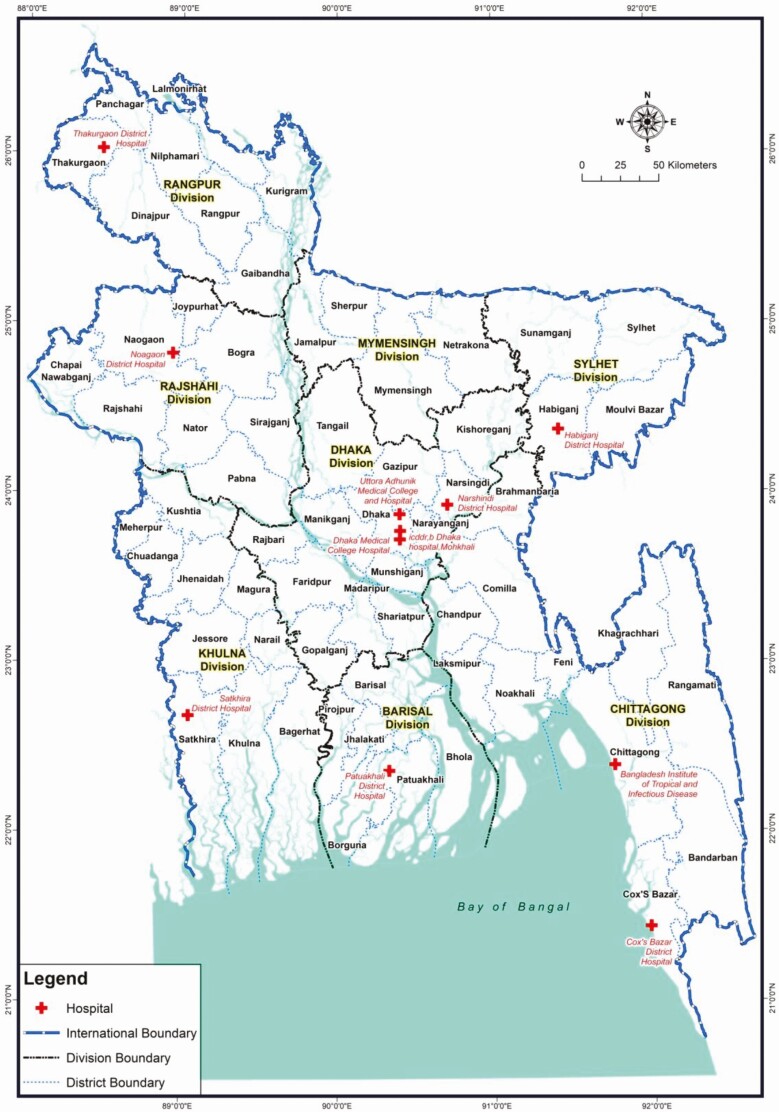
Diarrhea remains a major public health problem and characterization of its etiology is needed to prioritize interventions. However, most data are from single-site studies of children. We tested samples from participants of any age from 11 geographically diverse hospitals in Bangladesh to describe pathogen-specific burdens of diarrhea.
We utilized 2 existing diarrhea surveillance systems: a Nationwide network at 10 sentinel hospitals and at the icddr,b hospital. We tested stools from enrolled participants and nondiarrheal controls for enteropathogens using quantitative polymerase chain reaction and calculated pathogen-specific attributable fractions (AFs) of diarrhea.
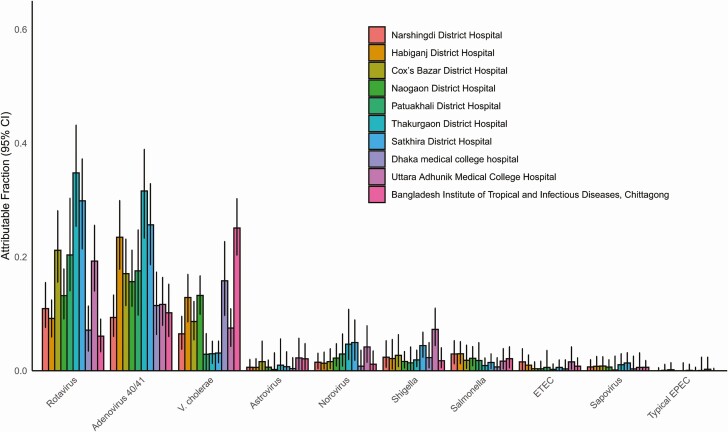
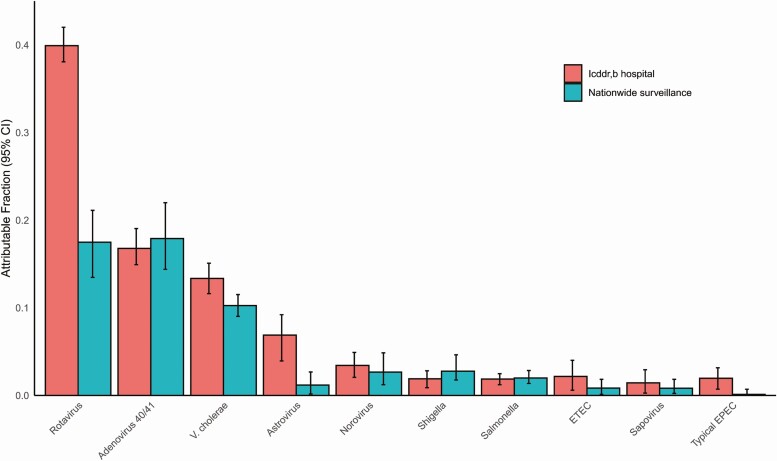
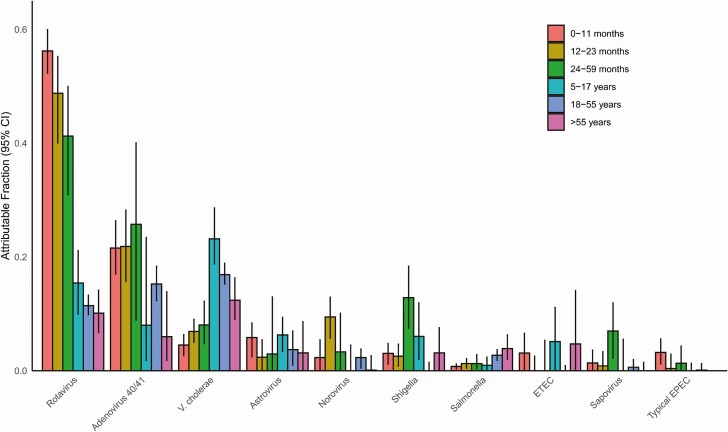
We analyzed 5516 patients with diarrhea and 735 controls. Overall, rotavirus had the highest attributable burden of diarrhea (Nationwide AF, 17.7%; 95% confidence interval [CI], 14.3-20.9%; icddr,b AF, 39.9%; 38.0-41.8%), followed by adenovirus 40/41 (Nationwide AF, 17.9%; 95% CI: 13.9-21.9%; icddr,b AF, 16.6%; 95% CI, 14.4-19.4%) and Vibrio cholerae (Nationwide AF, 10.2%; 95% CI, 9.1-11.3%; icddr,b AF, 13.3%; 95% CI: 11.9-15.1%). Rotavirus was the leading pathogen in children <5 years and was consistent across the sites (coefficient of variation = 56.3%). Adenovirus 40/41 was the second leading pathogen in both children and adults. Vibrio cholerae was the leading pathogen in individuals >5 years old, but was more geographically variable (coefficient of variation = 71.5%). Other attributable pathogens included astrovirus, norovirus, Shigella, Salmonella, ETEC, sapovirus, and typical EPEC.
Rotavirus, adenovirus 40/41, and V. cholerae were the leading etiologies of infectious diarrhea requiring hospitalization in Bangladesh. Other pathogens were important in certain age groups or sites.
腹泻仍是一个主要的公共卫生问题,需要对其病因进行描述,以便确定优先干预措施。然而,大多数数据来自单一地点的儿童研究。本研究在孟加拉国 11 家地理位置不同的医院中,对任何年龄的参与者进行了样本检测,以描述腹泻的病原体特异性负担。
我们利用了现有的 2 个腹泻监测系统:10 家哨点医院的全国网络监测系统和 icddr,b 医院监测系统。我们利用定量聚合酶链反应(qPCR)对入组的腹泻患者和非腹泻对照者的粪便样本进行了病原体检测,并计算了腹泻的病原体特异性归因分数(AFs)。
本研究共分析了 5516 例腹泻患者和 735 例对照者。总体而言,轮状病毒是导致腹泻的主要病原体(全国性归因分数,17.7%;95%置信区间[CI],14.3-20.9%;icddr,b 归因分数,39.9%;95% CI,38.0-41.8%),其次是腺病毒 40/41(全国性归因分数,17.9%;95% CI,13.9-21.9%;icddr,b 归因分数,16.6%;95% CI,14.4-19.4%)和霍乱弧菌(全国性归因分数,10.2%;95% CI,9.1-11.3%;icddr,b 归因分数,13.3%;95% CI,11.9-15.1%)。轮状病毒是<5 岁儿童腹泻的主要病原体,且在各地点均一致(变异系数=56.3%)。腺病毒 40/41 是儿童和成人腹泻的第二大主要病原体。霍乱弧菌是>5 岁个体腹泻的主要病原体,但在地理上存在更大的变异性(变异系数=71.5%)。其他病原体包括星状病毒、诺如病毒、志贺菌、沙门菌、肠产毒性大肠埃希菌、肠杯状病毒和典型肠致病性大肠埃希菌。
轮状病毒、腺病毒 40/41 和霍乱弧菌是导致孟加拉国需要住院治疗的传染性腹泻的主要病因。其他病原体在特定年龄组或地点更为重要。