Operario Darwin J, Platts-Mills James A, Nadan Sandrama, Page Nicola, Seheri Mapaseka, Mphahlele Jeffrey, Praharaj Ira, Kang Gagandeep, Araujo Irene T, Leite Jose Paulo G, Cowley Daniel, Thomas Sarah, Kirkwood Carl D, Dennis Francis, Armah George, Mwenda Jason M, Wijesinghe Pushpa Ranjan, Rey Gloria, Grabovac Varja, Berejena Chipo, Simwaka Chibumbya J, Uwimana Jeannine, Sherchand Jeevan B, Thu Hlaing Myat, Galagoda Geethani, Bonkoungou Isidore J O, Jagne Sheriffo, Tsolenyanu Enyonam, Diop Amadou, Enweronu-Laryea Christabel, Borbor Sam-Aliyah, Liu Jie, McMurry Timothy, Lopman Benjamin, Parashar Umesh, Gentsch John, Steele A Duncan, Cohen Adam, Serhan Fatima, Houpt Eric R
University of Virginia, Charlottesville.
National Institute for Communicable Diseases, Johannesburg.
J Infect Dis. 2017 Jul 15;216(2):220-227. doi: 10.1093/infdis/jix294.
The etiology of acute watery diarrhea remains poorly characterized, particularly after rotavirus vaccine introduction.
We performed quantitative polymerase chain reaction for multiple enteropathogens on 878 acute watery diarrheal stools sampled from 14643 episodes captured by surveillance of children <5 years of age during 2013-2014 from 16 countries. We used previously developed models of the association between pathogen quantity and diarrhea to calculate pathogen-specific weighted attributable fractions (AFs).
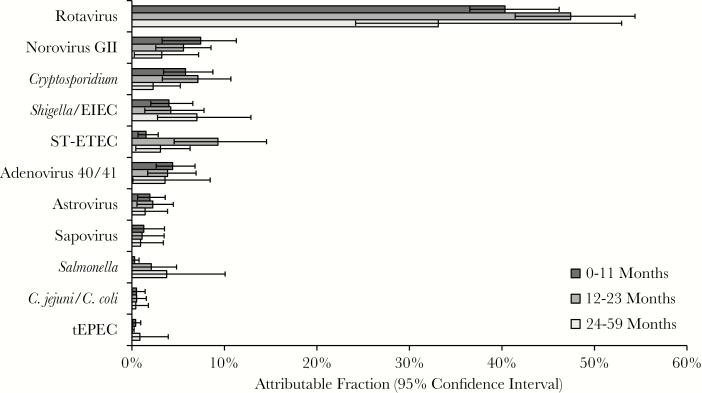
Rotavirus remained the leading etiology (overall weighted AF, 40.3% [95% confidence interval {CI}, 37.6%-44.3%]), though the AF was substantially lower in the Americas (AF, 12.2 [95% CI, 8.9-15.6]), based on samples from a country with universal rotavirus vaccination. Norovirus GII (AF, 6.2 [95% CI, 2.8-9.2]), Cryptosporidium (AF, 5.8 [95% CI, 4.0-7.6]), Shigella (AF, 4.7 [95% CI, 2.8-6.9]), heat-stable enterotoxin-producing Escherichia coli (ST-ETEC) (AF, 4.2 [95% CI, 2.0-6.1]), and adenovirus 40/41 (AF, 4.2 [95% CI, 2.9-5.5]) were also important. In the Africa Region, the rotavirus AF declined from 54.8% (95% CI, 48.3%-61.5%) in rotavirus vaccine age-ineligible children to 20.0% (95% CI, 12.4%-30.4%) in age-eligible children.
Rotavirus remained the leading etiology of acute watery diarrhea despite a clear impact of rotavirus vaccine introduction. Norovirus GII, Cryptosporidium, Shigella, ST-ETEC, and adenovirus 40/41 were also important. Prospective surveillance can help identify priorities for further reducing the burden of diarrhea.
急性水样腹泻的病因仍未得到充分阐明,尤其是在引入轮状病毒疫苗之后。
我们对来自16个国家2013 - 2014年期间5岁以下儿童监测中捕获的14643例急性水样腹泻粪便中的878份样本进行了多种肠道病原体的定量聚合酶链反应。我们使用先前开发的病原体数量与腹泻之间关联的模型来计算病原体特异性加权归因分数(AFs)。
轮状病毒仍然是主要病因(总体加权AF为40.3% [95%置信区间{CI},37.6% - 44.3%]),不过基于来自一个实施普遍轮状病毒疫苗接种国家的样本,美洲地区的AF显著较低(AF为12.2 [95% CI,8.9 - 15.6])。诺如病毒GII(AF为6.2 [95% CI,2.8 - 9.2])、隐孢子虫(AF为5.8 [95% CI,4.0 - 7.6])、志贺氏菌(AF为4.7 [95% CI,2.8 - 6.9])、产热稳定肠毒素大肠杆菌(ST - ETEC)(AF为4.2 [95% CI,2.0 - 6.1])和腺病毒40/41(AF为4.2 [95% CI,2.9 - 5.5])也很重要。在非洲地区,轮状病毒AF在不符合轮状病毒疫苗接种年龄的儿童中从54.8%(95% CI,48.3% - 61.5%)降至符合接种年龄儿童中的20.0%(95% CI,12.4% - 30.4%)。
尽管引入轮状病毒疫苗有明显影响,但轮状病毒仍然是急性水样腹泻的主要病因。诺如病毒GII、隐孢子虫、志贺氏菌、ST - ETEC和腺病毒40/41也很重要。前瞻性监测有助于确定进一步减轻腹泻负担的重点。