Division of Vascular and Endovascular Surgery, Department of Cardiothoracic and Vascular Surgery, Montefiore Medical Center/Albert Einstein College of Medicine, New York, NY.
Division of Hospital Medicine, Department of Medicine, Montefiore Medical Center/Albert Einstein College of Medicine, New York, NY.
J Vasc Surg Venous Lymphat Disord. 2021 Jan;9(1):36-46. doi: 10.1016/j.jvsv.2020.06.012. Epub 2020 Jun 25.
Little is known about coronavirus disease 2019 (COVID-19)-associated hypercoagulability. We sought to characterize patients with deep venous thrombosis (DVT) identified after admission for COVID-19.
All adult patients admitted to Montefiore Medical Center from March 1, 2020, to April 10, 2020, and undergoing lower extremity venous duplex for DVT evaluation were included. Patients admitted with suspicion of COVID-19 were divided into severe acute respiratory syndrome coronavirus 2 (SARS-CoV-2) positive and SARS-CoV-2 negative groups based on in-hospital test results. Patients without clinical suspicion for COVID-19 were not tested. A retrospective case-control study design was used to identify potential risk factors for DVT in patients with COVID-19. Demographic, radiographic, and laboratory values were abstracted and analyzed.
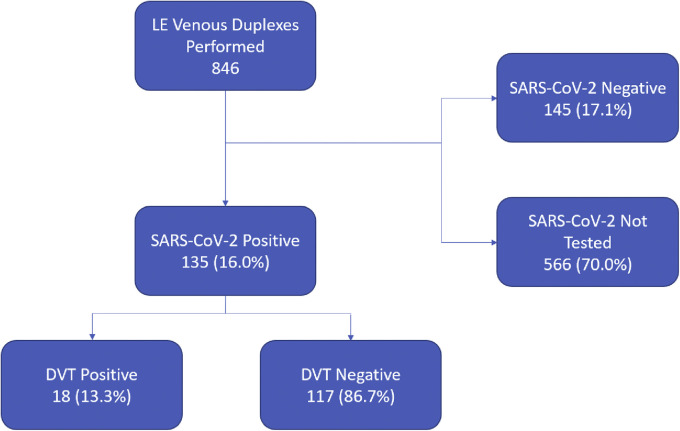
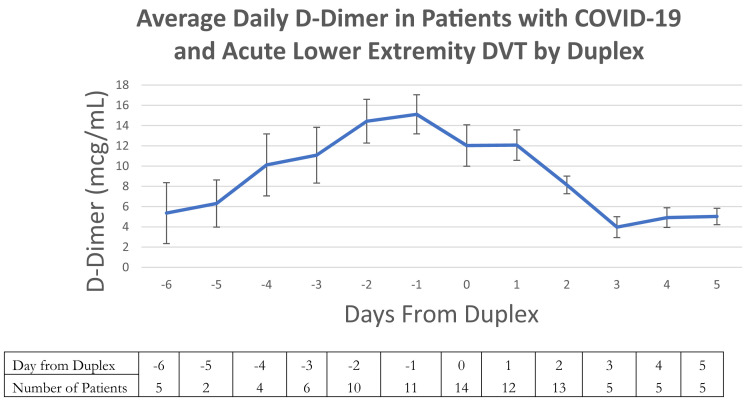
During the study period, 3404 patients with confirmed COVID-19 were admitted to the hospital. Of the 135 SARS-CoV-2 patients who underwent duplex scanning, there were 18 (13.3%) noted to have DVT compared with 72 of the 711 patients (10.1%) who were either SARS-CoV-2 negative or untested. The odds ratio for DVT in COVID-19 was 1.35 (95% confidence interval, 0.78-2.34; P = .289). Baseline characteristics for COVID-19 patients with and without DVT were overall similar. COVID-19 patients with DVT had an elevated median first d-dimer (18.88 μg/mL [interquartile range (IQR), 7.79-20.00] vs 2.55 μg/mL [IQR, 1.45-6.28]; P = .002; reference value, <0.5 μg/mL), average in-hospital d-dimer (median, 11.93 μg/mL [IQR, 8.25-16.97] vs 3.54 μg/mL [IQR, 2.05-8.53]; P < .001) and median fibrinogen level (501.0 [IQR, 440.0-629.0] vs 654.5 [IQR, 535.8-780.0]; P = .002; reference range, 187-502 mg/dL). There was a trend to significance for COVID-19 patients with DVT compared with without DVT in median d-dimer levels at the time of the duplex (13.61 μg/mL [IQR, 4.04-19.97] vs 3.58 μg/mL [IQR, 2.51-9.62]; P = .055) and median ferritin levels (1679.0 ng/mL [IQR, 1168.0-2577.0] vs 1103.0 ng/mL [IQR, 703.5-2076.5]; P = .055; reference range, 25-270 ng/mL). Twelve of the 18 patients with COVID who developed DVT did so despite chemical thromboprophylaxis, and 2 developed DVT despite therapeutic anticoagulation CONCLUSIONS: We found only a modestly increased risk of DVT in patients with COVID-19, likely underestimated owing to limitations in duplex testing early in the epidemic. Elevated d-dimer and a less elevated fibrinogen are associated with DVT in patients with COVID-19 who seem to form thrombus despite conventional chemical thromboprophylaxis. Additionally, an increasing d-dimer over time may be a reflection of the development of DVT in patients with COVID-19.
关于 2019 年冠状病毒病(COVID-19)相关高凝状态知之甚少。我们旨在描述 COVID-19 住院患者中发现的深静脉血栓形成(DVT)患者的特征。
纳入 2020 年 3 月 1 日至 2020 年 4 月 10 日期间因 COVID-19 入住蒙特菲奥雷医疗中心并接受下肢静脉双功超声检查以评估 DVT 的所有成年患者。根据住院期间的检查结果,将怀疑 COVID-19 的患者分为 SARS-CoV-2 阳性和 SARS-CoV-2 阴性组。对没有临床怀疑 COVID-19 的患者不进行检测。采用回顾性病例对照研究设计,确定 COVID-19 患者发生 DVT 的潜在危险因素。提取并分析人口统计学、影像学和实验室值。
在研究期间,共有 3404 例确诊 COVID-19 的患者入院。在接受双功扫描的 135 例 SARS-CoV-2 患者中,有 18 例(13.3%)被发现有 DVT,而在 711 例 SARS-CoV-2 阴性或未检测的患者中,有 72 例(10.1%)有 DVT。COVID-19 患者发生 DVT 的比值比为 1.35(95%置信区间,0.78-2.34;P=0.289)。COVID-19 患者有 DVT 与无 DVT 的患者的基线特征总体相似。有 DVT 的 COVID-19 患者的中位首次 D-二聚体水平较高(18.88μg/mL[四分位距(IQR),7.79-20.00] vs 2.55μg/mL[IQR,1.45-6.28];P=0.002;参考值,<0.5μg/mL),平均住院 D-二聚体水平(中位数,11.93μg/mL[IQR,8.25-16.97] vs 3.54μg/mL[IQR,2.05-8.53];P<0.001)和中位纤维蛋白原水平(501.0[IQR,440.0-629.0] vs 654.5[IQR,535.8-780.0];P=0.002;参考范围,187-502mg/dL)。与无 DVT 的 COVID-19 患者相比,有 DVT 的 COVID-19 患者在双功扫描时的 D-二聚体水平中位数(13.61μg/mL[IQR,4.04-19.97] vs 3.58μg/mL[IQR,2.51-9.62];P=0.055)和中位铁蛋白水平(1679.0ng/mL[IQR,1168.0-2577.0] vs 1103.0ng/mL[IQR,703.5-2076.5];P=0.055;参考范围,25-270ng/mL)也存在趋势意义。COVID-19 患者中 18 例发生 DVT 的患者中有 12 例尽管接受了化学预防血栓形成,但仍发生了 DVT,2 例尽管接受了抗凝治疗但仍发生了 DVT。
我们发现 COVID-19 患者的 DVT 风险仅略有增加,这可能是由于在疫情早期双功检测的局限性而被低估。COVID-19 患者的 D-二聚体升高和纤维蛋白原升高幅度较小与 DVT 相关,尽管接受了常规化学预防血栓形成,但 COVID-19 患者仍会形成血栓。此外,D-二聚体随时间增加可能反映 COVID-19 患者 DVT 的发展。