Warren R B, Blauvelt A, Poulin Y, Beeck S, Kelly M, Wu T, Geng Z, Paul C
The Dermatology Centre, Salford Royal NHS Foundation Trust, Manchester NIHR Biomedical Research Centre, Manchester, UK.
Oregon Medical Research Centre, Portland, OR, USA.
Br J Dermatol. 2021 Jan;184(1):50-59. doi: 10.1111/bjd.19341. Epub 2020 Sep 6.
Patients with plaque psoriasis treated with biologic therapies need more efficacious, safe and convenient treatments to improve quality of life. Risankizumab and secukinumab inhibit interleukin-23 and interleukin-17A, respectively, and are effective in adult patients with moderate-to-severe plaque psoriasis but have different dosing regimens.
To compare directly the efficacy and safety of risankizumab vs. secukinumab over 52 weeks.
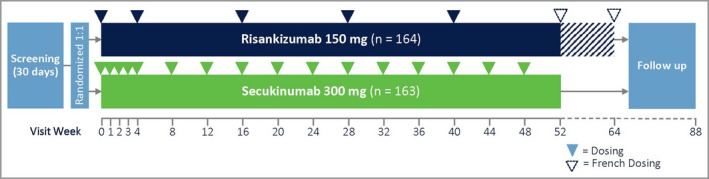
IMMerge was an international, phase III, multicentre, open-label, efficacy-assessor-blinded, active-comparator study, in which adult patients with chronic, moderate-to-severe plaque psoriasis were randomized in a 1 : 1 ratio to treatment with risankizumab 150 mg or secukinumab 300 mg. Primary efficacy endpoints were the proportions of patients achieving ≥ 90% improvement from baseline in Psoriasis Area and Severity Index (PASI 90) at week 16 (noninferiority comparison with margin of 12%) and week 52 (superiority comparison).
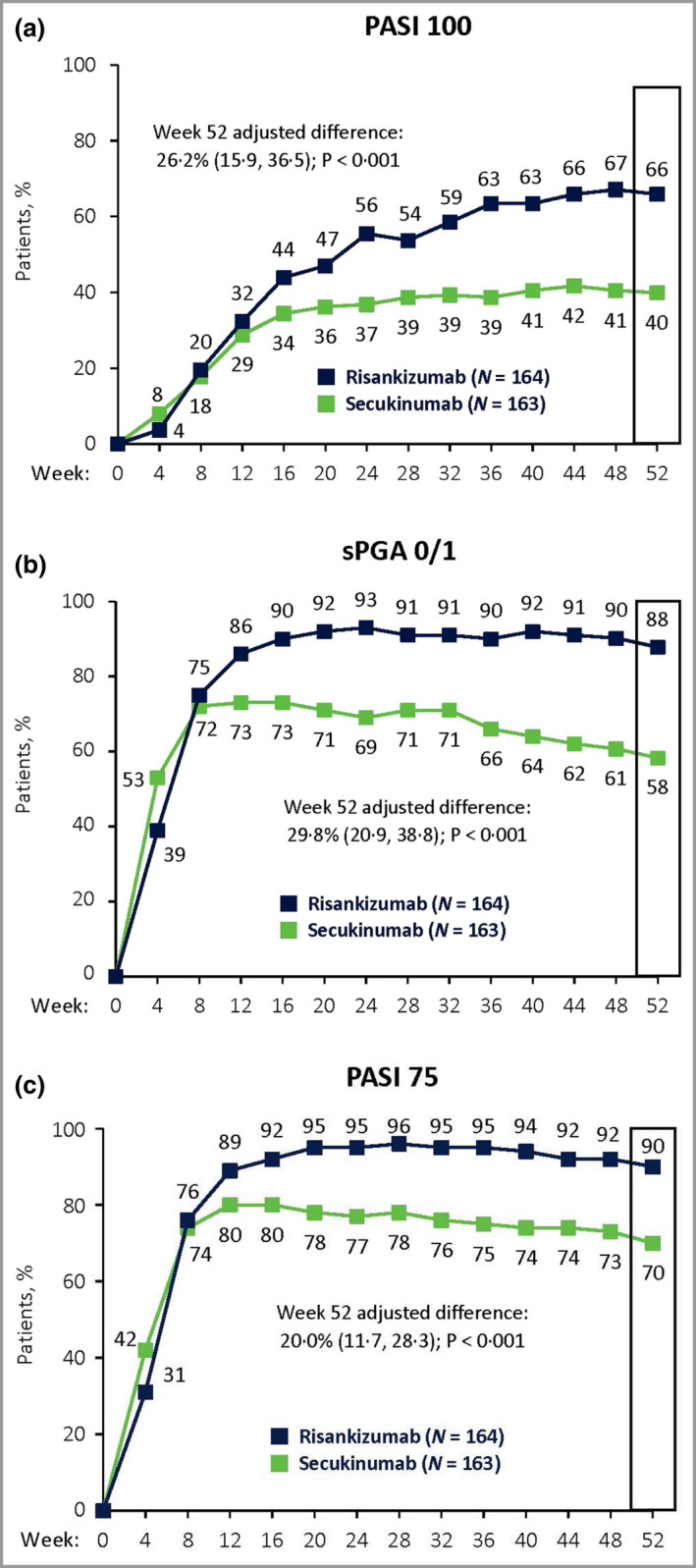
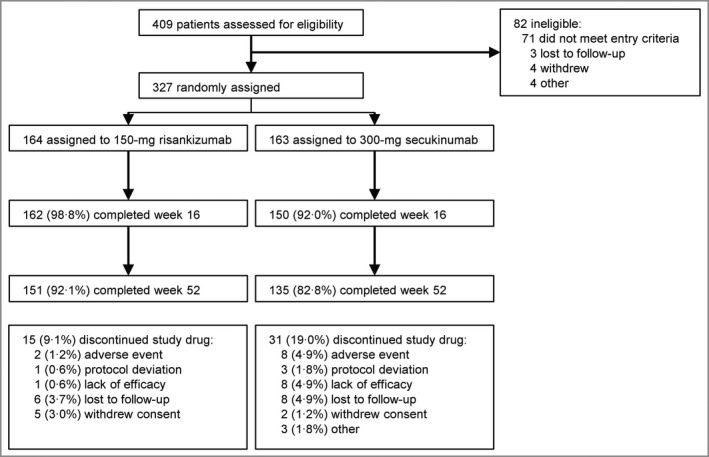
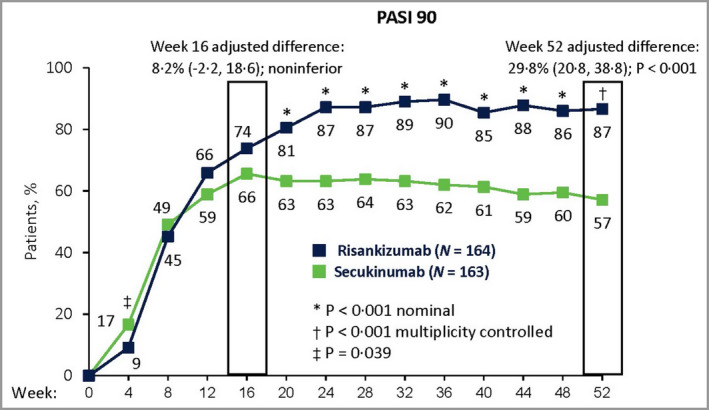
In total 327 patients from nine countries were treated with risankizumab (n = 164) or secukinumab (n = 163). Risankizumab was noninferior to secukinumab in the proportion of patients achieving PASI 90 at week 16 [73·8% vs. 65·6%; difference of 8·2%, 96·25% confidence interval (CI)-2·2 to 18·6; within the 12% noninferiority margin] and superior to secukinumab at week 52 (86·6% vs. 57·1%; difference of 29·8%, 95% CI 20·8-38·8; P < 0·001), thus meeting both primary endpoints. All secondary endpoints (PASI 100, static Physician's Global Assessment 0 or 1, and PASI 75) at week 52 demonstrated superiority for risankizumab vs. secukinumab (P < 0·001). No new safety concerns were identified.
At week 52, risankizumab demonstrated superior efficacy and similar safety with less frequent dosing compared with secukinumab.
接受生物疗法治疗的斑块状银屑病患者需要更有效、安全且便捷的治疗方法来改善生活质量。瑞莎珠单抗和司库奇尤单抗分别抑制白细胞介素-23和白细胞介素-17A,对中度至重度斑块状银屑病成年患者有效,但给药方案不同。
直接比较瑞莎珠单抗与司库奇尤单抗在52周内的疗效和安全性。
IMMerge是一项国际、III期、多中心、开放标签、疗效评估者设盲、活性对照研究,将慢性中度至重度斑块状银屑病成年患者按1:1比例随机分为接受150mg瑞莎珠单抗或300mg司库奇尤单抗治疗。主要疗效终点为在第16周(非劣效性比较,界值为12%)和第52周(优效性比较)达到银屑病面积和严重程度指数(PASI)较基线改善≥90%(PASI 90)的患者比例。
来自9个国家的327例患者接受了瑞莎珠单抗(n = 164)或司库奇尤单抗(n = 163)治疗。在第16周达到PASI 90的患者比例方面,瑞莎珠单抗不劣于司库奇尤单抗[73.8%对65.6%;差异为8.2%,96.25%置信区间(CI)-2.2至18.6;在12%的非劣效性界值内],且在第52周优于司库奇尤单抗(86.6%对57.1%;差异为29.8%,95%CI 20.8 - 38.8;P < 0.001),因此达到了两个主要终点。第52周时所有次要终点(PASI 100、静态医师整体评估为0或1、PASI 75)均显示瑞莎珠单抗优于司库奇尤单抗(P < 0.001)。未发现新的安全问题。
在第52周时,与司库奇尤单抗相比,瑞莎珠单抗疗效更优、安全性相似且给药频率更低。