Department of Psychology, University of Maryland, 1147 Biology-Psychology Building, College Park, MD 20742, USA.
Department of Psychology, University of Virginia, Charlottesville, VA 22903, USA.
Philos Trans R Soc Lond B Biol Sci. 2020 Aug 17;375(1805):20190432. doi: 10.1098/rstb.2019.0432. Epub 2020 Jul 29.
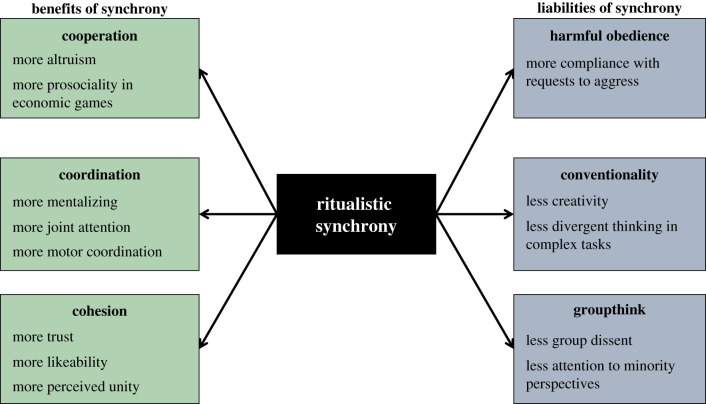
From Australia to the Arctic, human groups engage in synchronous behaviour during communal rituals. Because ritualistic synchrony is widespread, many argue that it is functional for human groups, encouraging large-scale cooperation and group cohesion. Here, we offer a more nuanced perspective on synchrony's function. We review research on synchrony's prosocial effects, but also discuss synchrony's antisocial effects such as encouraging group conflict, decreasing group creativity and increasing harmful obedience. We further argue that a tightness-looseness (TL) framework helps to explain this trade-off and generates new predictions for how ritualistic synchrony should evolve over time, where it should be most prevalent, and how it should affect group well-being. We close by arguing that synthesizing the literature on TL with the literature on synchrony has promise for understanding synchrony's role in a broader cultural evolutionary framework. This article is part of the theme issue 'Ritual renaissance: new insights into the most human of behaviours'.
从澳大利亚到北极,人类群体在集体仪式中进行同步行为。由于仪式性同步非常普遍,许多人认为它对人类群体是有功能的,它可以促进大规模的合作和群体凝聚力。在这里,我们提供了一个关于同步功能的更细微的视角。我们回顾了关于同步的亲社会影响的研究,但也讨论了同步的反社会影响,如鼓励群体冲突、降低群体创造力和增加有害的服从。我们进一步认为,紧密度-松弛度(TL)框架有助于解释这种权衡,并为仪式性同步如何随着时间的推移而演变、在何处最普遍以及如何影响群体幸福感提供了新的预测。最后,我们认为,将 TL 文献与同步文献综合起来,有望在更广泛的文化进化框架中理解同步的作用。本文是主题为“仪式复兴:对最具人类行为的新见解”的一部分。