Department of Veterinary Pathology, School of Veterinary Medicine, Kitasato University, 23-35-1, Higashi, Towada, Aomori 034-8628, Japan.
Veterinary Research Department, Research Institute for Tropical Medicine, Department of Health, 9002 Research Drive, Filinvest Corporate City, Alabang, Muntinlupa City 1781, Philippines.
J Vet Med Sci. 2020 Aug 28;82(8):1204-1208. doi: 10.1292/jvms.20-0252. Epub 2020 Jul 26.
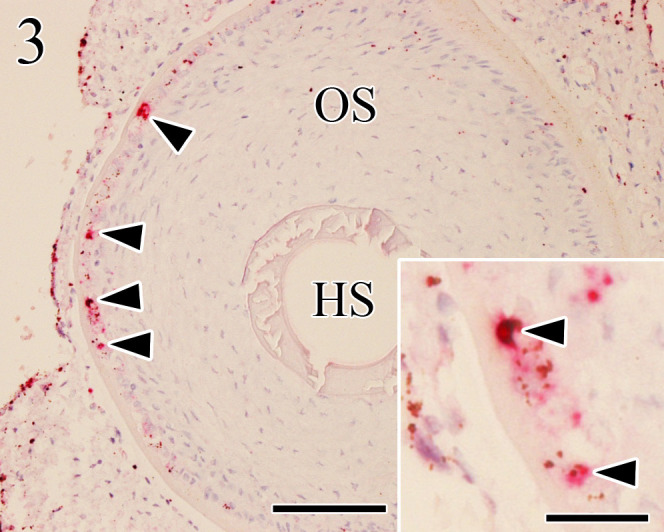
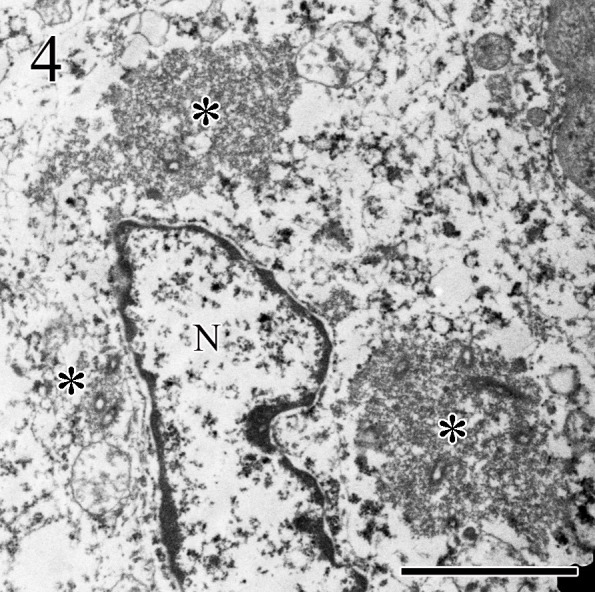
We previously reported a novel diagnostic method using follicle-sinus complexes (FSCs) in the muzzle skin for postmortem diagnosis of rabies in dogs. However, whether this method works in other animal species remains unclear. Here, FSCs were collected from a wolf, a red fox, 2 bats, and a cat, and examined for the presence of viral antigen, viral mRNA, and viral particles. Viral antigen and viral mRNA were confirmed in Merkel cells (MCs) in FSCs of all species. Electron microscopy performed using only samples from wolf and cat confirmed viral particles in MCs of FSCs. These results suggested that this novel diagnostic method using FSCs might be useful for detection of rabies not only in domestic but also wild animals.
我们之前报道了一种新的诊断方法,使用口鼻部皮肤中的滤泡-窦复合体(FSCs)来诊断犬的狂犬病死后。然而,该方法是否适用于其他动物物种尚不清楚。在此,我们从狼、红狐、2 只蝙蝠和猫中采集了 FSCs,并检查了病毒抗原、病毒 mRNA 和病毒颗粒的存在情况。在所有物种的 FSCs 中的 Merkel 细胞(MCs)中均证实存在病毒抗原和病毒 mRNA。仅使用来自狼和猫的样本进行的电子显微镜检查证实了 FSCs 中的 MC 中的病毒颗粒。这些结果表明,这种使用 FSCs 的新的诊断方法不仅对检测家养动物,而且对野生动物的狂犬病可能都有用。