Rosikiewicz Wojciech, Chen Xiaowen, Dominguez Pilar M, Ghamlouch Hussein, Aoufouchi Said, Bernard Olivier A, Melnick Ari, Li Sheng
The Jackson Laboratory for Genomic Medicine, Farmington, CT, USA.
Center for Applied Bioinformatics, St. Jude Children's Research Hospital, Memphis, TN, USA.
Sci Adv. 2020 Jun 17;6(25):eaay5872. doi: 10.1126/sciadv.aay5872. eCollection 2020 Jun.
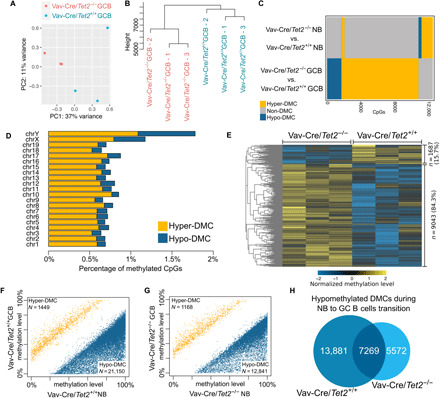
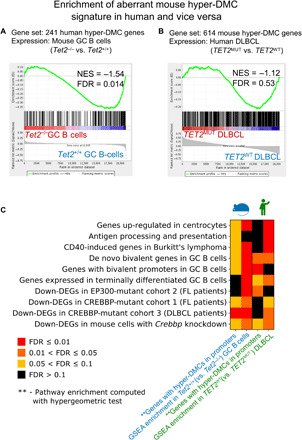
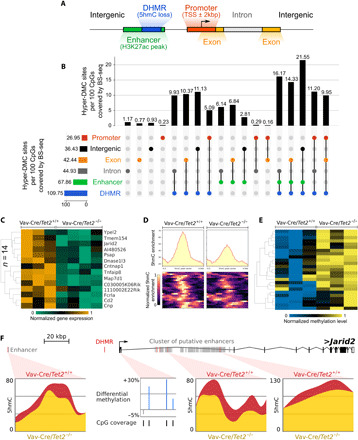
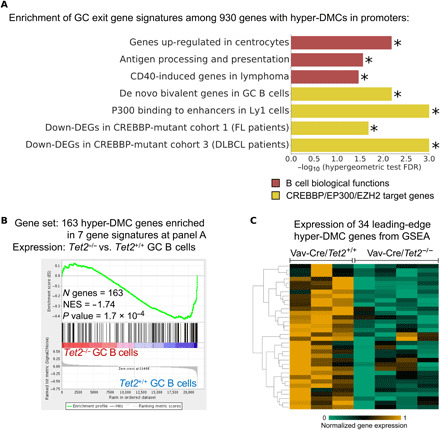
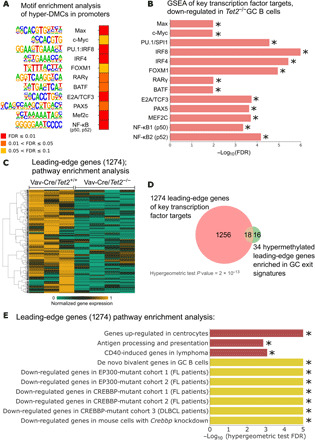
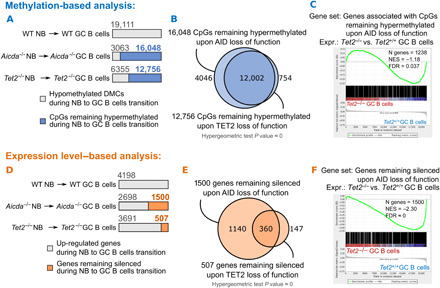
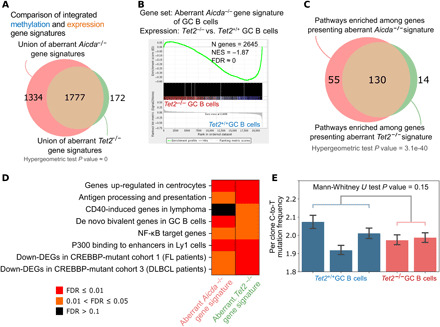
The TET2 DNA hydroxymethyltransferase is frequently disrupted by somatic mutations in diffuse large B cell lymphomas (DLBCLs), a tumor that originates from germinal center (GC) B cells. Here, we show that TET2 deficiency leads to DNA hypermethylation of regulatory elements in GC B cells, associated with silencing of the respective genes. This hypermethylation affects the binding of transcription factors including those involved in exit from the GC reaction and involves pathways such as B cell receptor, antigen presentation, CD40, and others. Normal GC B cells manifest a typical hypomethylation signature, which is caused by AID, the enzyme that mediates somatic hypermutation. However, AID-induced demethylation is markedly impaired in TET2-deficient GC B cells, suggesting that AID epigenetic effects are partially dependent on TET2. Last, we find that TET2 mutant DLBCLs also manifest the aberrant TET2-deficient GC DNA methylation signature, suggesting that this epigenetic pattern is maintained during and contributes to lymphomagenesis.
TET2 DNA羟甲基转移酶在弥漫性大B细胞淋巴瘤(DLBCL)中经常因体细胞突变而受到破坏,DLBCL是一种起源于生发中心(GC)B细胞的肿瘤。在此,我们表明TET2缺陷导致GC B细胞中调控元件的DNA高甲基化,这与相应基因的沉默相关。这种高甲基化影响转录因子的结合,包括那些参与从GC反应中退出的转录因子,并涉及B细胞受体、抗原呈递、CD40等途径。正常的GC B细胞表现出典型的低甲基化特征,这是由介导体细胞高频突变的酶AID引起的。然而,在TET2缺陷的GC B细胞中,AID诱导的去甲基化明显受损,这表明AID的表观遗传效应部分依赖于TET2。最后,我们发现TET2突变的DLBCL也表现出异常的TET2缺陷型GC DNA甲基化特征,这表明这种表观遗传模式在淋巴瘤发生过程中得以维持并促进了淋巴瘤的发生。