Fuster H A, Wang Xin, Wang Xiaoguang, Bukusoglu E, Spagnolie S E, Abbott N L
Department of Chemical and Biological Engineering, University of Wisconsin-Madison, Madison, WI 53706, USA.
Smith School of Chemical and Biomolecular Engineering, Cornell University, Ithaca, NY 14853, USA.
Sci Adv. 2020 Jun 19;6(25):eabb1327. doi: 10.1126/sciadv.abb1327. eCollection 2020 Jun.
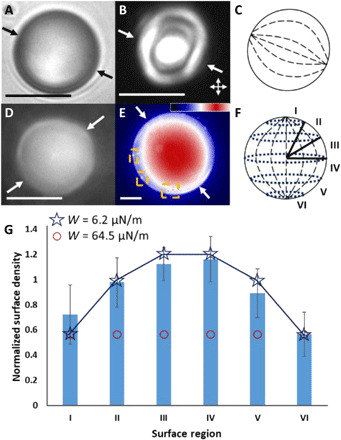
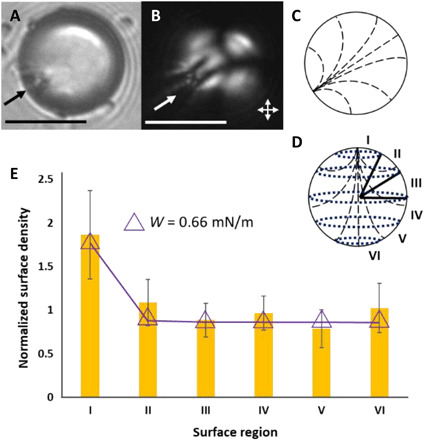
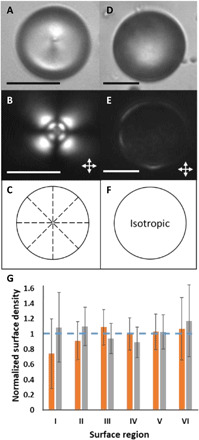
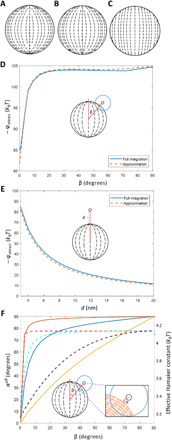
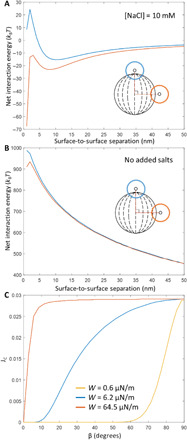
Asymmetric interactions such as entropic (e.g., encoded by nonspherical shapes) or surface forces (e.g., encoded by patterned surface chemistry or DNA hybridization) provide access to functional states of colloidal matter, but versatile approaches for engineering asymmetric van der Waals interactions have the potential to expand further the palette of materials that can be assembled through such bottom-up processes. We show that polymerization of liquid crystal (LC) emulsions leads to compositionally homogeneous and spherical microparticles that encode van der Waals interactions with complex symmetries (e.g., quadrupolar and dipolar) that reflect the internal organization of the LC. Experiments performed using kinetically controlled probe colloid adsorption and complementary calculations support our conclusion that LC ordering can program van der Waals interactions by ~20 across the surfaces of microparticles. Because diverse LC configurations can be engineered by confinement, these results provide fresh ideas for programming van der Waals interactions for assembly of soft matter.
诸如熵相互作用(例如,由非球形形状编码)或表面力(例如,由图案化表面化学或DNA杂交编码)之类的不对称相互作用为胶体物质的功能状态提供了途径,但是用于设计不对称范德华相互作用的通用方法有可能进一步扩展可以通过这种自下而上的过程组装的材料种类。我们表明,液晶(LC)乳液的聚合会产生成分均匀的球形微粒,这些微粒编码具有复杂对称性(例如四极和偶极)的范德华相互作用,这些对称性反映了LC的内部组织。使用动力学控制的探针胶体吸附进行的实验和补充计算支持了我们的结论,即LC有序可以在微粒表面上对范德华相互作用进行约20 的编程。由于可以通过限制来设计多种LC构型,因此这些结果为编程用于软物质组装的范德华相互作用提供了新的思路。