Department of Orthopaedics, Rehabilitation and Physical Therapy, Leiden University Medical Center, j11, P.O. Box 9600, 2300 RC, Leiden, the Netherlands.
Department of Rheumatology, Leiden University Medical Center, Leiden, the Netherlands.
Rheumatol Int. 2020 Sep;40(9):1519-1528. doi: 10.1007/s00296-020-04637-x. Epub 2020 Jun 28.
This study aimed to compare the engagement in moderate- and vigorous-intensity PA in axSpA patients with and without current physical therapy (PT).
In this cross-sectional study, a survey, including current PT treatment (yes/no) and PA, using the 'Short QUestionnaire to ASsess Health-enhancing PA' (SQUASH), was sent to 458 axSpA patients from three Dutch hospitals. From the SQUASH, the proportions meeting aerobic PA recommendations (≥ 150 min/week moderate-, ≥ 75 min/week vigorous-intensity PA or equivalent combination; yes/no) were calculated. To investigate the association between PT treatment and meeting the PA recommendations, odds ratios (OR) with 95% confidence intervals (95% CI) were estimated using logistic regression models, adjusting for sex, age, health status and hospital.
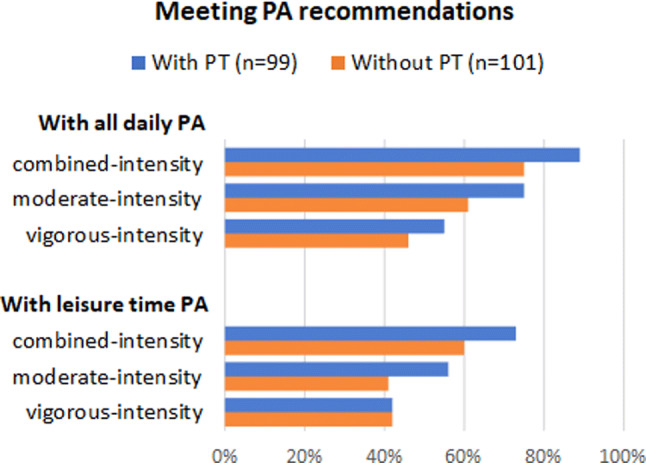
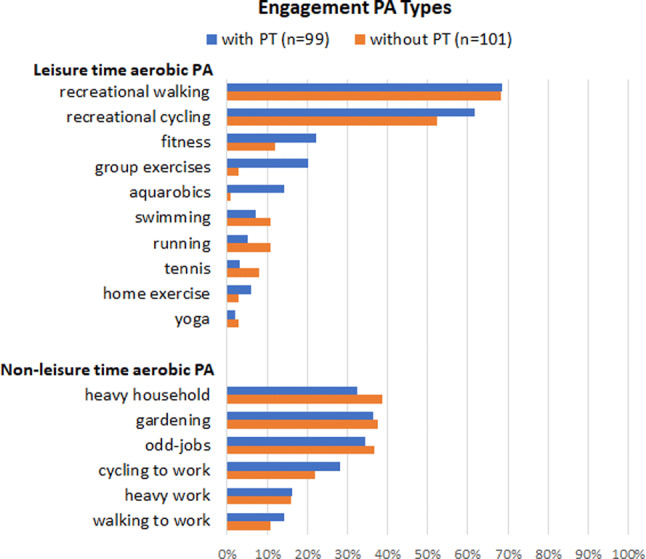
The questionnaire was completed by 200 patients, of whom 68%, 50% and 82% met the moderate-, vigorous- or combined-intensity PA recommendations, respectively. Ninety-nine patients (50%) had PT treatment, and those patients were more likely to meet the moderate- (OR 2.09 [95% CI 1.09-3.99]) or combined-intensity (OR 3.35 [95% CI 1.38-8.13]) PA recommendations, but not the vigorous-intensity PA recommendation (OR 1.53 [95% CI 0.80-2.93]). Aerobic exercise was executed in 19% of individual PT programs.
AxSpA patients with PT were more likely to meet the moderate- and combined-intensity PA recommendations, whereas there was no difference in meeting the vigorous-intensity PA recommendation. Irrespective of having PT treatment, recommendations for vigorous-intensity PA are met by only half of the patients. Implementation should thus focus on aerobic PA in patients without PT and on vigorous-intensity PA in PT programs.
本研究旨在比较患有和不患有当前物理治疗(PT)的 axSpA 患者进行中等强度和高强度 PA 的参与情况。
在这项横断面研究中,向来自荷兰三家医院的 458 名 axSpA 患者发送了一份包含当前 PT 治疗(是/否)和 PA 的调查,使用“短问卷评估健康促进 PA”(SQUASH)。从 SQUASH 中,计算出符合有氧运动 PA 建议(每周≥ 150 分钟中等强度,每周≥ 75 分钟剧烈强度 PA 或等效组合;是/否)的比例。为了研究 PT 治疗与满足 PA 建议之间的关联,使用逻辑回归模型估计了比值比(OR)及其 95%置信区间(95%CI),调整了性别、年龄、健康状况和医院。
共有 200 名患者完成了问卷,其中 68%、50%和 82%分别符合中等强度、剧烈强度或组合强度 PA 建议。99 名患者(50%)接受了 PT 治疗,这些患者更有可能符合中等强度(OR 2.09 [95%CI 1.09-3.99])或组合强度(OR 3.35 [95%CI 1.38-8.13])PA 建议,但不符合剧烈强度 PA 建议(OR 1.53 [95%CI 0.80-2.93])。在个人 PT 计划中,19%的患者进行了有氧运动。
接受 PT 的 axSpA 患者更有可能符合中等强度和组合强度 PA 建议,而在符合剧烈强度 PA 建议方面则没有差异。无论是否接受 PT 治疗,只有一半的患者符合剧烈强度 PA 建议。因此,实施应侧重于没有 PT 的患者的有氧运动,以及 PT 计划中的剧烈强度 PA。