Rausch Osthoff Anne-Kathrin, Juhl Carsten Bogh, Knittle Keegan, Dagfinrud Hanne, Hurkmans Emalie, Braun Juergen, Schoones Jan, Vliet Vlieland Theodora P M, Niedermann Karin
School of Health Professions, Institute of Physiotherapy, Zurich University of Applied Sciences, Winterthur, Switzerland.
Department of Orthopaedics, Rehabilitation and Physical Therapy, Leiden University Medical Center, Leiden, The Netherlands.
RMD Open. 2018 Dec 4;4(2):e000713. doi: 10.1136/rmdopen-2018-000713. eCollection 2018.
To evaluate the effectiveness of exercise and physical activity (PA) promotion on cardiovascular fitness, muscle strength, flexibility, neuromotor performance (eg, balance) and daily PA in people with rheumatoid arthritis (RA), spondyloarthritis (SpA) and hip/knee osteoarthritis (HOA/KOA).
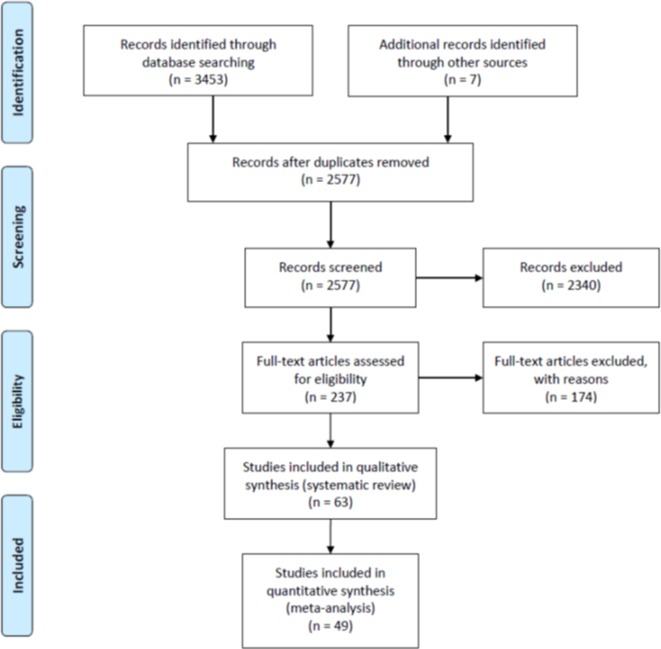
systematic review (SR) and meta-analysis (MA) were performed searching the databases PubMed/Medline, CENTRAL, Embase, Web of Science, Emcare and PsycInfo until April 2017. We included randomised controlled trials (RCTs) in adults (≥18 years) with RA, SpA and HOA/KOA, investigating the effects of exercise or PA promotion according to the public health PA recommendations by the American College of Sports Medicine. The time point of interest was the first assessment after the intervention period. If suitable, data were pooled in a MA using a random-effects model presented as standardised mean difference (SMD).
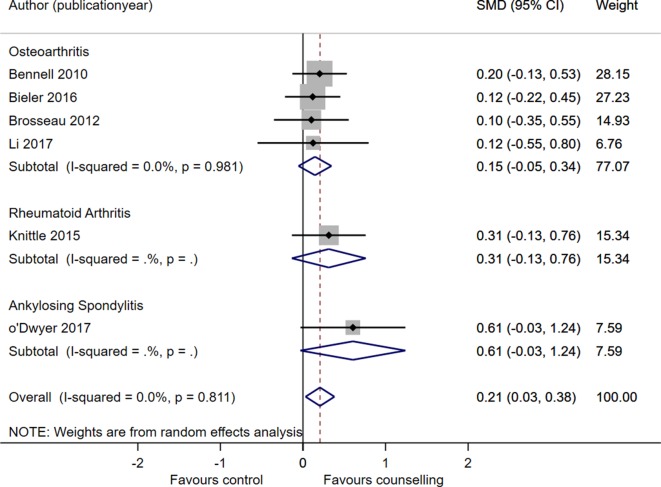
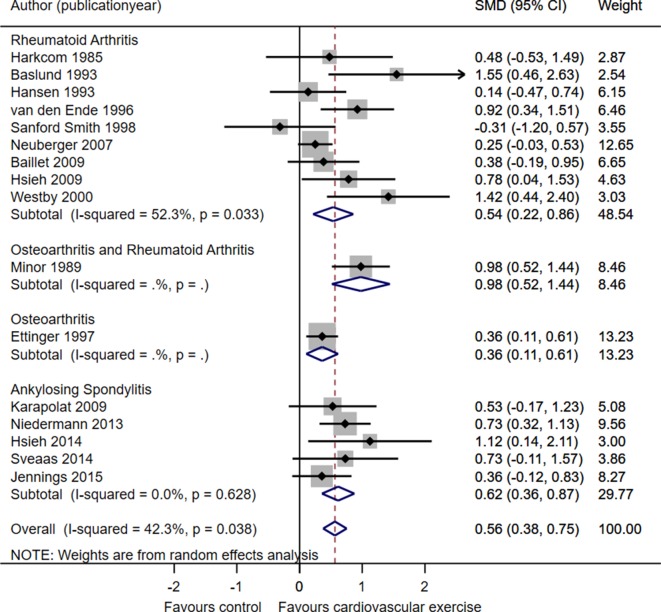
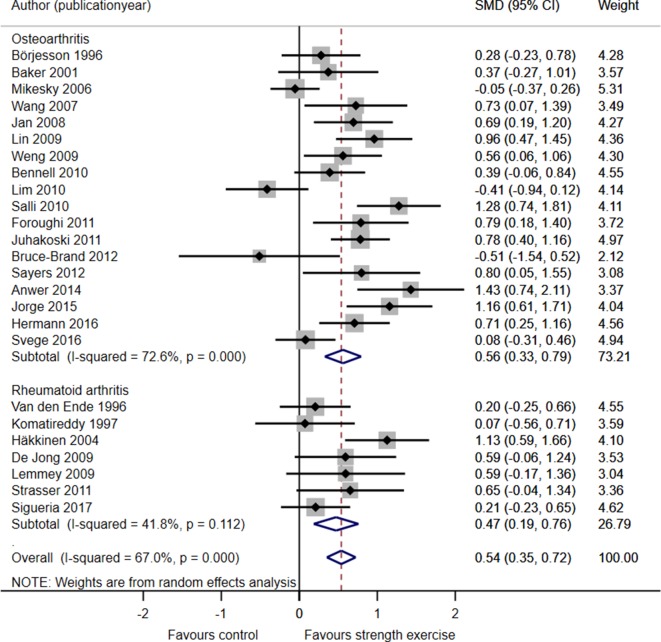
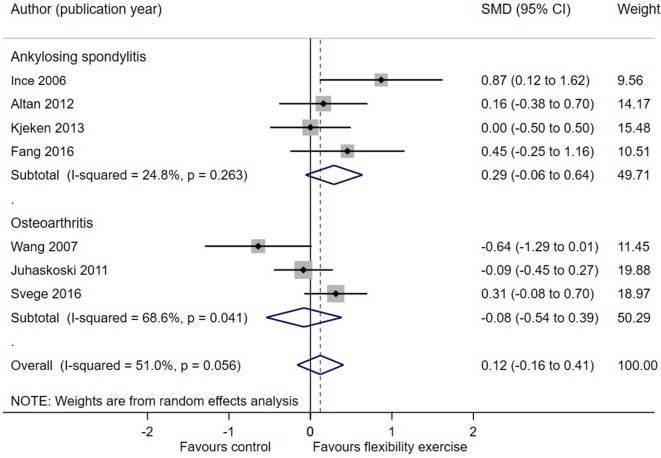
The SR included 63 RCTs, of which 49 (3909 people with RA/SpA/HOA/KOA) were included in the MA. Moderate effects were found of aerobic exercises and resistance training on cardiovascular fitness (SMD 0.56 (95% CI 0.38 to 0.75)) and muscle strength (SMD 0.54 (95% CI 0.35 to 0.72)), respectively, but no effect of combined strength/aerobic/flexibility exercises on flexibility (SMD 0.12 (95% CI -0.16 to 0.41)). PA promotion interventions produced a small increase in PA behaviour (SMD 0.21 (95% CI 0.03 to 0.38)).
Exercises and PA promotion according to public health recommendations for PA improved cardiovascular fitness, muscle strength and PA behaviour, with moderate effect sizes in people with SpA, RA and HOA/KOA.
CRD42017082131.
评估运动和身体活动(PA)促进对类风湿性关节炎(RA)、脊柱关节炎(SpA)以及髋/膝骨关节炎(HOA/KOA)患者心血管健康、肌肉力量、灵活性、神经运动表现(如平衡能力)和日常身体活动的效果。
进行系统评价(SR)和荟萃分析(MA),检索截至2017年4月的PubMed/Medline、CENTRAL、Embase、Web of Science、Emcare和PsycInfo数据库。我们纳入了年龄≥18岁的RA、SpA和HOA/KOA成年患者的随机对照试验(RCT),这些试验根据美国运动医学学院的公共卫生PA建议,研究运动或PA促进的效果。感兴趣的时间点是干预期后的首次评估。如果合适,使用随机效应模型以标准化均数差(SMD)的形式将数据合并到荟萃分析中。
系统评价纳入了63项随机对照试验,其中49项(3909例RA/SpA/HOA/KOA患者)纳入了荟萃分析。有氧运动和抗阻训练分别对心血管健康(SMD 0.56(95%CI 0.38至0.75))和肌肉力量(SMD 0.54(95%CI 0.35至0.72))有中等效果,但力量/有氧/灵活性联合运动对灵活性没有效果(SMD 0.12(95%CI -0.16至0.41))。PA促进干预使PA行为略有增加(SMD 0.21(95%CI 0.03至0.38))。
根据公共卫生PA建议进行的运动和PA促进改善了心血管健康、肌肉力量和PA行为,对SpA、RA和HOA/KOA患者有中等效应量。
CRD42017082131。