Department of Clinical Laboratory, Shanghai General Hospital, Shanghai Jiaotong University School of Medicine, 100 Haining Rd, Shanghai, 200080, People's Republic of China.
Department of Clinical Laboratory, Xiaoshan Hospital, Hangzhou, Zhejiang Province, China.
BMC Microbiol. 2020 Jun 29;20(1):183. doi: 10.1186/s12866-020-01862-z.
The data on the prevalence of resistance to mupirocin (MUP), fusidic acid (FA) and retapamulin (RET) in methicillin-resistant Staphylococcus aureus (MRSA) from China are still limited. This study aimed to examine these three antibiotics resistance in 1206 MRSA clinical isolates from Eastern China. Phenotypic MUP, FA and RET resistance was determined by minimum inhibitory concentrations (MICs), and genotypic by PCR and DNA sequencing of the mupA/B, fusB-D, cfr, vgaA/Av/A/B/C/E, lsaA-C/E and salA and mutations in ileS, fusA/E, rplC, and 23S RNA V domain. The genetic characteristics of resistance isolates were conducted by pulsed field gel electrophoresis (PFGE) and multilocus sequence typing (MLST).
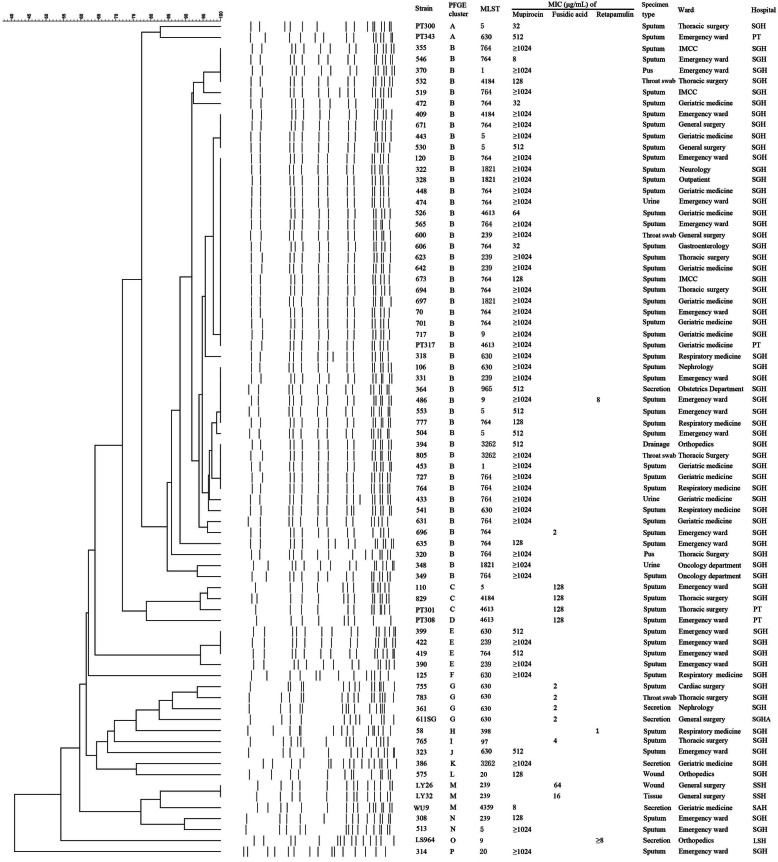
Overall MRSA MUP, FA and RET resistance was low (5.1, 1.0 and 0.3%, respectively). MupA was the mechanism of high-level MUP resistance. All low-level MUP resistance isolates possessed an equivocal mutation N213D in IleS; of these, 2 reported an additional V588F mutation with an impact on the Rossman fold. FusA mutations, such as L461K, H457Q, H457Y and V90I were the primary FA mechanisms among high-level resistance isolates, most of which also contained fusC; however, all low-level resistance strains carried fusB. Except lsaE gene detected in one isolate, no other resistance mechanisms tested were found among RET-resistant isolates. Additionally, sixteen PFGE types (A-P) were observed, among which type B was the most common (49/76, 64.5%), followed by types E and G (4/76, 5.3% each) and types C and M (3/76, 3.9% each). All resistant strains were divided into 15 ST types by MLST. ST764 (24/76, 31.6%), ST630 (11/76, 14.5%), ST239 (9/76, 11.8%) and ST5 (7/76, 9.2%) were the major types. PFGE type B isolates with the aforementioned STs were mainly found in mupirocin resistant isolates.
MUP, FA and RET exhibited highly activity against the MRSA isolates. Acquired genes and chromosome-borne genes mutations were responsible for MUP and FA resistance; however, the mechanism for some RET-resistant isolates remains to be further elucidated. Also, the surveillance to MUP in MRSA should be strengthened to prevent elevated resistance due to the expansion of clones.
目前中国耐甲氧西林金黄色葡萄球菌(MRSA)中莫匹罗星(MUP)、夫西地酸(FA)和瑞他帕林(RET)耐药的数据仍然有限。本研究旨在检测华东地区 1206 株 MRSA 临床分离株对这三种抗生素的耐药性。采用最低抑菌浓度(MIC)法检测 MUP、FA 和 RET 的表型耐药性,采用 PCR 和 mupA/B、fusB-D、cfr、vgaA/Av/A/B/C/E、lsaA-C/E 和 salA 以及 ileS、fusA/E、rplC 和 23S RNA V 结构域基因突变的 DNA 测序检测基因型耐药性。采用脉冲场凝胶电泳(PFGE)和多位点序列分型(MLST)分析耐药株的遗传特征。
MRSA 的 MUP、FA 和 RET 总耐药率较低(分别为 5.1%、1.0%和 0.3%)。MupA 是高水平 MUP 耐药的机制。所有低水平 MUP 耐药株均在 IleS 中携带可疑突变 N213D;其中,2 株报告了另外的 V588F 突变,该突变影响 Rossman 折叠。高水平耐药株的主要 FA 机制是 FusA 突变,如 L461K、H457Q、H457Y 和 V90I,其中大多数还含有 fusC;然而,所有低水平耐药株均携带 fusB。除了在一个分离株中检测到 lsaE 基因外,在 RET 耐药分离株中未发现其他耐药机制。此外,观察到 16 种 PFGE 类型(A-P),其中 B 型最常见(49/76,64.5%),其次是 E 型和 G 型(各 4/76,5.3%)和 C 型和 M 型(各 3/76,3.9%)。MLST 将所有耐药株分为 15 种 ST 型。ST764(24/76,31.6%)、ST630(11/76,14.5%)、ST239(9/76,11.8%)和 ST5(7/76,9.2%)是主要类型。B 型 PFGE 型与上述 ST 型主要存在于耐莫匹罗星的分离株中。
MUP、FA 和 RET 对 MRSA 分离株具有高度活性。获得的基因和染色体基因的突变是导致 MUP 和 FA 耐药的原因;然而,一些 RET 耐药分离株的机制仍需进一步阐明。此外,应加强对 MRSA 中 MUP 的监测,以防止由于克隆的扩展而导致耐药性升高。