The Liggins Institute, The University of Auckland, Auckland, New Zealand.
The Riddet Institute, Palmerston North, New Zealand.
BMC Gastroenterol. 2020 Jun 29;20(1):204. doi: 10.1186/s12876-020-01352-6.
Adult lactase non-persistence (LNP) is due to low lactase expression, resulting in lactose malabsorption (LM). LNP is a genetic trait, but is typically determined by LM markers including breath H, blood glucose, and urinary galactose after a lactose tolerance test. Known validity of these markers using milk is limited, despite being common practice. Compositional variation, such as β-casein variants, in milk may impact diagnostic efficacy. This study aimed to evaluate the diagnostic accuracy to detect LNP using these commonly measured LM markers after both lactose and milk challenges.
Fourty healthy young women were challenged with 50 g lactose then randomized for separate cross-over visits to ingest 750 mL milk (37.5 g lactose) as conventional (both A1 and A2 β-casein) and A1 β-casein-free (a2 Milk™) milk. Blood, breath and urine were collected prior to and up to 3 h following each challenge. The presence of C/T and G/A polymorphisms, determined by restriction fragment length polymorphism, was used as the diagnostic reference for LNP.
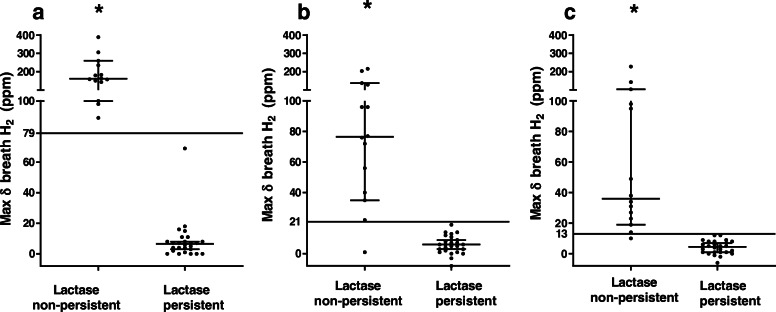
Genetic testing identified 14 out of 40 subjects as having LNP (C/C and G/G). All three LM markers (breath H, plasma glucose and urinary galactose/creatinine) discriminated between lactase persistence (LP) and LNP following lactose challenge with an area under the receiver operating characteristic (ROC) curve (AUC) of 1.00, 0.75 and 0.73, respectively. Plasma glucose and urinary galactose/creatinine were unreliable (AUC < 0.70) after milk ingestion. The specificity of breath H remained high (100%) when milk was used, but sensitivity was reduced with conventional (92.9%) and a2 Milk™ (78.6%) compared to lactose (sensitivities adjusted for lactose content). The breath H optimal cut-off value was lower with a2 Milk™ (13 ppm) than conventional milk (21 ppm). Using existing literature cut-off values the sensitivity and specificity of breath H was greater than plasma glucose to detect LNP following lactose challenge whereas values obtained for urinary galactose/creatinine were lower than the existing literature cut-offs.
This study showed accurate diagnosis of LNP by breath H irrespective of the substrate used, although the diagnostic threshold may vary depending on the lactose substrate or the composition of the milk.
ACTRN12616001694404 . Registered prospectively on December 9, 2016.
成人乳糖酶非持续性(LNP)是由于乳糖酶表达水平低,导致乳糖吸收不良(LM)。LNP 是一种遗传特征,但通常由乳糖耐量试验后的呼气氢(breath H)、血糖和尿半乳糖/肌酐等 LM 标志物来确定。尽管这是常见的做法,但已知这些标志物使用牛奶的有效性是有限的。牛奶中的组成变化,如β-酪蛋白变体,可能会影响诊断效果。本研究旨在评估使用这些常用的 LM 标志物在乳糖和牛奶挑战后检测 LNP 的诊断准确性。
40 名健康年轻女性接受 50g 乳糖挑战,然后随机进行单独的交叉访问,分别摄入 750ml 牛奶(37.5g 乳糖),包括常规牛奶(A1 和 A2β-酪蛋白)和 A1β-酪蛋白缺失(a2 MilkTM)牛奶。在每次挑战之前和之后最多 3 小时采集血液、呼气和尿液。通过限制性片段长度多态性确定 C/T 和 G/A 多态性,作为 LNP 的诊断参考。
基因检测确定 40 名受试者中有 14 名存在 LNP(C/C 和 G/G)。所有三种 LM 标志物(呼气 H、血浆葡萄糖和尿半乳糖/肌酐)在乳糖挑战后均能区分乳糖酶持续存在(LP)和 LNP,受试者工作特征(ROC)曲线下面积(AUC)分别为 1.00、0.75 和 0.73。牛奶摄入后,血浆葡萄糖和尿半乳糖/肌酐不可靠(AUC<0.70)。呼气 H 的特异性在使用牛奶时仍保持 100%,但与乳糖相比,常规牛奶(92.9%)和 a2 MilkTM(78.6%)的敏感性降低(灵敏度根据乳糖含量进行调整)。使用呼气 H 的最佳截断值低于常规牛奶(13ppm),但高于 a2 MilkTM(78.6%)。使用现有文献的截断值,呼气 H 的敏感性和特异性大于血浆葡萄糖,可用于检测乳糖挑战后的 LNP,而尿半乳糖/肌酐的值则低于现有文献的截断值。
本研究表明,通过呼气 H 可以准确诊断 LNP,无论使用的底物如何,尽管诊断阈值可能因乳糖底物或牛奶组成而异。
ACTRN12616001694404。于 2016 年 12 月 9 日前瞻性注册。