Fisiosur I+D Research Institute, Garrucha, Almería, Spain.
Deparment Nursing, Physiotherapy and Medicine, University of Almeria, Almeria, Spain.
Trials. 2020 Jun 29;21(1):588. doi: 10.1186/s13063-020-04494-w.
In December 2019, 27 cases of pneumonia, of unknown cause, were identified in the province of Hubei (China). The WHO declared the situation as a Public Health Emergency of International Concern, and it was finally declared a global pandemic on March 11, 2020. The Spanish Government obliges the entire population to remain confined to their homes, with the exception of essential basic services, to stop the spread of COVID-19. Home isolation implies a notable physical deconditioning. Telerehabilitation methods have reported positive experiences, and we propose to study in affected patients of COVID-19, due to the general house confinement of the entire Spanish population.
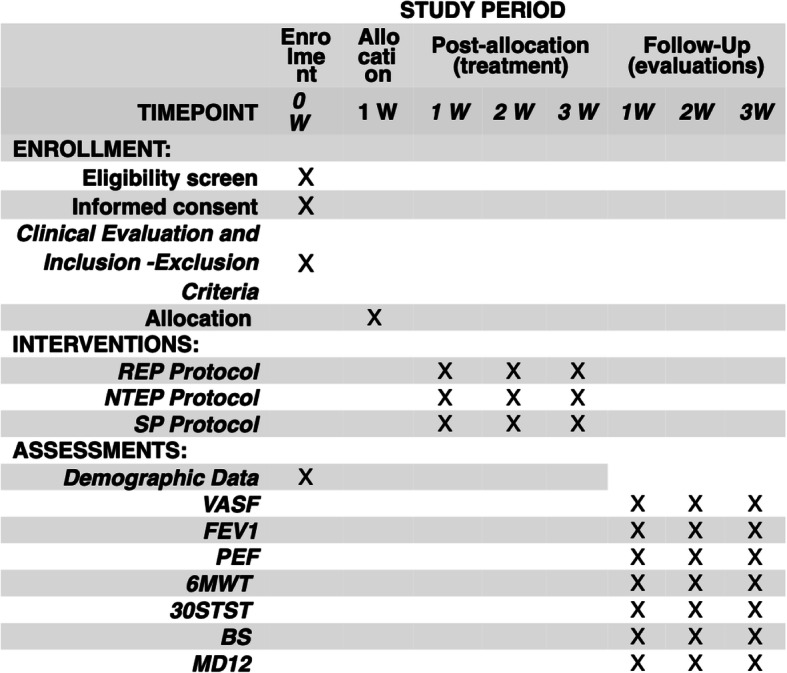
Patients will be recruited in the regions of Andalusia, Murcia, and Valencia (Spain). Patients will remain confined to their homes, and there, they will carry out their assigned exercise program, which will be controlled telematically. Evaluators will attend to carry out all measurements at the beginning, during, and end of the study, telematically controlled. The patients will be randomly divided into three groups, two of them will perform a home exercise program (breathing exercises or non-specific exercises for muscle toning) and the third group will perform sedentary activities, using mental activation techniques, and will act as a sham group. We will evaluate respiratory variables and other variables of the physical state through physical tests, effort, and perceived fatigue. The data will be statistically analyzed, and the hypotheses will be tested between the groups, using the SPSS software, v.24, considering a 95% confidence interval.
We will analyze the results, in terms of the level of fatigue and perceived exertion, physical health, and maintenance of respiratory activity of two types of exercise programs, toning and respiratory, applied in patients affected by COVID-19 during the period of home confinement. We intend to investigate a field not previously studied, such as the repercussion of carrying out a toning and respiratory exercise program in these patients, in historical circumstances that no one had previously observed in Spain, since the general population has never been forced to remain confined in their homes, due to a pandemic infection, by a coronavirus (COVID-19). Observing the effects that these two home exercise programs could produce in patients infected with COVID-19, we will try to better analyze and understand the mechanisms that are associated with the worsening of breathing in this type of patient.
Brazilian Clinical Trial Registry RBR-6m69fc . Registered on March 31, 2020.
2019 年 12 月,在中国湖北省发现了 27 例不明原因的肺炎病例。世界卫生组织宣布该情况为国际关注的突发公共卫生事件,并最终于 2020 年 3 月 11 日宣布该情况为全球大流行。西班牙政府要求全体民众除了基本的必要服务外,都必须留在家中,以阻止 COVID-19 的传播。家庭隔离意味着身体明显的不适。远程康复方法已经报告了积极的经验,我们建议在 COVID-19 的受影响患者中进行研究,因为整个西班牙人口都被普遍居家隔离。
患者将在安达卢西亚、穆尔西亚和瓦伦西亚(西班牙)地区招募。患者将留在家中,并在那里执行他们指定的锻炼计划,该计划将通过远程进行控制。评估员将远程进行所有测量,以开始、进行和结束研究。患者将随机分为三组,其中两组将进行家庭锻炼计划(呼吸练习或非特定的肌肉锻炼),第三组将进行久坐活动,使用心理激活技术,并作为假组。我们将通过体力测试、努力和感知疲劳来评估呼吸变量和身体状态的其他变量。数据将进行统计分析,并使用 SPSS 软件 v.24 测试组间假设,置信区间为 95%。
我们将分析两种类型的锻炼计划(肌肉锻炼和呼吸锻炼)在因 COVID-19 而居家隔离的患者中的应用,在疲劳和感知疲劳、身体健康和维持呼吸活动方面的结果。我们打算研究一个以前没有研究过的领域,例如在西班牙从未观察到的这种情况下,对这些患者进行肌肉锻炼和呼吸锻炼计划的影响,因为整个西班牙人口从未因冠状病毒(COVID-19)感染而被迫留在家中。观察这两种家庭锻炼计划对感染 COVID-19 的患者可能产生的影响,我们将尝试更好地分析和理解与这类患者呼吸恶化相关的机制。
巴西临床试验注册 RBR-6m69fc。注册于 2020 年 3 月 31 日。