Department of Applied Chemistry, The University of Tokyo, Tokyo 113-8654, Japan.
Research Center for Advanced Science and Technology, The University of Tokyo, Tokyo 153-8904, Japan.
Proc Natl Acad Sci U S A. 2020 Jul 14;117(28):16373-16382. doi: 10.1073/pnas.2000895117. Epub 2020 Jun 29.
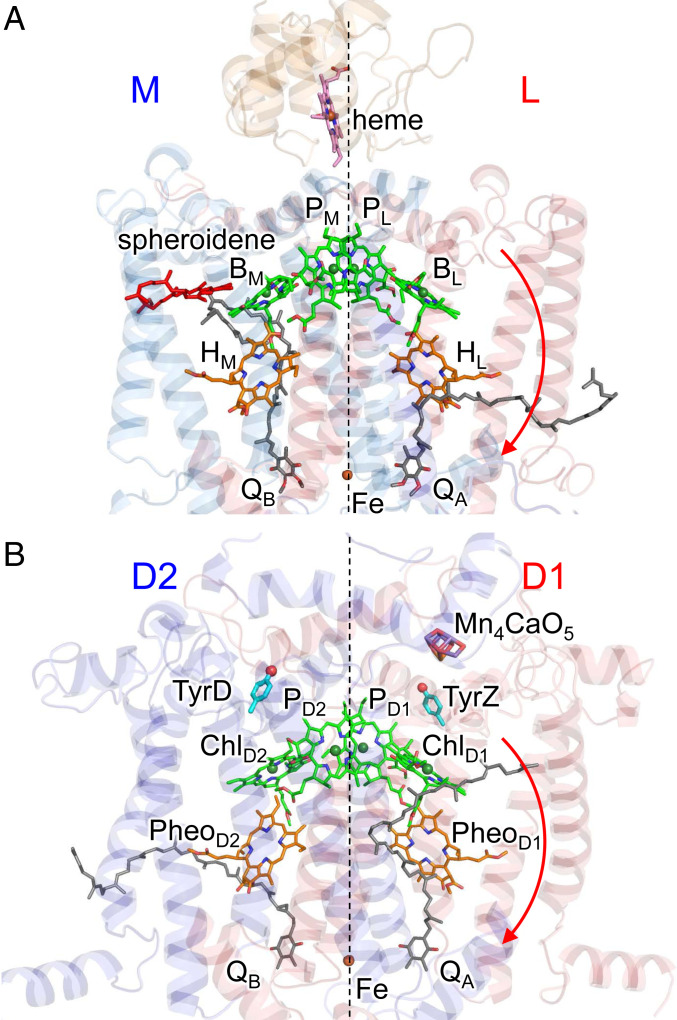
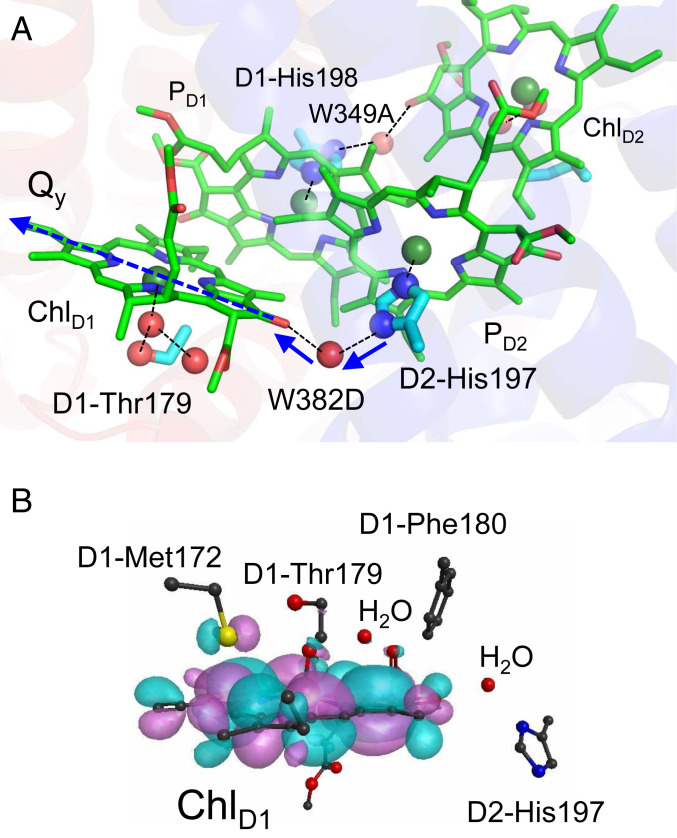
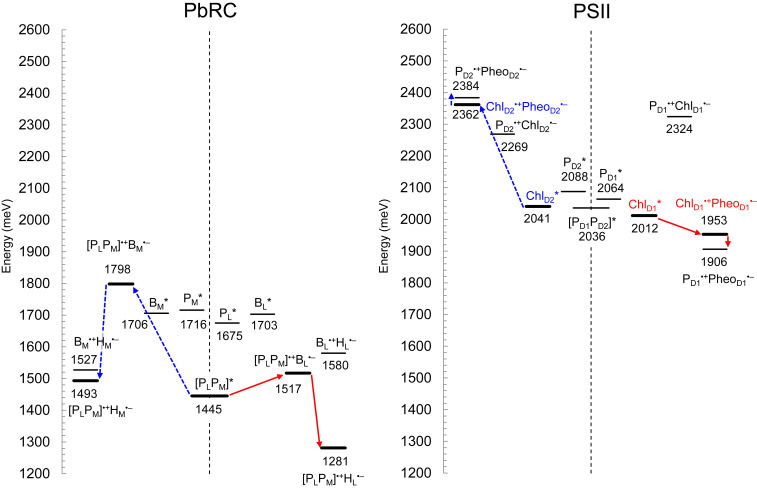
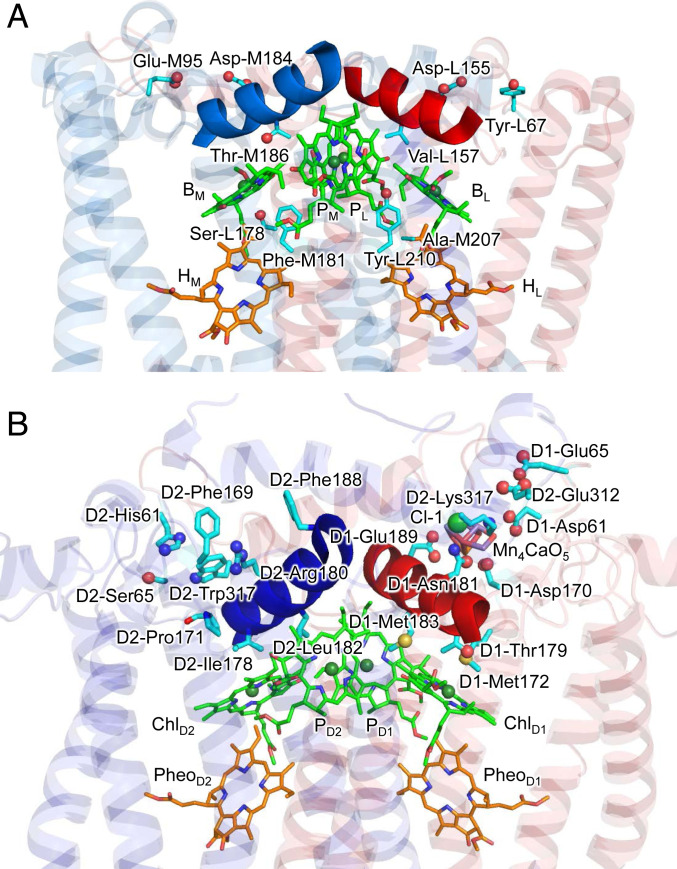
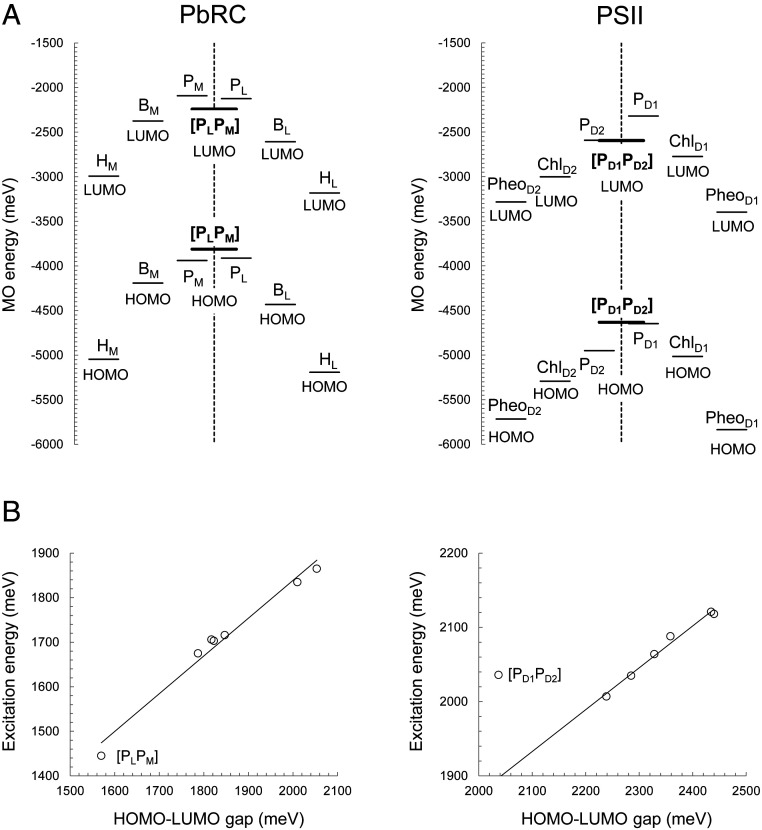
In photosynthetic reaction centers from purple bacteria (PbRC) and the water-oxidizing enzyme, photosystem II (PSII), charge separation occurs along one of the two symmetrical electron-transfer branches. Here we report the microscopic origin of the unidirectional charge separation, fully considering electron-hole interaction, electronic coupling of the pigments, and electrostatic interaction with the polarizable entire protein environments. The electronic coupling between the pair of bacteriochlorophylls is large in PbRC, forming a delocalized excited state with the lowest excitation energy (i.e., the special pair). The charge-separated state in the active branch is stabilized by uncharged polar residues in the transmembrane region and charged residues on the cytochrome binding surface. In contrast, the accessory chlorophyll in the D1 protein (Chl) has the lowest excitation energy in PSII. The charge-separated state involves Chl and is stabilized predominantly by charged residues near the MnCaO cluster and the proceeding proton-transfer pathway. It seems likely that the acquirement of water-splitting ability makes Chl the initial electron donor in PSII.
在紫色细菌(PbRC)的光合反应中心和水氧化酶——光系统 II(PSII)中,电荷分离沿着两个对称的电子传递分支之一发生。在这里,我们充分考虑电子-空穴相互作用、色素的电子耦合以及与可极化整个蛋白质环境的静电相互作用,报道了单向电荷分离的微观起源。PbRC 中一对细菌叶绿素之间的电子耦合很大,形成了具有最低激发能的离域激发态(即特殊对)。在活性分支中的电荷分离态由跨膜区域中的不带电的极性残基和细胞色素结合表面上的带电残基稳定。相比之下,PSII 中 D1 蛋白中的辅助叶绿素具有最低的激发能。电荷分离态涉及 Chl,主要由 MnCaO 簇附近的带电残基和随后的质子转移途径稳定。似乎获得水分解能力使得 Chl 成为 PSII 中的初始电子供体。