Department of Cancer Epidemiology, H. Lee Moffitt Cancer Center and Research Institute, Tampa, FL, USA.
Department of Cancer Physiology, H. Lee Moffitt Cancer Center and Research Institute, Tampa, FL, USA.
Sci Rep. 2020 Jun 29;10(1):10528. doi: 10.1038/s41598-020-67378-8.
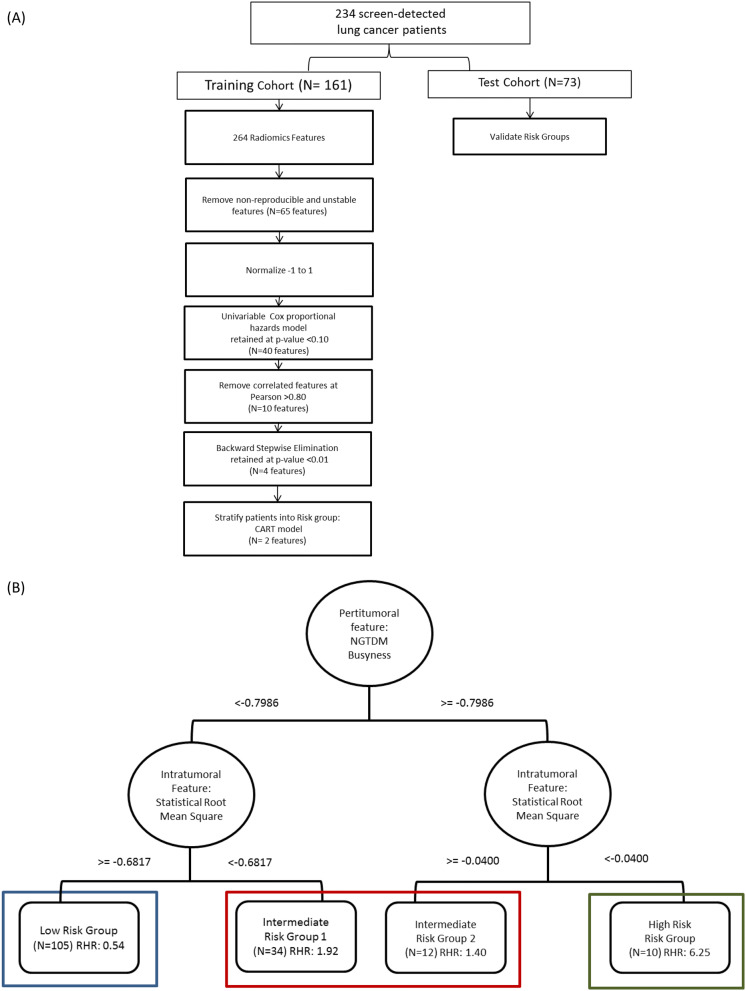
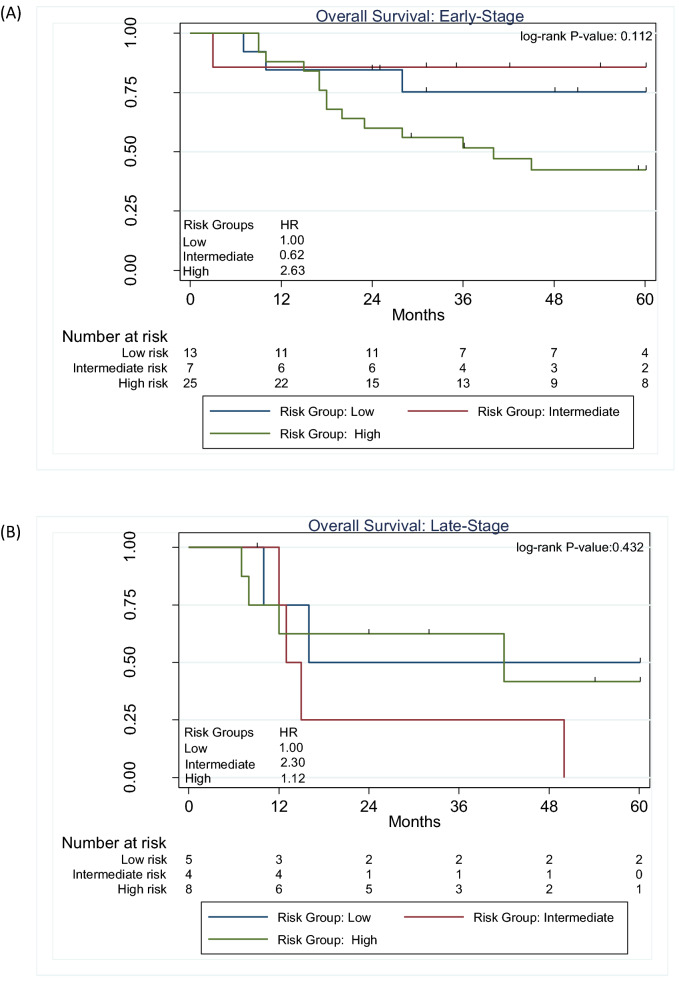
The National Lung Screening Trial (NLST) demonstrated that screening with low-dose computed tomography (LDCT) is associated with a 20% reduction in lung cancer mortality. One potential limitation of LDCT screening is overdiagnosis of slow growing and indolent cancers. In this study, peritumoral and intratumoral radiomics was used to identify a vulnerable subset of lung patients associated with poor survival outcomes. Incident lung cancer patients from the NLST were split into training and test cohorts and an external cohort of non-screen detected adenocarcinomas was used for further validation. After removing redundant and non-reproducible radiomics features, backward elimination analyses identified a single model which was subjected to Classification and Regression Tree to stratify patients into three risk-groups based on two radiomics features (NGTDM Busyness and Statistical Root Mean Square [RMS]). The final model was validated in the test cohort and the cohort of non-screen detected adenocarcinomas. Using a radio-genomics dataset, Statistical RMS was significantly associated with FOXF2 gene by both correlation and two-group analyses. Our rigorous approach generated a novel radiomics model that identified a vulnerable high-risk group of early stage patients associated with poor outcomes. These patients may require aggressive follow-up and/or adjuvant therapy to mitigate their poor outcomes.
国家肺癌筛查试验 (NLST) 表明,低剂量计算机断层扫描 (LDCT) 筛查可使肺癌死亡率降低 20%。LDCT 筛查的一个潜在局限性是过度诊断生长缓慢和惰性的癌症。在这项研究中,使用肿瘤周围和肿瘤内放射组学来识别与不良生存结果相关的易患肺癌患者亚组。NLST 中的新发肺癌患者被分为训练和测试队列,以及一个非筛查检测的腺癌外部队列用于进一步验证。在去除冗余和不可重复的放射组学特征后,向后消除分析确定了一个单一的模型,该模型经过分类和回归树分析,根据两个放射组学特征(NGTDM 忙碌度和统计均方根 [RMS])将患者分为三个风险组。最终模型在测试队列和非筛查检测腺癌队列中进行了验证。使用放射基因组数据集,通过相关性和两组分析,统计 RMS 与 FOXF2 基因显著相关。我们严格的方法生成了一个新的放射组学模型,该模型确定了一个与不良预后相关的早期高危脆弱患者群体。这些患者可能需要积极的随访和/或辅助治疗来减轻他们的不良预后。