
当前及未来气候条件下喜马拉雅冰川黑碳沉积的来源
Sources of Black Carbon Deposition to the Himalayan Glaciers in Current and Future Climates.
作者信息
Alvarado Matthew J, Winijkul Ekbordin, Adams-Selin Rebecca, Hunt Eric, Brodowski Christopher, Lonsdale Chantelle R, Shindell Drew T, Faluvegi Gregory, Kleiman Gary, Mosier Thomas M, Kumar Rajesh
机构信息
Atmospheric and Environmental Research, Lexington, MA, USA.
Nicholas School of the Environment, Duke University, Durham, NC, USA.
出版信息
J Geophys Res Atmos. 2018 Jul 27;123(4):7482-7505. doi: 10.1029/2018jd029049. Epub 2018 Jun 27.
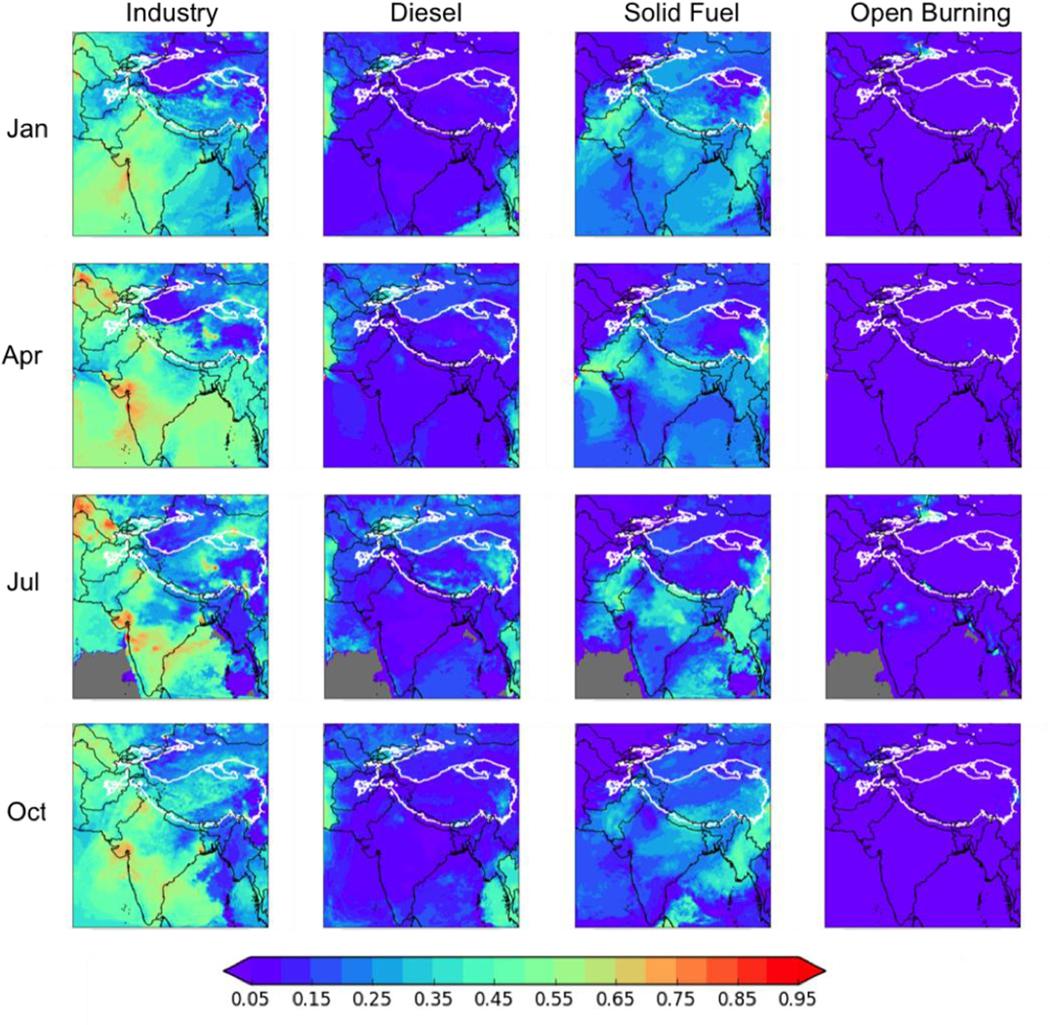
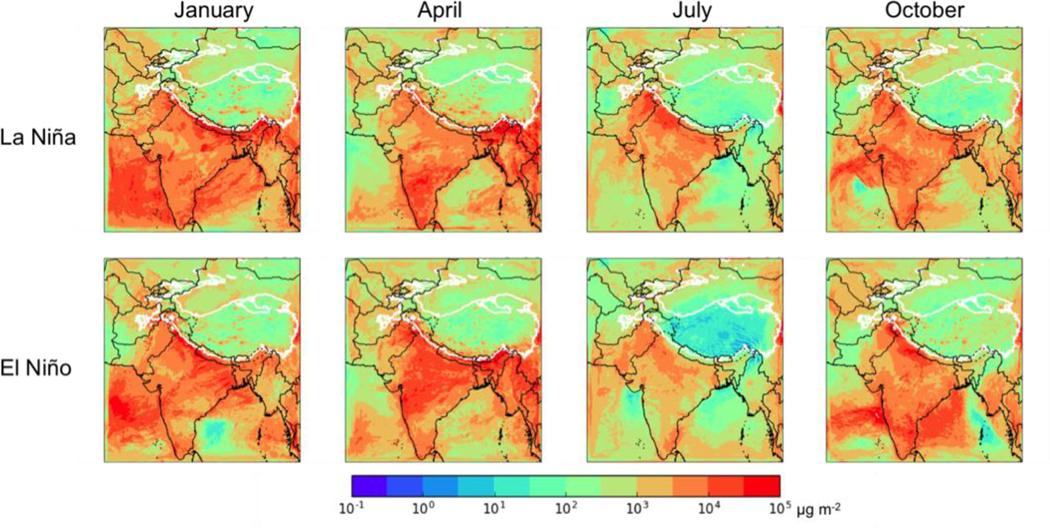
WRF-Chem and a modified version of the ECLIPSE 5a emission inventory were used to investigate the sources impacting black carbon (BC) deposition to the Himalaya, Karakoram, and Hindu Kush (HKHK) region. This work extends previous studies by simulating deposition to the HKHK region not only under current conditions, but also in the 2040-2050 period under two realistic emission scenarios and in three different phases of the El Niño-Southern Oscillation (ENSO). Under current conditions, sources from outside our South Asian modelling domain have a similar impact on total BC deposition to the HKHK region (35-87%, varying with month) as South Asian anthropogenic sources (13-62%). Industry (primarily brick kilns) and residential solid fuel burning combined account for 45-66% of the in-domain anthropogenic BC deposition to the HKHK region. Under a no further control emission scenario for 2040-2050, the relative contributions to BC deposition in the HKHK region are more skewed toward in-domain anthropogenic sources (45-65%) relative to sources outside the domain (26-52%). The in-domain anthropogenic BC deposition has significant contributions from industry (32-42%), solid fuel burning (17-28%), and diesel fuel burning (17-27%). Under a scenario in which emissions in South Asia are mitigated, the relative cotribution from South Asian anthropogenic sources is significantly reduced to 11-34%. The changes due to phase of ENSO do not seem to follow consistent patterns with ENSO. Future work will use the high-resolution deposition maps developed here to determine the impact of different sources of BC on glacier melt and water availability in the region.
利用WRF-Chem模型和经过修改的ECLIPSE 5a排放清单,研究了影响喜马拉雅、喀喇昆仑和兴都库什(HKHK)地区黑碳(BC)沉降的来源。这项工作不仅模拟了当前条件下HKHK地区的沉降情况,还模拟了2040-2050年期间在两种现实排放情景以及厄尔尼诺-南方涛动(ENSO)三个不同阶段下的沉降情况,从而扩展了以往的研究。在当前条件下,南亚建模区域以外的源对HKHK地区BC总沉降的影响(35%-87%,随月份变化)与南亚人为源(13%-62%)相似。工业(主要是砖窑)和居民固体燃料燃烧合计占该区域内人为BC沉降到HKHK地区的45%-66%。在2040-2050年无进一步控制排放情景下,相对于区域外的源(26%-52%),HKHK地区BC沉降的相对贡献更偏向于区域内人为源(45%-65%)。区域内人为BC沉降有很大一部分来自工业(32%-42%)、固体燃料燃烧(17%-28%)和柴油燃料燃烧(17%-27%)。在南亚排放得到缓解的情景下,南亚人为源的相对贡献显著降至11%-34%。ENSO不同阶段导致的变化似乎与ENSO没有一致的模式。未来的工作将利用这里绘制的高分辨率沉降地图,来确定不同BC源对该地区冰川融化和水资源可利用性的影响。







 Zotero 插件