Department of Biochemistry, University of Cambridge, 80 Tennis Court Road, Cambridge CB2 1GA, UK.
Department of Chemistry, University of Cambridge, Lensfield Road, Cambridge CB2 1EW, UK.
Nucleic Acids Res. 2020 Aug 20;48(14):8099-8112. doi: 10.1093/nar/gkaa539.
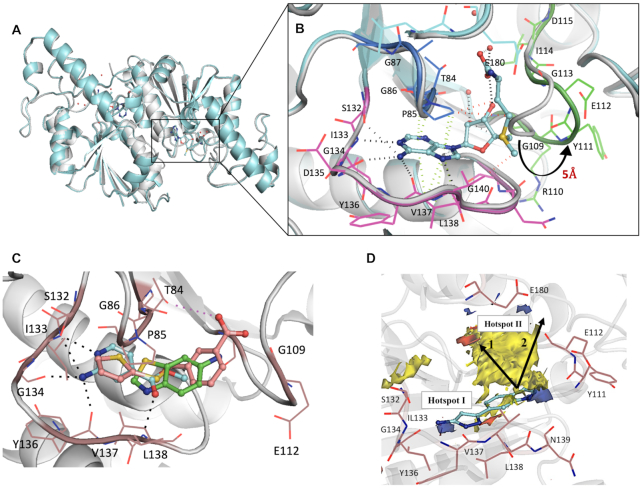
Translational frameshift errors are often deleterious to the synthesis of functional proteins and could therefore be promoted therapeutically to kill bacteria. TrmD (tRNA-(N(1)G37) methyltransferase) is an essential tRNA modification enzyme in bacteria that prevents +1 errors in the reading frame during protein translation and represents an attractive potential target for the development of new antibiotics. Here, we describe the application of a structure-guided fragment-based drug discovery approach to the design of a new class of inhibitors against TrmD in Mycobacterium abscessus. Fragment library screening, followed by structure-guided chemical elaboration of hits, led to the rapid development of drug-like molecules with potent in vitro TrmD inhibitory activity. Several of these compounds exhibit activity against planktonic M. abscessus and M. tuberculosis as well as against intracellular M. abscessus and M. leprae, indicating their potential as the basis for a novel class of broad-spectrum mycobacterial drugs.
翻译移码突变错误通常对功能性蛋白质的合成有害,因此可以通过治疗来促进其发生,从而杀死细菌。TrmD(tRNA-(N(1)G37)甲基转移酶)是细菌中一种必需的 tRNA 修饰酶,可防止蛋白质翻译过程中读码框中的+1 错误,是开发新型抗生素的有吸引力的潜在目标。在这里,我们描述了一种基于结构的片段药物发现方法在设计针对脓肿分枝杆菌 TrmD 的新型抑制剂中的应用。片段文库筛选,然后对命中物进行基于结构的化学修饰,快速开发出具有强效体外 TrmD 抑制活性的类药物分子。这些化合物中的几种对浮游生物状态的脓肿分枝杆菌和结核分枝杆菌以及胞内脓肿分枝杆菌和麻风分枝杆菌均具有活性,表明它们有可能成为一类新型的广谱分枝杆菌药物的基础。