Department of Radiation Medicine, Roswell Park Comprehensive Cancer Center, Buffalo, New York.
Department of Radiation Medicine, University at Buffalo Jacobs School of Medicine and Biomedical Sciences, The State University of New York, Buffalo.
JAMA Netw Open. 2020 Jun 1;3(6):e207199. doi: 10.1001/jamanetworkopen.2020.7199.
Nonsteroidal anti-inflammatory drugs (NSAIDs), such as aspirin, are commonly prescribed medications with anti-inflammatory and antiplatelet properties used long term to decrease the risk of cardiovascular events. A recent study showed that aspirin was associated with improved survival in patients with head and neck squamous cell carcinoma (HNSCC) who were treated with surgery.
To examine whether use of NSAIDs during definitive chemoradiation therapy (CRT) was associated with improved outcomes in patients with HNSCC.
DESIGN, SETTING, AND PARTICIPANTS: This cohort study analyzed patients with HNSCC who were treated with CRT at a single institution between January 1, 2005, and August 1, 2017. Patient and tumor characteristics included age, race/ethnicity, smoking status, alcohol use, comorbidities (respiratory, cardiovascular, immune, renal, endocrine), disease stage, human papillomavirus status, and treatment duration. Data were analyzed from May 1, 2019, to March 17, 2020.
Patients were dichotomized by NSAID use during treatment.
The association of NSAID use with patterns of failure, disease-specific survival (DSS), and overall survival (OS) was examined using multivariate Cox proportional hazard regression models. Survival estimates for OS and DSS were generated using Kaplan-Meier survival curves.
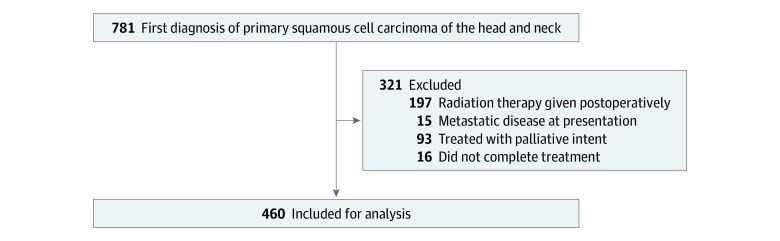
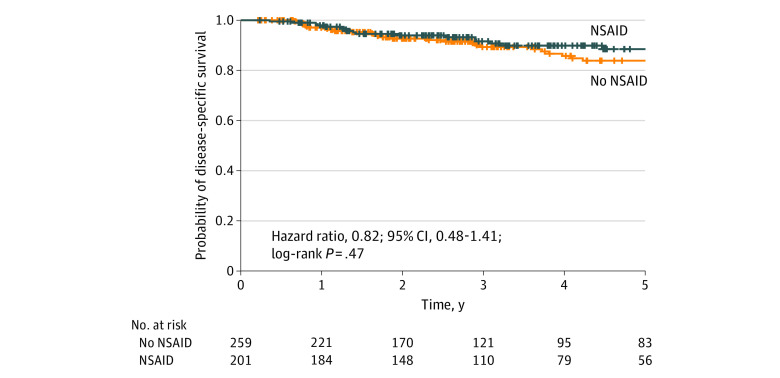
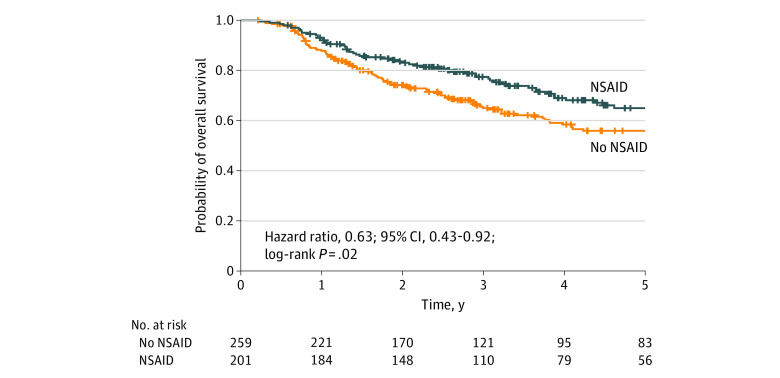
A total of 460 patients (median [interquartile range] age, 60 [53.9-65.6] years; 377 [82.0%] men) were included in the analysis. Among these patients, 201 (43.7%) were taking NSAIDs during treatment. On univariate analysis, NSAID use (hazard ratio [HR], 0.63; 95% CI, 0.43-0.92; P = .02) was associated with better OS. On Cox regression analysis, after backward selection adjustment for potentially confounding factors (age, smoking status, primary tumor site, human papillomavirus status, diabetes, stroke, hyperlipidemia), NSAID use remained significantly associated with better OS (HR, 0.59; 95% CI, 0.38-0.90; P = .02). NSAID use was associated with significantly better OS at 5 years compared with patients who did not take concurrent NSAIDs (63.6% [56 of 88 patients]; 95% CI, 58%-73% vs 56.1% [83 of 148 patients]; 95% CI, 50%-63%; P = .03). NSAID use was not associated with better DSS in univariate (HR, 0.82; 95% CI, 0.48-1.41; P = .47) or multivariate (HR, 0.98; 95% CI, 0.57-1.70; P = .44) analysis. NSAID use was not associated with better response to treatment (HR, 1.44; 95% CI, 0.91-2.27; P = .12) or distant failure (HR, 1.12; 95% CI, 0.68-1.84; P = .65). Change in local control with NSAID use was not statistically significant (HR, 0.59; 95% CI, 0.31-1.10; P = .10).
This cohort study suggests a possible OS advantage for patients taking NSAIDs during chemoradiation for HNSCC. Further studies examining this association are warranted.
非甾体抗炎药(NSAIDs),如阿司匹林,是一种具有抗炎和抗血小板特性的常用处方药,长期使用可降低心血管事件的风险。最近的一项研究表明,在接受手术治疗的头颈部鳞状细胞癌(HNSCC)患者中,阿司匹林的使用与改善生存相关。
研究在 HNSCC 患者接受放化疗期间使用 NSAIDs 是否与改善结局相关。
设计、地点和参与者:本队列研究分析了 2005 年 1 月 1 日至 2017 年 8 月 1 日期间在单一机构接受 CRT 治疗的 HNSCC 患者。患者和肿瘤特征包括年龄、种族/民族、吸烟状况、饮酒情况、合并症(呼吸、心血管、免疫、肾脏、内分泌)、疾病分期、人乳头瘤病毒状态和治疗持续时间。数据于 2019 年 5 月 1 日至 2020 年 3 月 17 日进行分析。
患者根据治疗期间是否使用 NSAIDs 分为两组。
使用多变量 Cox 比例风险回归模型分析 NSAIDs 使用与失败模式、疾病特异性生存(DSS)和总生存(OS)的关联。使用 Kaplan-Meier 生存曲线生成 OS 和 DSS 的生存估计值。
共纳入 460 例患者(中位[四分位距]年龄,60 [53.9-65.6] 岁;377 [82.0%] 为男性)。其中 201 例(43.7%)患者在治疗期间使用 NSAIDs。单因素分析显示,NSAIDs 使用(风险比[HR],0.63;95%CI,0.43-0.92;P=0.02)与 OS 更好相关。在 Cox 回归分析中,经过潜在混杂因素(年龄、吸烟状况、原发肿瘤部位、人乳头瘤病毒状态、糖尿病、中风、高脂血症)的向后选择调整后,NSAIDs 使用与 OS 显著相关(HR,0.59;95%CI,0.38-0.90;P=0.02)。与未同时使用 NSAIDs 的患者相比,NSAIDs 使用患者在 5 年时的 OS 显著更好(63.6%[88 例患者中的 56 例];95%CI,58%-73%vs 56.1%[148 例患者中的 83 例];95%CI,50%-63%;P=0.03)。单因素(HR,0.82;95%CI,0.48-1.41;P=0.47)或多因素(HR,0.98;95%CI,0.57-1.70;P=0.44)分析均显示 NSAIDs 使用与 DSS 无关。NSAIDs 使用与治疗反应(HR,1.44;95%CI,0.91-2.27;P=0.12)或远处失败(HR,1.12;95%CI,0.68-1.84;P=0.65)无关。NSAIDs 使用对局部控制的影响无统计学意义(HR,0.59;95%CI,0.31-1.10;P=0.10)。
本队列研究表明,在 HNSCC 患者接受放化疗期间使用 NSAIDs 可能与 OS 获益相关。需要进一步研究来证实这一关联。