Faculty of Psychology, Technische Universität Dresden, Dresden, Germany.
Department of Psychology, Chemnitz University of Technology, Chemnitz, Germany.
PLoS One. 2020 Jun 30;15(6):e0235253. doi: 10.1371/journal.pone.0235253. eCollection 2020.
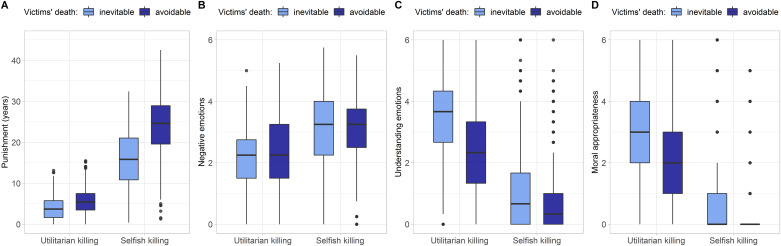
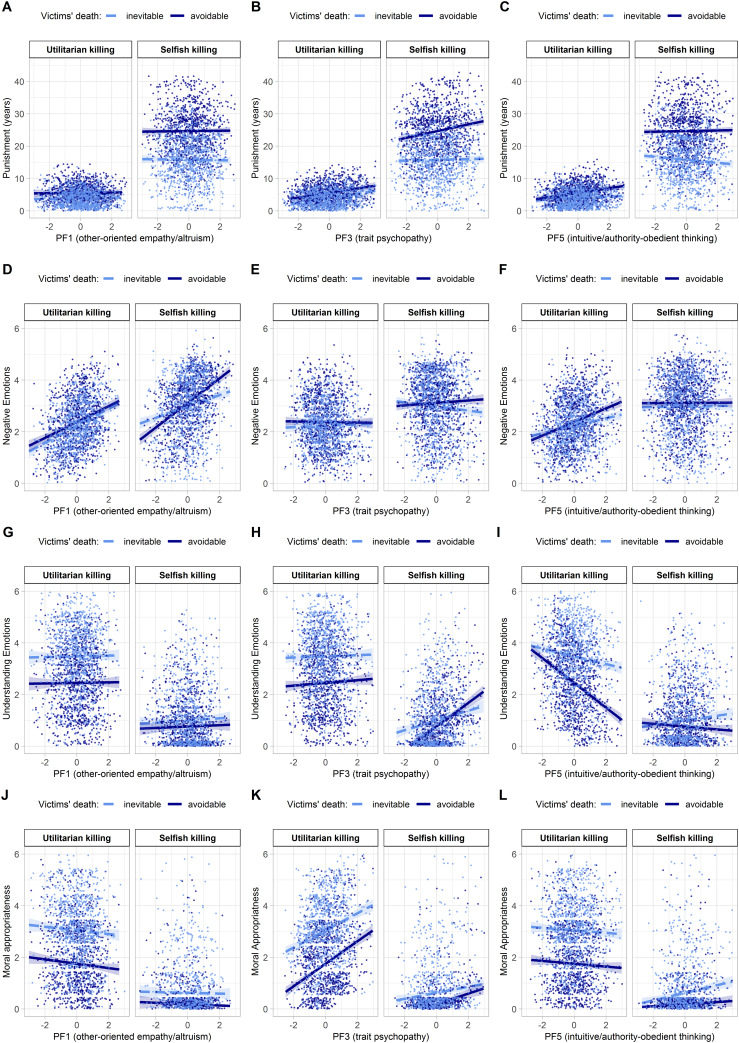
Killing people is universally considered reprehensible and evokes in observers a need to punish perpetrators. Here, we explored how observers' personality is associated with their cognitive, emotional, and punishing reactions towards perpetrators using data from 1,004 participants who responded to a set of fifteen third-party perspective moral dilemmas. Among those, four scenarios (architect, life boat, footbridge, smother for dollars) describing deliberate killings were compared to investigate the role of the content features "motive for killing" (selfish vs. utilitarian) and "evitability of victims' death". Participants' moral appropriateness ratings, emotions towards perpetrators, and assigned punishments revealed complex scenario-personality interactions. Trait psychopathy was associated with harsher punishments in all scenarios but also with less concern about killing in general, an increased moral appreciation of utilitarian motives for killing, and a reduced concern about the killing of avoidable victims. Need for cognition was associated with considering a utilitarian motive for killing as a mitigating factor, while intuitive/authority-obedient thinking was linked to a strong focus on avoidability of harm as an aggravating factor when assigning punishments. Other-oriented empathy, trait anxiety, and justice sensitivity did not account for differences in third-party punishments. Our explorative findings highlight the importance of inter-individual differences for moral decision making and sense of justice.
杀人被普遍认为是应受谴责的行为,会引起观察者对惩罚犯罪者的需求。在这里,我们利用来自 1004 名参与者的数据,探索了观察者的个性如何与其对犯罪者的认知、情感和惩罚反应相关联。这些参与者对一组 15 个第三方视角的道德困境做出了回应。在这 15 个情景中,有 4 个情景(建筑师、救生艇、天桥、为钱捂死)描述了蓄意杀人,我们比较了这些情景以研究“杀人动机”(自私与功利)和“受害者死亡的可避免性”这两个内容特征的作用。参与者对道德行为的适当性评价、对犯罪者的情感以及所分配的惩罚揭示了复杂的情景-个性相互作用。特质性精神变态与所有情景中的更严厉惩罚有关,但也与普遍对杀人的关注度较低、对功利杀人动机的道德评价增加以及对可避免受害者的关注减少有关。认知需求与将功利杀人动机视为减轻因素有关,而直觉/权威服从思维则与在分配惩罚时强烈关注伤害的可避免性有关。他人取向的同理心、特质焦虑和正义感并不能解释第三方惩罚的差异。我们的探索性发现强调了个体差异对道德决策和正义感的重要性。