School of Public Health and Family Medicine, University of Cape Town, Cape Town, South Africa.
London School of Hygiene and Tropical Medicine, London, United Kingdom.
PLoS One. 2020 Jun 30;15(6):e0235471. doi: 10.1371/journal.pone.0235471. eCollection 2020.
High rates of pre-treatment loss to care among persons diagnosed with HIV persist. Linkage to care can be improved through active digitally-based surveillance. Currently, record-keeping for HIV diagnoses in South Africa is paper-based. Aggregated testing data are reported routinely, and only discordant findings result in a specimen being tested at a laboratory and digitised. The Western Cape Province in South Africa has a Provincial Health Data Centre (PHDC) where person-level routine electronic data are consolidated in a single database, leveraging the existence of a unique patient identifier. To facilitate improved HIV surveillance, a pre-carbonated point-of-care test (PoCT) form was piloted, where one copy was routed to a central point and digitised for PHDC inclusion.
We evaluated the utility of the intervention using cross-sectional and retrospective cohort analyses, as well as comparisons with aggregate data. Data were linked to the Patient Master Index of the PHDC using unique identifiers. Prior evidences of HIV within the PHDC were used to differentiate newly diagnosed patients and those retesting, as well as linkage to care and treatment.
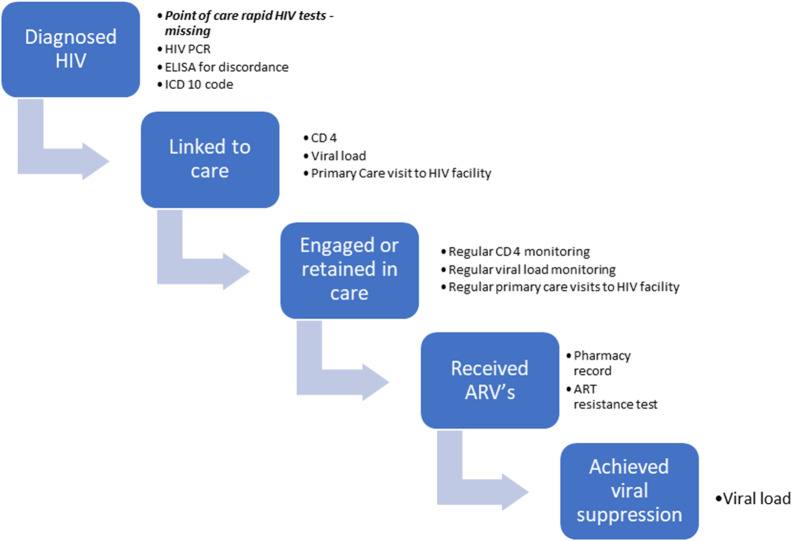
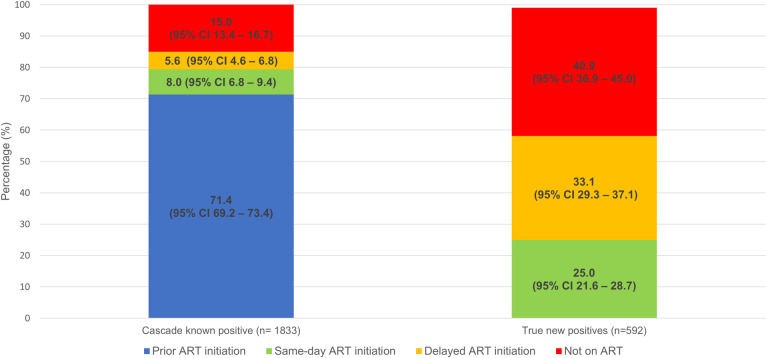
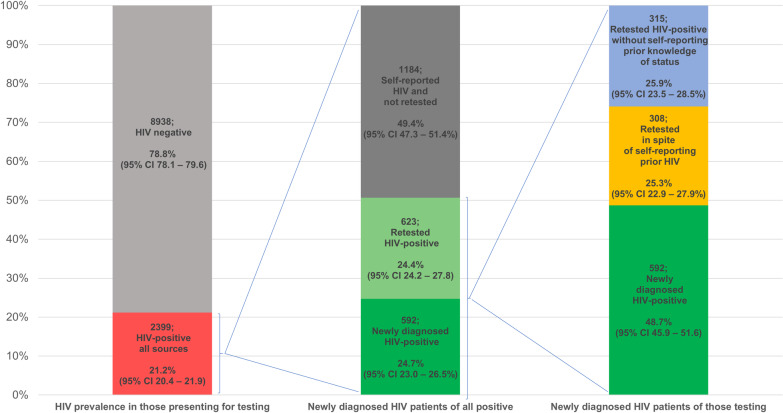
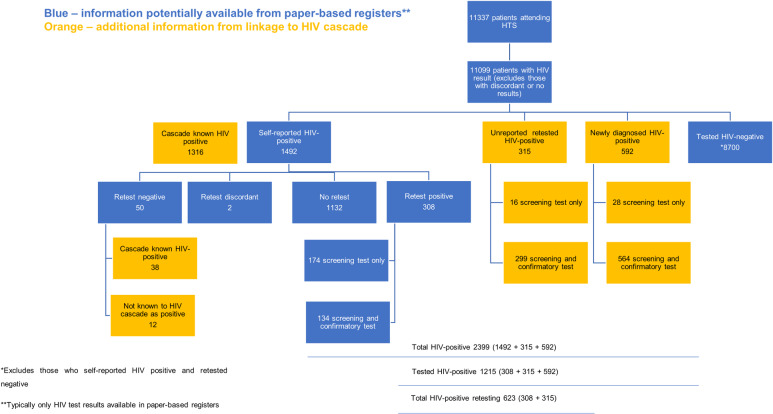
From May 2017 to June 2018, 11337 digitised point-of-care HIV testing records were linked to the PHDC. Overall, 96% of records in the aggregate dataset were digitised, with 97% linked to the PHDC. Of those tested, 79% were female (median age 27 years). Linkage demonstrated that 51.3% (95% CI 48.4-54.1%) of patients testing HIV-positive were retesting. Of those newly diagnosed, 81% (95% CI 77.9-84.3%) were linked to HIV care and 25% (95% CI 21.6-28.7%) were initiated on antiretroviral therapy immediately.
Digitisation of PoCT results provides individuated HIV testing data to assist in linkage to care and in differentiating newly diagnosed patients from positive patients retesting. Actionable and accurate data can improve the measurement of performance towards the UNAIDS 90-90-90 targets.
在被诊断出患有 HIV 的人群中,治疗前的失访率仍然很高。通过积极的数字监测,可以提高与治疗的联系。目前,南非的 HIV 诊断记录是基于纸质的。定期报告汇总检测数据,只有不一致的结果才会导致将标本送到实验室进行检测和数字化。南非西开普省有一个省级卫生数据中心(PHDC),该中心将人员层面的常规电子数据整合到一个数据库中,利用了一个独特的患者标识符的存在。为了促进 HIV 监测的改进,试点了一种预碳酸化即时检测(PoCT)表格,其中一份副本被路由到一个中心点并进行数字化,以便纳入 PHDC。
我们使用横断面和回顾性队列分析以及与汇总数据的比较来评估干预措施的实用性。数据使用唯一标识符与 PHDC 的患者主索引相关联。利用 PHDC 中之前 HIV 的证据来区分新诊断的患者和重新检测的患者,以及与治疗的联系。
从 2017 年 5 月至 2018 年 6 月,11337 份数字化即时检测 HIV 检测记录与 PHDC 相关联。总体而言,汇总数据集中 96%的记录进行了数字化,其中 97%与 PHDC 相关联。在接受检测的人群中,79%为女性(中位数年龄 27 岁)。通过关联,发现 51.3%(95%CI 48.4-54.1%)的 HIV 阳性检测者是重新检测的。在新诊断的患者中,81%(95%CI 77.9-84.3%)与 HIV 护理相关联,25%(95%CI 21.6-28.7%)立即开始接受抗逆转录病毒治疗。
即时检测结果的数字化提供了个体 HIV 检测数据,有助于与治疗相关联,并区分新诊断的患者和重新检测的阳性患者。可操作和准确的数据可以提高对 UNAIDS 90-90-90 目标的衡量。