Laboratory of Molecular Immunology, Department of Microbiology, Immunology and Transplantation, Rega Institute for Medical Research, KU Leuven, Herestraat 49-Box 1042, 3000 Leuven, Belgium.
Neuro Immune Connections & Repair Lab, Department of Immunology and Infection, Biomedical Research Institute, Hasselt University, Martelarenlaan 42, 3500 Hasselt, Belgium.
Int J Mol Sci. 2020 Jun 26;21(12):4558. doi: 10.3390/ijms21124558.
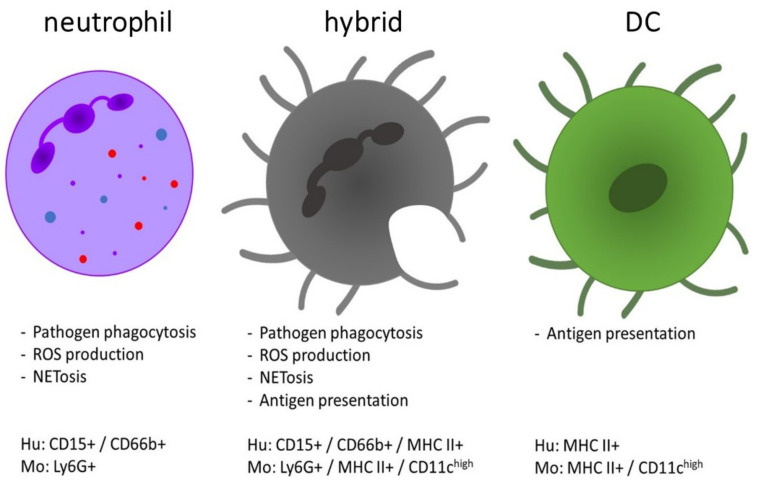
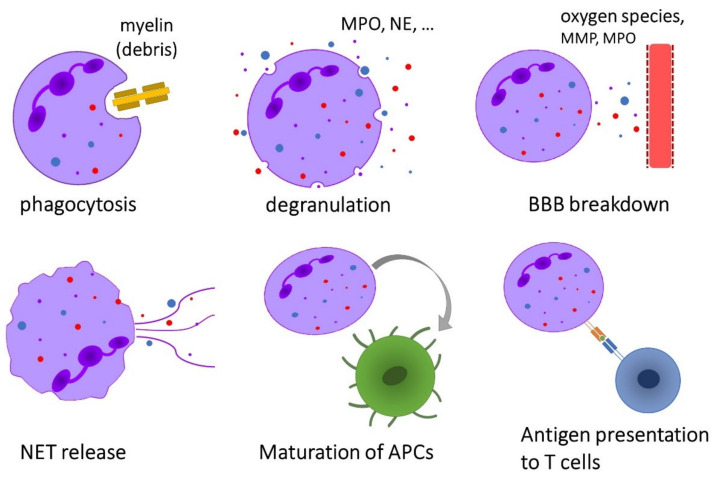
Neutrophils are the most abundant circulating and first-responding innate myeloid cells and have so far been underestimated in the context of multiple sclerosis (MS). MS is the most frequent, immune-mediated, inflammatory disease of the central nervous system. MS is treatable but not curable and its cause(s) and pathogenesis remain elusive. The involvement of neutrophils in MS pathogenesis has been suggested by the use of preclinical animal disease models, as well as on the basis of patient sample analysis. In this review, we provide an overview of the possible mechanisms and functions by which neutrophils may contribute to the development and pathology of MS. Neutrophils display a broad variety of effector functions enabling disease pathogenesis, including (1) the release of inflammatory mediators and enzymes, such as interleukin-1β, myeloperoxidase and various proteinases, (2) destruction and phagocytosis of myelin (as debris), (3) release of neutrophil extracellular traps, (4) production of reactive oxygen species, (5) breakdown of the blood-brain barrier and (6) generation and presentation of autoantigens. An important question relates to the issue of whether neutrophils exhibit a predominantly proinflammatory function or are also implicated in the resolution of chronic inflammatory responses in MS.
中性粒细胞是最丰富的循环和第一反应先天髓样细胞,迄今为止在多发性硬化症(MS)的背景下被低估了。MS 是中枢神经系统最常见的、免疫介导的、炎症性疾病。MS 是可以治疗的,但不能治愈,其病因和发病机制仍然难以捉摸。中性粒细胞在 MS 发病机制中的作用已被临床前动物疾病模型的应用以及对患者样本的分析所证实。在这篇综述中,我们提供了中性粒细胞可能有助于 MS 发展和病理学的可能机制和功能的概述。中性粒细胞表现出多种效应功能,包括(1)释放炎症介质和酶,如白细胞介素-1β、髓过氧化物酶和各种蛋白酶;(2)髓鞘的破坏和吞噬(作为碎片);(3)中性粒细胞胞外陷阱的释放;(4)活性氧的产生;(5)血脑屏障的破坏;(6)自身抗原的产生和呈递。一个重要的问题涉及到中性粒细胞是否表现出主要的促炎功能,或者是否也与 MS 中慢性炎症反应的消退有关。