Department of Medical Microbiology and Nanobiomedical Engineering, Medical University of Bialystok, Bialystok 15-222, Poland.
Faculty of Chemistry, University of Bialystok, Bialystok 15-245, Poland.
Int J Nanomedicine. 2020 Jun 24;15:4573-4589. doi: 10.2147/IJN.S255170. eCollection 2020.
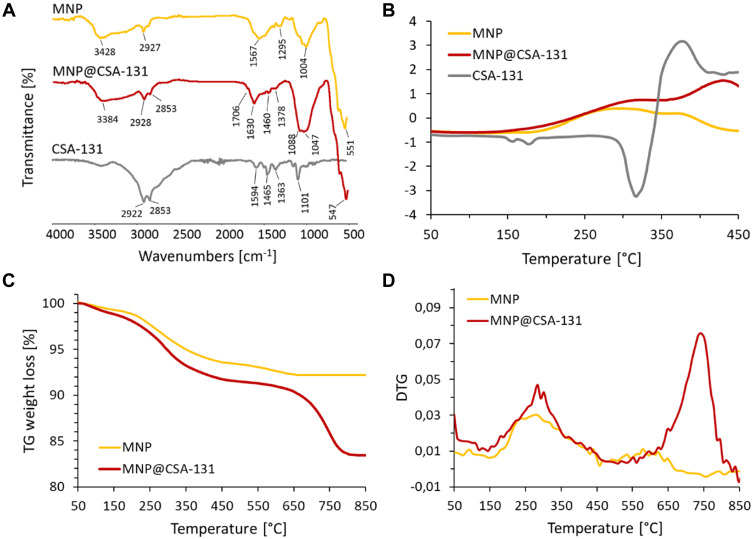
Therapeutic efficiency of ceragenins against cancers may be limited by lack of their hemocompatibility when high concentrations of molecules are required to reach a desired result. Synergistic effects observed upon administration of anticancer agents and metal nanoparticles may provide an opportunity to limit toxicity of immobilized ceragenins on the surface of metal nanoparticles and to improve their therapeutic efficiency at the same time. The aim of present work is to investigate the anticancer activities and hemocompatibility of nanoformulations consisting of ceragenin CSA-131 united with aminosilane-modified iron oxide-based magnetic nanoparticles (MNP) and prepared by 1) covalent bonding (MNP@CSA-131) or 2) by combining CSA-131 with MNP in 1:1 ratio (CSA-131 + MNP). Possible synergistic interactions between CSA-131 and magnetic nanoparticles were also quantified.
MNP@CSA-131 and CSA-131+MNP were tested in vitro against selected lung and colon cancer cells using colorimetric, fluorimetric and flow cytometry methods.
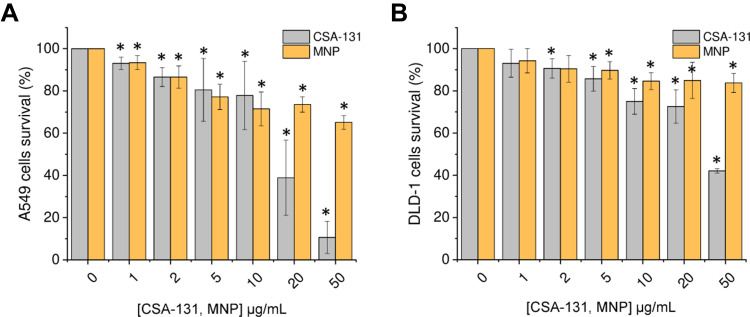
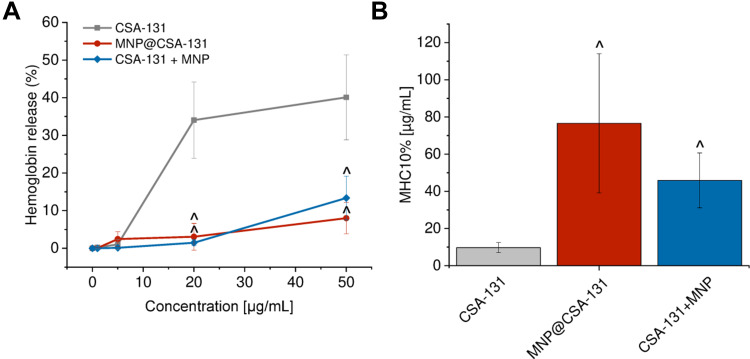
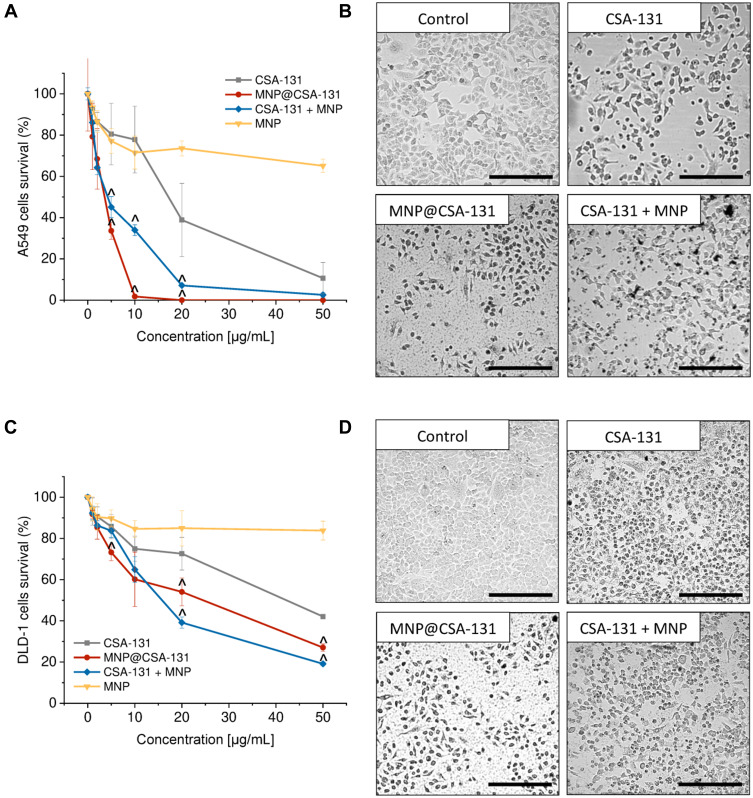
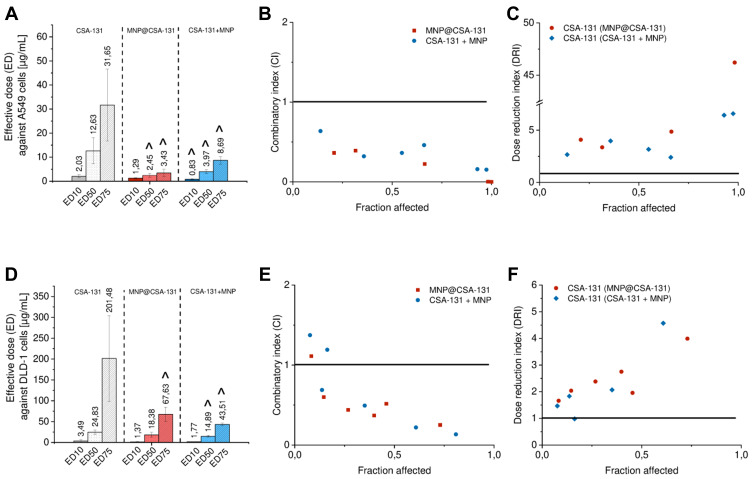
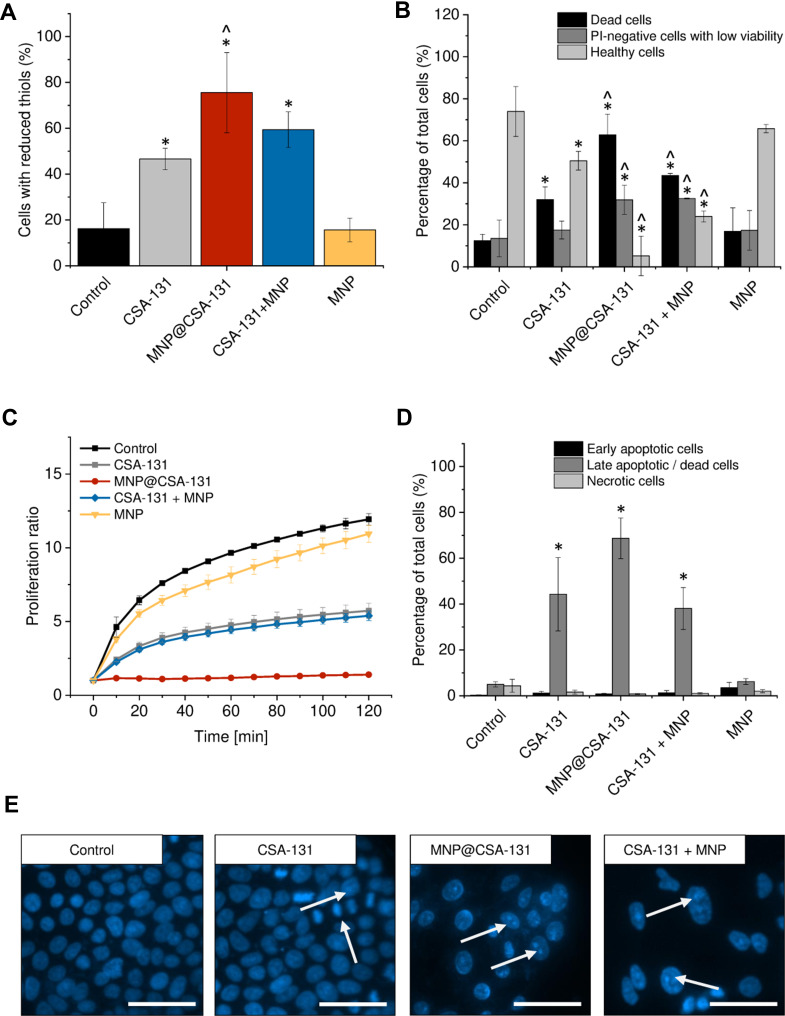
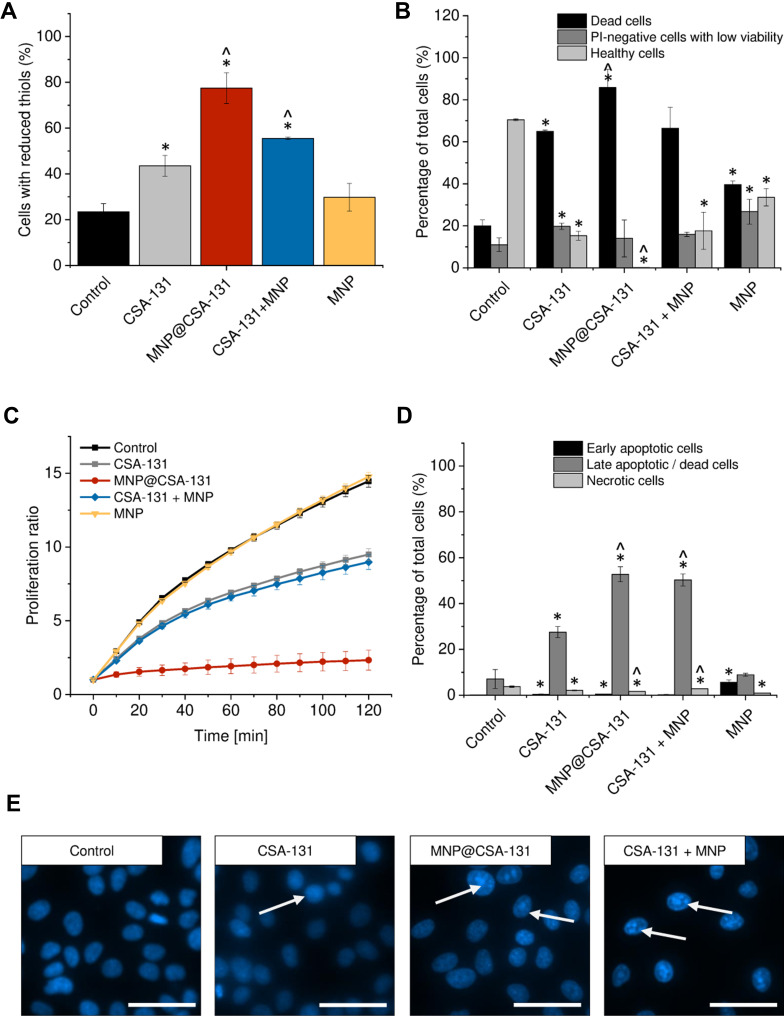
Performed analysis demonstrates that MNP-based nanosystems significantly improve the killing efficiency of tested ceragenin, decreasing the viability of extra 1.37±4.72% to 76.07±15.30% cancer cells when compared to free CSA-131. Quantification of synergistic effects indicates the favorable interactions between CSA-131 and magnetic nanoparticles (CI < 1 for all tested doses), revealing at the same time a reduction in effective doses of ceragenin from 1.17 ± 0.61 to 34.57 ± 12.78 times when combined with MNP. We demonstrate that both MNP@CSA-131 and CSA-131+MNP induce significantly apoptosis of cancer cells and prevent the division of colon cancer cells even at relatively low doses of the active compound (10 µg/mL). Importantly, combining CSA-131 with MNP decreases the hemolytic activity of free ceragenin 4.72 to 7.88 times, which indicates a considerable improvement of hemotoxicity profile.
Comparative analyses have revealed that both developed CSA-containing nanoformulations due to the utility of synergistic interactions between MNP and CSA-131, which are effective against lung and colon cancer cells. This indicates the new directions in preparation of MNP-based therapeutics, which are relatively easy to synthetize, cost-effective and safe when intravenously administrated.
当需要高浓度分子以达到预期效果时,杀菌素对癌症的治疗效率可能会受到其血液相容性差的限制。在给予抗癌药物和金属纳米粒子时观察到的协同作用可能为限制固定在金属纳米粒子表面的杀菌素的毒性并同时提高其治疗效率提供了机会。本工作的目的是研究由杀菌素 CSA-131 与氨基硅烷修饰的基于氧化铁的磁性纳米粒子(MNP)组成的纳米制剂的抗癌活性和血液相容性,并通过以下两种方法制备:1)通过共价键合(MNP@CSA-131)或 2)以 CSA-131 与 MNP 1:1 的比例结合(CSA-131+MNP)。还定量了 CSA-131 和磁性纳米粒子之间可能存在的协同相互作用。
使用比色法、荧光法和流式细胞术在体外测试 MNP@CSA-131 和 CSA-131+MNP 对选定的肺癌和结肠癌细胞的作用。
进行的分析表明,与游离 CSA-131 相比,基于 MNP 的纳米系统可显著提高测试杀菌素的杀伤效率,使癌细胞的存活率降低了 1.37±4.72%至 76.07±15.30%。协同作用的定量分析表明,CSA-131 和磁性纳米粒子之间存在有利的相互作用(所有测试剂量的 CI<1),同时表明当与 MNP 结合时,杀菌素的有效剂量从 1.17±0.61 降低至 34.57±12.78 倍。我们证明,MNP@CSA-131 和 CSA-131+MNP 均诱导癌细胞显著凋亡,并阻止结肠癌细胞分裂,即使在活性化合物的相对低剂量(10µg/mL)下也是如此。重要的是,将 CSA-131 与 MNP 结合使用可使游离杀菌素的溶血活性降低 4.72 至 7.88 倍,这表明血液毒性谱得到了显著改善。
比较分析表明,由于 MNP 和 CSA-131 之间的协同相互作用的实用性,两种开发的含 CSA 的纳米制剂均对肺癌和结肠癌细胞有效。这为基于 MNP 的治疗剂的制备指明了新的方向,这些制剂易于合成,具有成本效益,并且静脉给药时安全性高。