Luna-Luna María, Criales-Vera Sergio, Medina-Leyte Diana, Díaz-Zamudio Mariana, Flores-Zapata Adriana, Cruz-Robles David, López-Meneses Mauricio, Olvera-Cruz Sergio, Ramírez-Marroquín Samuel, Flores-Castillo Cristóbal, Fragoso José Manuel, Carreón-Torres Elizabeth, Vargas-Barrón Jesús, Vargas-Alarcón Gilberto, Pérez-Méndez Óscar
Molecular Biology, National Institute of Cardiology "Ignacio Chávez", Mexico City, Mexico.
Radiology, National Institute of Cardiology "Ignacio Chávez", Mexico City, Mexico.
Diabetes Metab Syndr Obes. 2020 Jun 11;13:1943-1951. doi: 10.2147/DMSO.S253632. eCollection 2020.
It has been proposed that the cardiovascular effects of obesity are related to epicardial adipose tissue (EAT), which seems to play an active role on the development and calcification of atherosclerotic plaques, but the mechanisms are still unknown. Therefore, the aim of this study was to determine whether the EAT expresses the genes of calcifying factors and whether such expression is associated with the body mass index (BMI) and with the presence of coronary artery calcium (CAC) in patients with coronary artery disease (CAD).
Forty-three patients with CAD were enrolled specifically for this study, and their CAC score and EAT volume were determined by computed tomography. As the group of comparison, 41 patients with aortic valve stenosis and CAC = 0 were included (control group). A representative subgroup of 16 CAD patients and 23 controls were selected to obtain EAT biopsies during the chirurgical procedure from the atrio-interventricular groove. The mRNA expression of bone morphogenetic protein-2 and -4 (, osteopontin (), osteonectin (), and osteoprotegerin () in EAT was determined by qPCR.
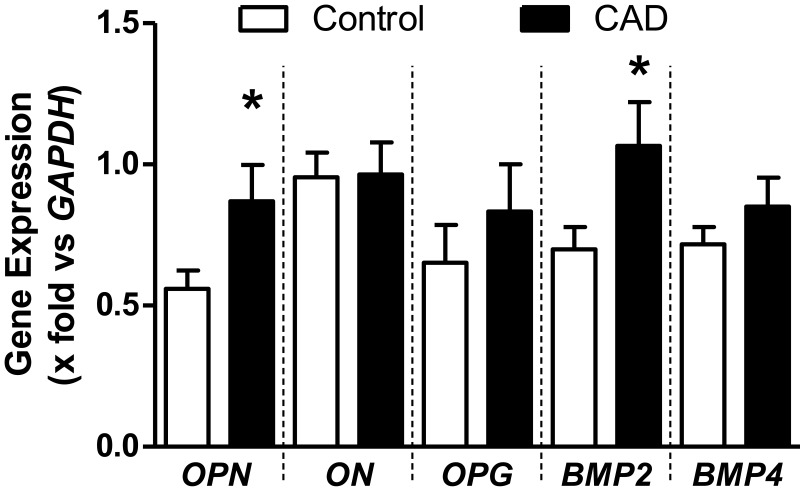
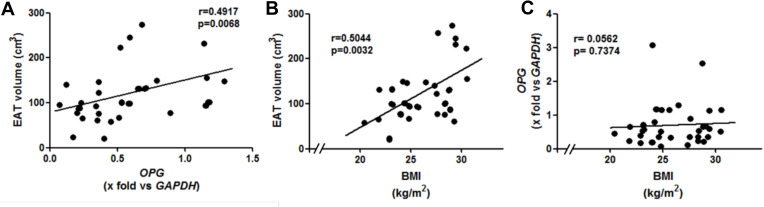
The gene expression of and was 70% and 52% higher in the EAT from CAD patients than that in controls, respectively, whereas the expression of , and was similar in both groups. The EAT volume positively correlated with and with the BMI, suggesting a relationship of obesity with local higher expression of calcifying genes in the coronary territory. The logistic regression analysis showed that high levels of both and increased about 6 and 8 times the odds of coronary calcification (CAC score > 0), respectively.
EAT correlated with BMI and expressed the mRNA of calcifying genes but only and expression was higher in CAD patients. Higher levels of both and statistically determined the presence of calcium in coronary arteries of CAD patients.
有人提出肥胖对心血管系统的影响与心外膜脂肪组织(EAT)有关,EAT似乎在动脉粥样硬化斑块的形成和钙化过程中发挥着积极作用,但其机制尚不清楚。因此,本研究旨在确定EAT是否表达钙化因子基因,以及这种表达是否与冠心病(CAD)患者的体重指数(BMI)和冠状动脉钙化(CAC)的存在有关。
本研究专门纳入了43例CAD患者,通过计算机断层扫描确定其CAC评分和EAT体积。作为对照组,纳入41例主动脉瓣狭窄且CAC = 0的患者(对照组)。选择16例CAD患者和23例对照的代表性亚组,在手术过程中从房室沟获取EAT活检样本。通过qPCR测定EAT中骨形态发生蛋白-2和-4( )、骨桥蛋白( )、骨连接蛋白( )和骨保护素( )的mRNA表达。
CAD患者EAT中 和 的基因表达分别比对照组高70%和52%,而两组中 和 的表达相似。EAT体积与 和BMI呈正相关,提示肥胖与冠状动脉区域钙化基因的局部高表达有关。逻辑回归分析显示, 和 水平升高分别使冠状动脉钙化(CAC评分>0)的几率增加约6倍和8倍。
EAT与BMI相关且表达钙化基因的mRNA,但只有 和 在CAD患者中表达较高。 和 的较高水平在统计学上决定了CAD患者冠状动脉中钙的存在。