Ding Lu, Gao Yu-Hang, Li Ye-Ran, Huang Yi-Fan, Wang Xin-Yu, Qi Xin
Department of Orthopaedic Surgery, The First Hospital of Jilin University, Jilin University, Chang Chun, People's Republic of China.
Diabetes Metab Syndr Obes. 2020 Jun 19;13:2109-2118. doi: 10.2147/DMSO.S249025. eCollection 2020.
This study was to evaluate the metabolic score for insulin resistance (METS-IR) in female knee osteoarthritis (KOA) patients in a Chinese population. The associations between METS-IR and adipokines, erythrocyte sedimentation rate (ESR), and C-reactive protein (CRP) were investigated.
This study included 4686 women from the 2011 China Health and Retirement Longitudinal Study (CHARLS) and 108 women who underwent arthroplasty of KOA at a university hospital. The clinical data were collected, and adipokines were evaluated. METS-IR was calculated in the KOA patients and compared with the national baseline. Logistic regression analyses were applied to explore the associations of METS-IR with adipokines, ESR, and CRP.
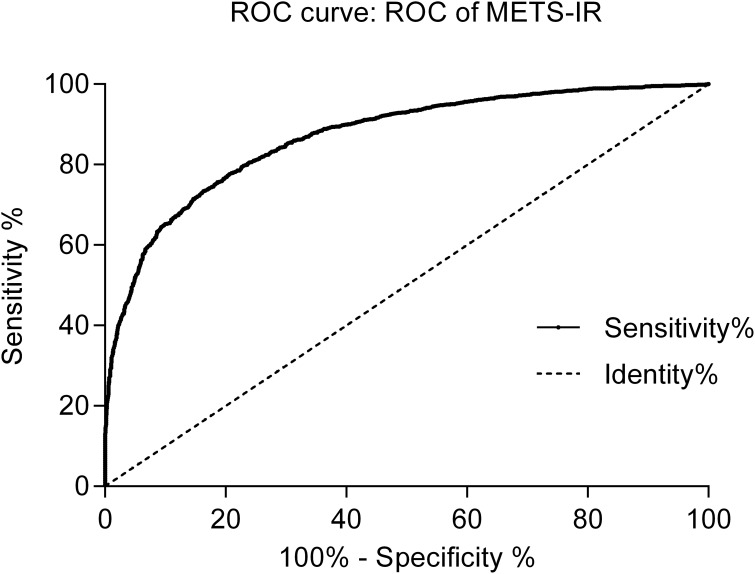
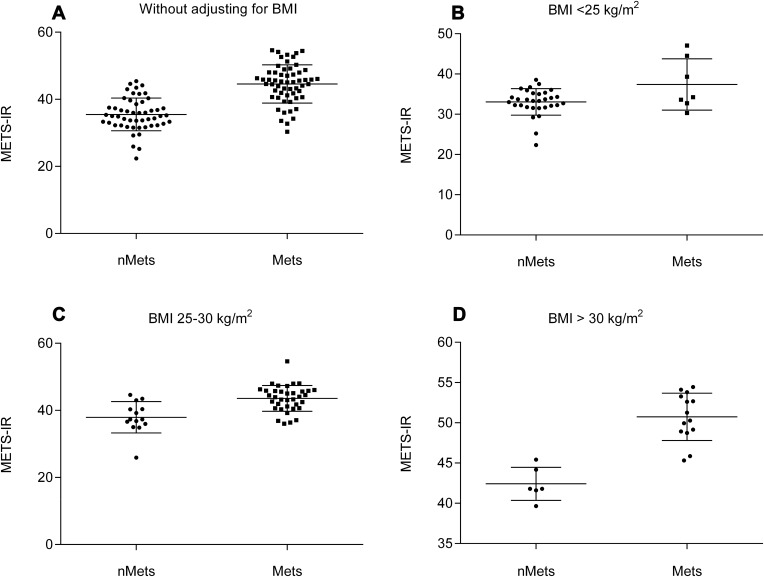
Receiver operating characteristic curve analysis of METS-IR and metabolic syndrome (MetS) in national baseline showed an area under the curve value of 0.851, with sensitivity of 0.777 and specificity of 0.772. The METS-IR of KOA was higher than the national baseline level (40.29 ± 6.98 vs 36.20 ± 8.50, < 0.01), even after adjusting age. In addition, the METS-IR was higher in patients with KOA who had MetS than in those without metabolic syndrome (nMetS), even after adjusting body mass index (BMI). After adjusting for age and BMI, METS-IR was associated with CRP (OR 1.238, 95% confidence interval (CI) 1.088, 1.409, < 0.01), ESR (OR 1.124, 95% CI 1.008, 1.254, = 0.036), plasma leptin (OR 1.123, 95% CI 1.052, 1.199, < 0.01), plasma resistin (OR 1.134, 95% CI 1.011, 1.271, = 0.031), and plasma adiponectin (OR 0.865, 95% CI 0.771, 0.971, = 0.014).
METS-IR in female KOA was higher than that of the national baseline. The METS-IR was related to adipokine disorder and inflammatory activity. These findings suggest that METS-IR can be used to evaluate the degree of involvement of MetS in KOA.
本研究旨在评估中国人群中女性膝关节骨关节炎(KOA)患者的胰岛素抵抗代谢评分(METS-IR)。研究了METS-IR与脂肪因子、红细胞沉降率(ESR)和C反应蛋白(CRP)之间的关联。
本研究纳入了来自2011年中国健康与养老追踪调查(CHARLS)的4686名女性以及一家大学医院108名接受KOA关节置换术的女性。收集临床数据并评估脂肪因子。计算KOA患者的METS-IR并与全国基线进行比较。应用逻辑回归分析来探讨METS-IR与脂肪因子、ESR和CRP之间的关联。
全国基线中METS-IR与代谢综合征(MetS)的受试者工作特征曲线分析显示曲线下面积值为0.851,敏感性为0.777,特异性为0.772。即使在调整年龄后,KOA患者的METS-IR仍高于全国基线水平(40.29±6.98 vs 36.20±8.50,P<0.01)。此外,即使在调整体重指数(BMI)后,患有MetS的KOA患者的METS-IR也高于无代谢综合征(nMetS)的患者。在调整年龄和BMI后,METS-IR与CRP(比值比[OR]1.238,95%置信区间[CI]1.088,1.409,P<0.01)、ESR(OR 1.124,95%CI 1.008,1.254,P=0.036)、血浆瘦素(OR 1.123,95%CI 1.052,1.199,P<0.01)、血浆抵抗素(OR 1.134,95%CI 1.011,1.271,P=0.031)和血浆脂联素(OR 0.865,95%CI 0.771,0.971,P=0.014)相关。
女性KOA患者的METS-IR高于全国基线。METS-IR与脂肪因子紊乱和炎症活动有关。这些发现表明METS-IR可用于评估MetS在KOA中的累及程度。