Intensive Care Unit, CHU Réunion, Saint Pierre, Reunion, France.
Department of Public Health and Research, CHU Réunion, Saint-Pierre, Reunion, France.
PLoS Negl Trop Dis. 2023 Apr 17;17(4):e0011260. doi: 10.1371/journal.pntd.0011260. eCollection 2023 Apr.
Since 2018, a dengue epidemic has been raging annually in Reunion Island, which poses the major problem of its morbidity and mortality. However, there is no consensus in the literature on factors associated with severity of illness. The objective of this study was to identify the factors associated with the occurrence of severe dengue (SD) according to the criteria adopted in 2009 by the World Health Organization (WHO), during the 2019 epidemic.
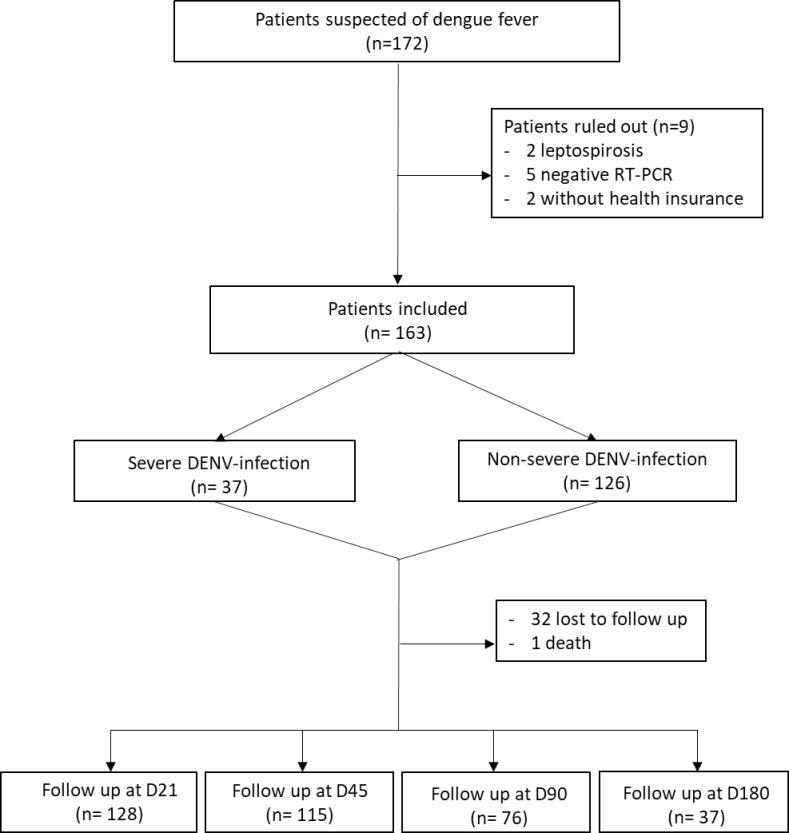
METHODOLOGY/PRINCIPAL FINDINGS: A total of 163 patients with RT-PCR-confirmed dengue were included in a multicenter prospective cohort study in Reunion Island between January and June 2019. Of these, 37 (23%) were classified as SD, which involves presentation dominated by at least one organ failure, and 126 (77%) classified as non-SD (of which 90 (71%) had warning signs). Confusion, dehydration, and relative hypovolemia were significantly associated with SD in bivariate analysis (p < 0.05). The factors associated with SD in multivariate analysis were a time from first symptom to hospital consultation over 2 days (OR: 2.46, CI: 1.42-4.27), a history of cardiovascular disease (OR: 2.75, 95%CI: 1.57-4.80) and being of Western European origin (OR: 17.60, CI: 4.15-74).
CONCLUSIONS/SIGNIFICANCE: This study confirms that SD is a frequent cause of hospitalization during dengue epidemics in Reunion Island. It suggests that cardiovascular disease, Western European origin, and delay in diagnosis and management are risk factors associated with SD fever, and that restoration of blood volume and correction of dehydration must be performed early to be effective.
NCT01099852; clinicaltrials.gov.
自 2018 年以来,留尼汪岛每年都会爆发登革热疫情,这给当地的发病率和死亡率带来了极大的挑战。然而,目前文献中尚未就与疾病严重程度相关的因素达成共识。本研究的目的是根据世界卫生组织(WHO)2009 年采用的标准,确定与 2019 年疫情中严重登革热(SD)发生相关的因素。
方法/主要发现:2019 年 1 月至 6 月,在留尼汪岛进行了一项多中心前瞻性队列研究,共纳入 163 例经 RT-PCR 确诊的登革热患者。其中 37 例(23%)被归类为 SD,表现为至少有一个器官衰竭,126 例(77%)归类为非 SD(其中 90 例(71%)有预警症状)。在单变量分析中,意识障碍、脱水和相对低血容量与 SD 显著相关(p < 0.05)。多变量分析中与 SD 相关的因素包括从首发症状到医院就诊的时间超过 2 天(OR:2.46,95%CI:1.42-4.27)、心血管疾病史(OR:2.75,95%CI:1.57-4.80)和西欧血统(OR:17.60,95%CI:4.15-74)。
结论/意义:本研究证实,SD 是留尼汪岛登革热疫情期间住院的常见原因。提示心血管疾病、西欧血统和诊断与治疗的延迟是与 SD 发热相关的危险因素,早期恢复血容量和纠正脱水必须有效。
NCT01099852;clinicaltrials.gov。