Department of Neurosurgery, Xiangya Hospital, Central South University, Central South University, 87 Xiangya Road, Changsha, Hunan, 410008, China.
Clinical Diagnosis and Therapy Center for Glioma of Xiangya Hospital, Central South University, 87 Xiangya Road, Changsha, Hunan, 410008, China.
Sci Rep. 2020 Jul 1;10(1):10768. doi: 10.1038/s41598-020-66806-z.
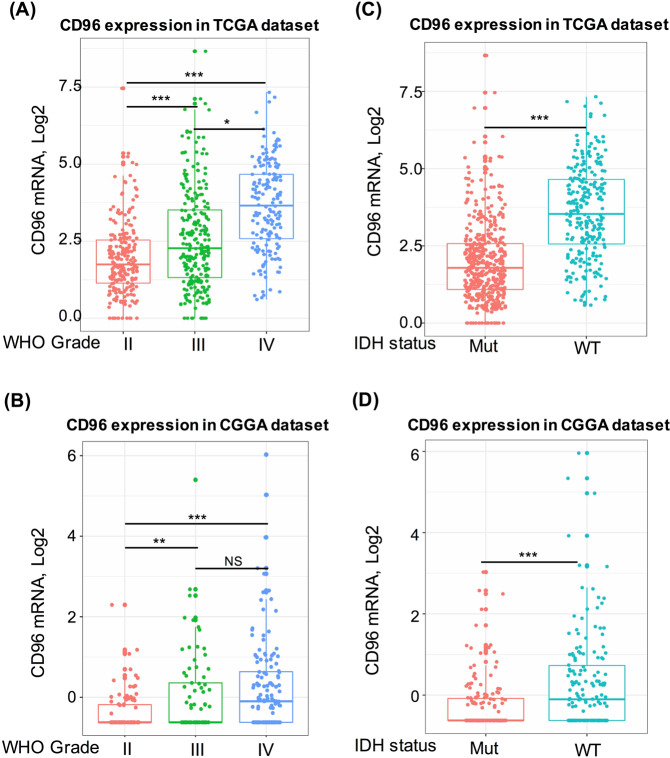
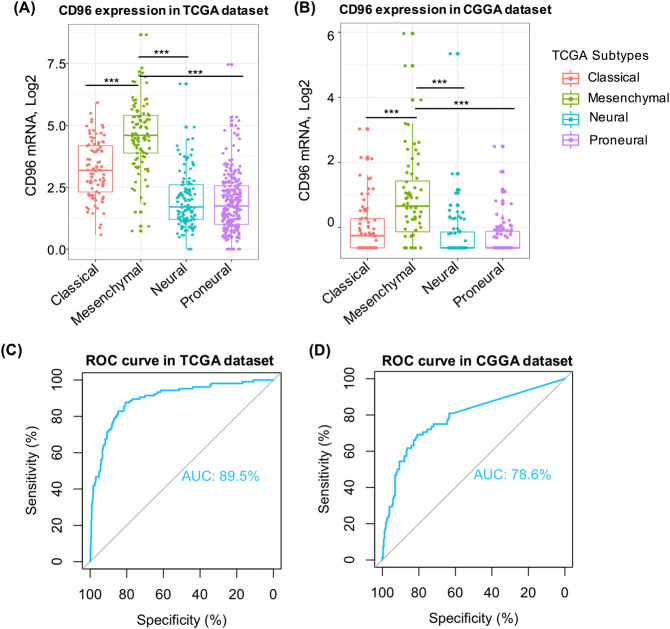
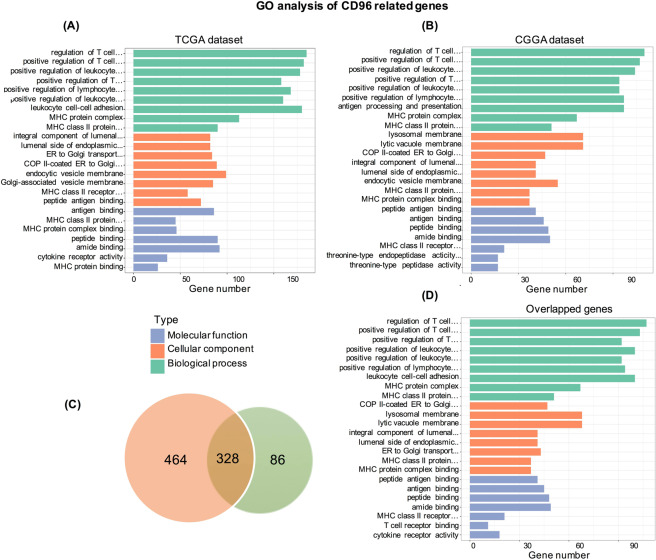
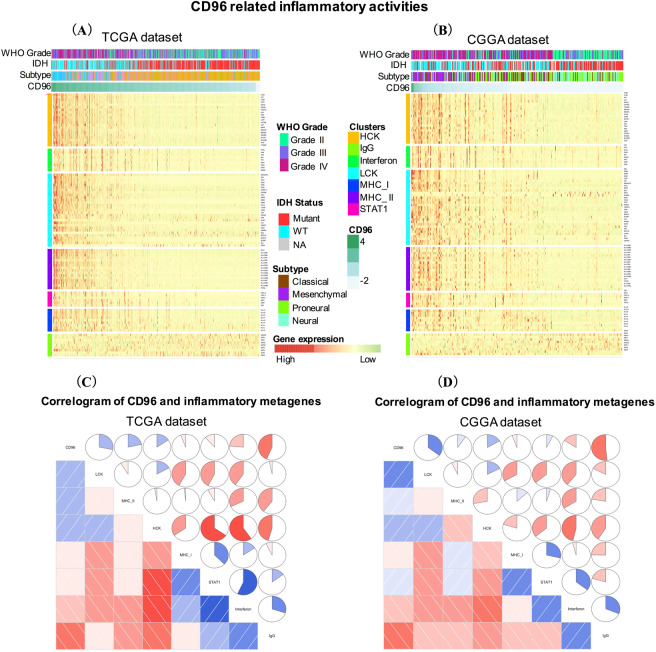
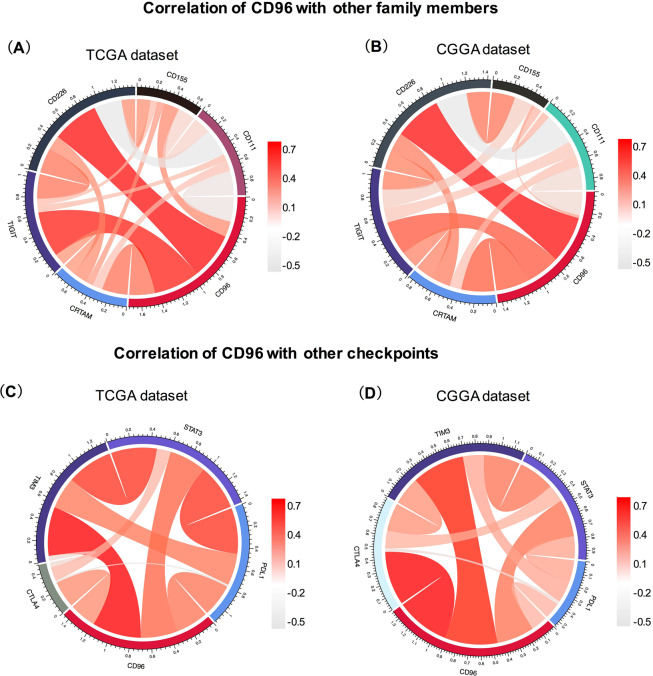
CD96 is a promising candidate for immunotherapy. However, its role and importance in glioma remains unknown. We thus aimed to genetically and clinically characterize CD96 expression in gliomas. For this, we extracted RNA-seq data of 699 glioma samples from the TCGA dataset and validated these findings using the CGGA dataset comprising 325 glioma samples. Clinical and isocitrate dehydrogenase (IDH) mutation status were also analyzed. Various packages in R language were mainly used for statistical analysis. CD96 expression was significantly up-regulated in high-grade, IDH-wildtype, and mesenchymal-molecular subtype gliomas based on TCGA data, which was validated using the CGGA dataset. Subsequent gene ontology analysis of both datasets suggested that genes relevant to CD96 are mainly involved in immune functions in glioma as such genes were positively correlated with CD96 expression. To further explore the relationship between CD96 and immune responses, we selected seven immune-related metagenes and found that CD96 expression was positively correlated with HCK, LCK, and MHC II in the CGGA and TCGA cohorts but negatively associated with IgG. Further, Pearson correlation analysis showed that CD96 is associated with TIGIT, CD226, CRTAM, TIM-3, PD-L1, CTLA-4, and STAT3, indicating the additive antitumoral effects of these checkpoint proteins. CD96 was also suggested to play an important role in immune responses and positively collaborate with other checkpoint members. These findings show that CD96 is promising candidate for immunotherapy, and that such agents could complement current immunotherapy strategies for glioma.
CD96 是免疫治疗的有前途的候选物。然而,其在神经胶质瘤中的作用和重要性尚不清楚。因此,我们旨在从遗传学和临床角度表征神经胶质瘤中的 CD96 表达。为此,我们从 TCGA 数据集提取了 699 个神经胶质瘤样本的 RNA-seq 数据,并使用包含 325 个神经胶质瘤样本的 CGGA 数据集验证了这些发现。还分析了临床和异柠檬酸脱氢酶(IDH)突变状态。R 语言中的各种软件包主要用于统计分析。根据 TCGA 数据,CD96 的表达在高级别、IDH 野生型和间充质分子亚型神经胶质瘤中显著上调,这在 CGGA 数据集中得到了验证。两个数据集的后续基因本体分析表明,与 CD96 相关的基因主要参与神经胶质瘤中的免疫功能,因为这些基因与 CD96 表达呈正相关。为了进一步探讨 CD96 与免疫反应之间的关系,我们选择了七个免疫相关的元基因,发现 CD96 在 CGGA 和 TCGA 队列中的表达与 HCK、LCK 和 MHC II 呈正相关,但与 IgG 呈负相关。此外,Pearson 相关分析表明 CD96 与 TIGIT、CD226、CRTAM、TIM-3、PD-L1、CTLA-4 和 STAT3 相关,表明这些检查点蛋白具有附加的抗肿瘤作用。CD96 还被认为在免疫反应中起重要作用,并与其他检查点成员积极合作。这些发现表明 CD96 是免疫治疗的有前途的候选物,并且这些药物可以补充当前神经胶质瘤的免疫治疗策略。