Wang Zheng, Zhang Chuanbao, Liu Xing, Wang Zhiliang, Sun Lihua, Li Guanzhang, Liang Jingshan, Hu Huimin, Liu Yanwei, Zhang Wei, Jiang Tao
Department of Molecular Neuropathology, Beijing Neurosurgical Institute, Capital Medical University, Beijing, China; Department of Neurosurgery, Beijing Tiantan Hospital, Capital Medical University, Beijing, China; Chinese Glioma Genome Atlas network, Beijing, China.
Department of Neurosurgery, Beijing Tiantan Hospital, Capital Medical University, Beijing, China; Chinese Glioma Genome Atlas network, Beijing, China.
Oncoimmunology. 2016 Jun 16;5(11):e1196310. doi: 10.1080/2162402X.2016.1196310. eCollection 2016.
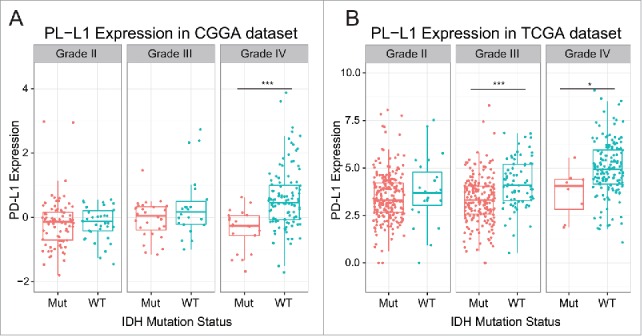
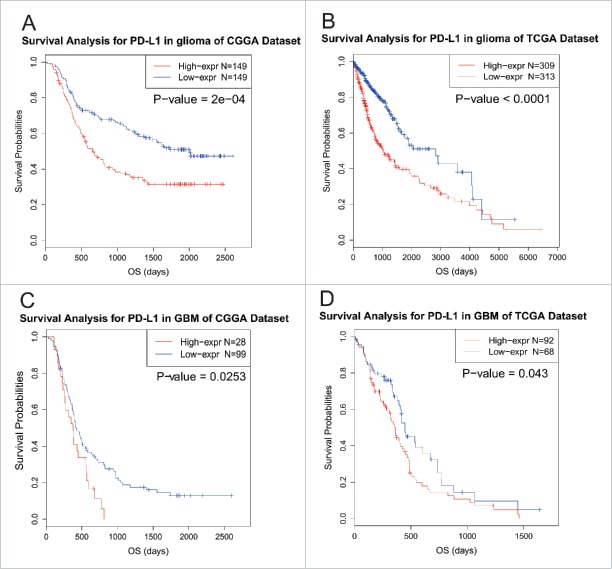
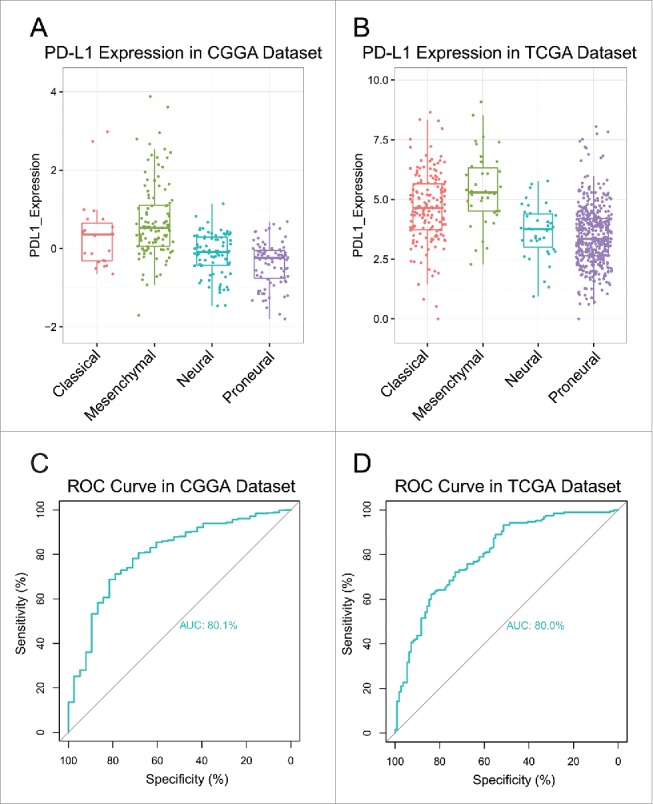
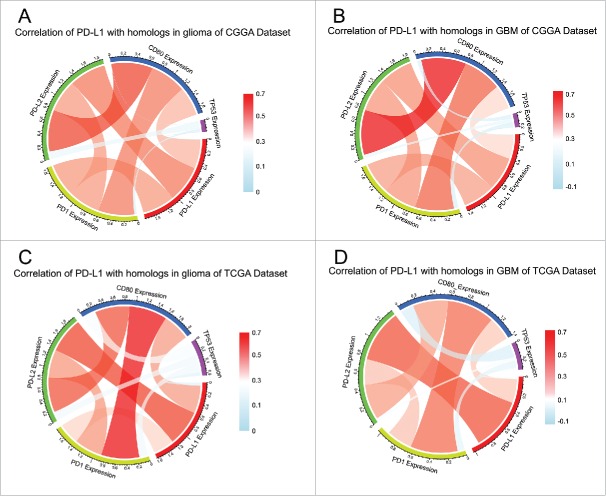
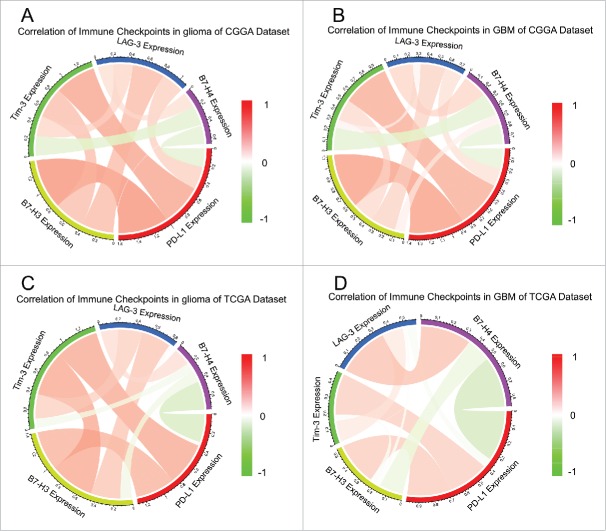
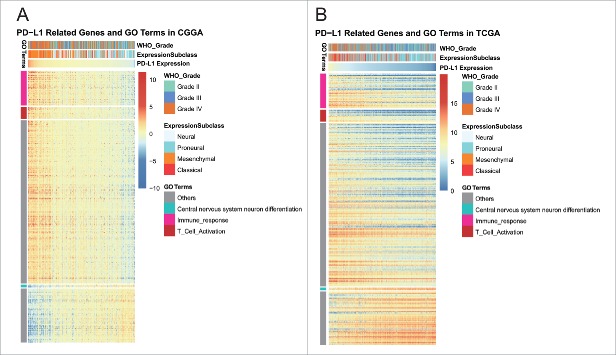
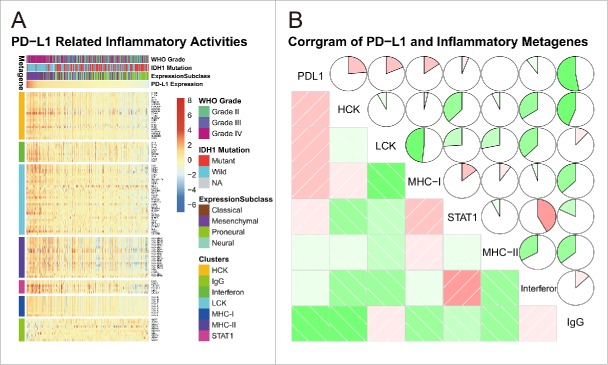
: PD-L1 has been widely reported as immune check points in a range of malignancies as well as some immune-originated diseases. In glioma, the role of PD-L1 remains unclear. We aimed at investigating its role at transcriptome level and relationship with clinical practice. : In total, 976 glioma samples with transcriptome data, including 301 microarray data from Chinese Glioma Genome Atlas (CGGA project) and 675 RNAseq data from TCGA project, were enrolled into our study. Clinical and IDH mutation data were also available. R language was used as the main tool for statistical analysis and graphical work. : PD-L1 expression was found to be positively correlated with WHO grade of glioma. PD-L1 seemed to express more in mesenchymal subtype according to TCGA transcriptional classification scheme and may contribute as a potential marker for mesenchymal subtype in glioblastoma. Pearson correlation test indicated that PD-L1 showed robust correlation with PD1, PD-L2, and CD80 in CGGA dataset. Subsequent gene ontology analysis based on significantly correlated genes of PD-L1 revealed that PD-L1 seemed to be profoundly associated with T cell activation. To further investigate the relationship between PD-L1 expression and immune response, we selected a series of immune signatures, which were then transformed into metagenes, and found that PD-L1 expression was particularly paralleled with T-cells and macrophages-related immune response instead of B cell linage-related immune response. In line with the corresponding biological process, PD-L1 exhibited predictive value for glioma patients: Higher PD-L1 indicated significantly shorter survival, especially in glioblastoma. : PD-L1 is upregulated in glioblastoma, and is synergistic with other check point members. Moreover, PD-L1 is significantly associated with T-cell activation and macrophage-related immune response and predicts much worse survival for patients, warranting clinical trials of PD1/PD-L1 checkpoint inhibitors for potential glioma treatment.
PD-L1作为免疫检查点,已在一系列恶性肿瘤以及一些免疫源性疾病中被广泛报道。在胶质瘤中,PD-L1的作用仍不明确。我们旨在研究其在转录组水平的作用及其与临床实践的关系。
总共976个具有转录组数据的胶质瘤样本被纳入我们的研究,其中包括来自中国胶质瘤基因组图谱(CGGA项目)的301个微阵列数据和来自TCGA项目的675个RNAseq数据。临床和异柠檬酸脱氢酶(IDH)突变数据也可获取。R语言用作统计分析和图形处理的主要工具。
发现PD-L1表达与胶质瘤的世界卫生组织(WHO)分级呈正相关。根据TCGA转录分类方案,PD-L1似乎在间充质亚型中表达更多,并且可能作为胶质母细胞瘤中间充质亚型的潜在标志物。Pearson相关性检验表明,在CGGA数据集中,PD-L1与PD1、PD-L2和CD80显示出强相关性。基于与PD-L1显著相关的基因进行的后续基因本体分析表明,PD-L1似乎与T细胞活化密切相关。为了进一步研究PD-L1表达与免疫反应之间的关系,我们选择了一系列免疫特征,然后将其转化为元基因,发现PD-L1表达特别与T细胞和巨噬细胞相关的免疫反应平行,而不是与B细胞谱系相关的免疫反应。与相应的生物学过程一致,PD-L1对胶质瘤患者具有预测价值:较高的PD-L1表明生存期显著缩短,尤其是在胶质母细胞瘤中。
PD-L1在胶质母细胞瘤中上调,并与其他检查点成员协同作用。此外,PD-L1与T细胞活化和巨噬细胞相关的免疫反应显著相关,并预测患者的生存期更差,这使得PD1/PD-L1检查点抑制剂用于潜在的胶质瘤治疗的临床试验成为必要。