Rocha Luís A, Gomes Eduardo D, Afonso João L, Granja Sara, Baltazar Fatima, Silva Nuno A, Shoichet Molly S, Sousa Rui A, Learmonth David A, Salgado Antonio J
Life and Health Sciences Research Institute (ICVS), School of Medicine, University of Minho, Braga, Portugal.
ICVS/3B's - PT Government Associate Laboratory, Guimaraes, Portugal.
Front Cell Dev Biol. 2020 Jun 16;8:489. doi: 10.3389/fcell.2020.00489. eCollection 2020.
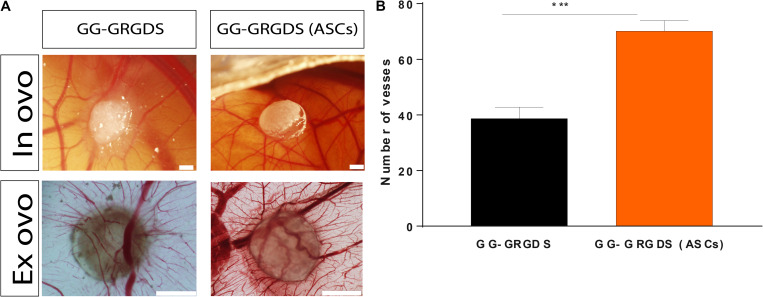
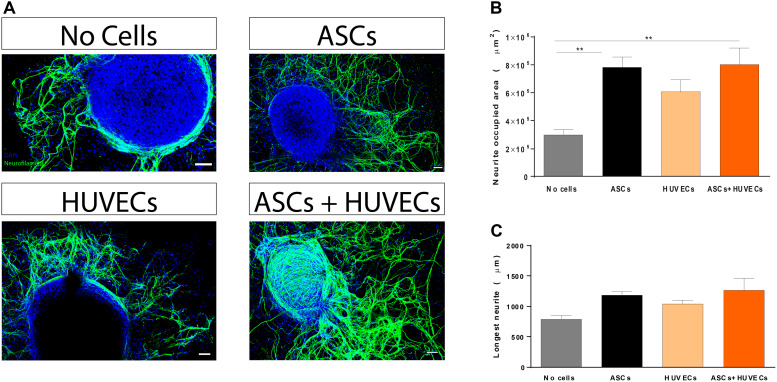
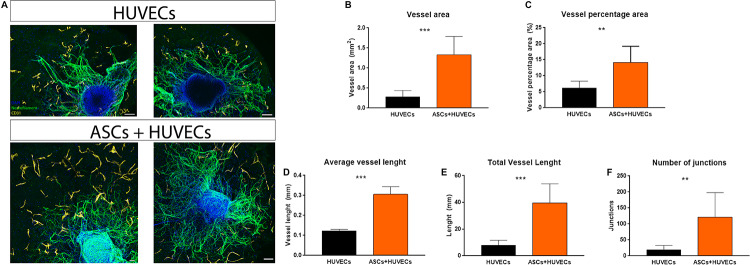
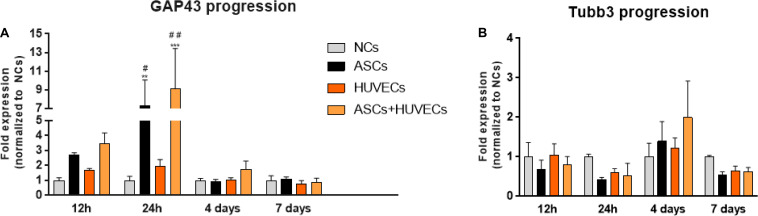
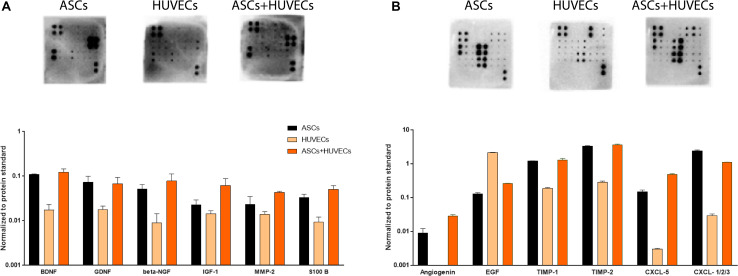
Vascular disruption following spinal cord injury (SCI) decisively contributes to the poor functional recovery prognosis facing patients with the condition. Using a previously developed gellan gum hydrogel to which the adhesion motif GRGDS was grafted (GG-GRGDS), this work aimed to understand the ability of adipose-derived stem cells (ASCs) to impact vascular organization of human umbilical vein endothelial cells (HUVECs), and how this in turn affects neurite outgrowth of dorsal root ganglia (DRG) explants. Our data shows that culturing these cells together lead to a synergistic effect as showed by increased stimulation of neuritogenesis on DRG. Importantly, HUVECs were only able to assemble into vascular-like structures when cultured in the presence of ASCs, which shows the capacity of these cells in reorganizing the vascular milieu. Analysis of selected neuroregulatory molecules showed that the co-culture upregulated the secretion of several neurotrophic factors. On the other hand, ASCs, and ASCs + HUVECs presented a similar profile regarding the presence of angiotrophic molecules herein analyzed. Finally, the implantation of GG-GRGDS hydrogels encapsulating ASCs in the chick chorioallantoic membrane (CAM) lead to increases in vascular recruitment toward the hydrogels in comparison to GG-GRGDS alone. This indicates that the combination of ASCs with GG-GRGDS hydrogels could promote re-vascularization in trauma-related injuries in the central nervous system and thus control disease progression and induce functional recovery.
脊髓损伤(SCI)后的血管破坏是导致该疾病患者功能恢复预后不良的关键因素。本研究使用先前开发的接枝了黏附基序GRGDS的结冷胶水凝胶(GG-GRGDS),旨在了解脂肪干细胞(ASC)影响人脐静脉内皮细胞(HUVEC)血管组织的能力,以及这如何反过来影响背根神经节(DRG)外植体的神经突生长。我们的数据表明,将这些细胞共同培养会产生协同效应,表现为对DRG神经突生成的刺激增加。重要的是,只有在ASC存在的情况下培养时,HUVEC才能组装成血管样结构,这表明这些细胞具有重组血管微环境的能力。对选定的神经调节分子的分析表明,共培养上调了几种神经营养因子的分泌。另一方面,就本文分析的促血管生成分子的存在而言,ASC和ASC+HUVEC呈现出相似的特征。最后,与单独的GG-GRGDS相比,将包裹ASC的GG-GRGDS水凝胶植入鸡胚绒毛尿囊膜(CAM)会导致向水凝胶的血管募集增加。这表明ASC与GG-GRGDS水凝胶的组合可以促进中枢神经系统创伤相关损伤中的再血管化,从而控制疾病进展并诱导功能恢复。