Plant Breeding and Genetics Section, School of Integrative Plant Science, Cornell University, Ithaca, NY, 14853, USA.
Horticulture Section, School of Integrative Plant Science, Cornell University, Ithaca, NY, 14853, USA.
Theor Appl Genet. 2020 Oct;133(10):2853-2868. doi: 10.1007/s00122-020-03637-6. Epub 2020 Jul 1.
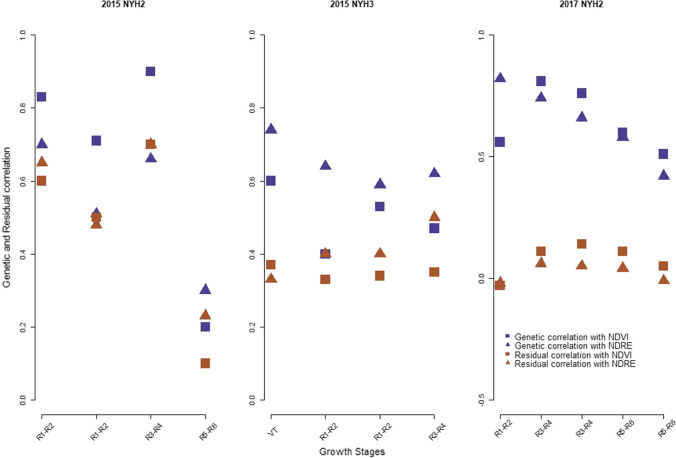
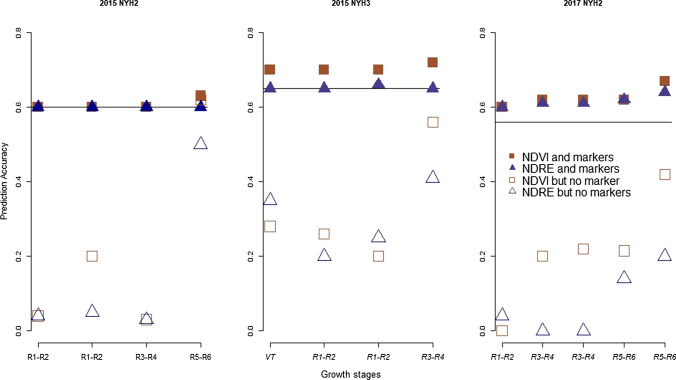
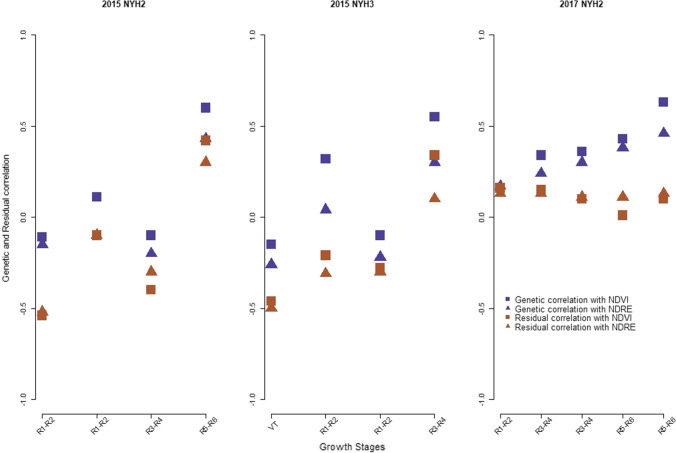
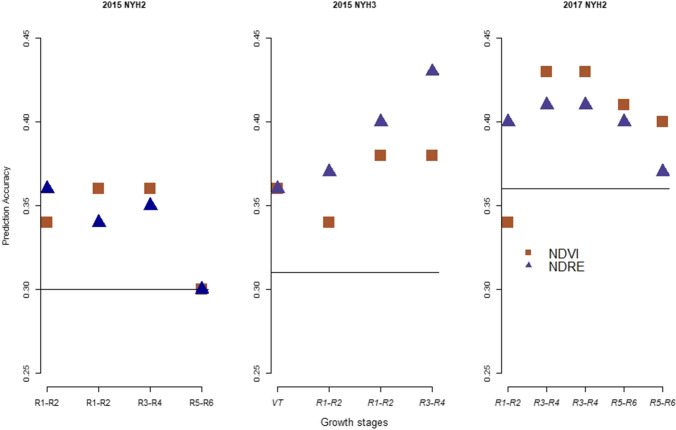
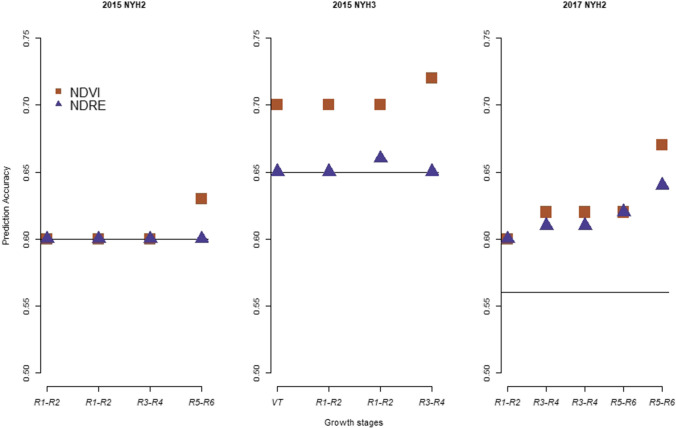
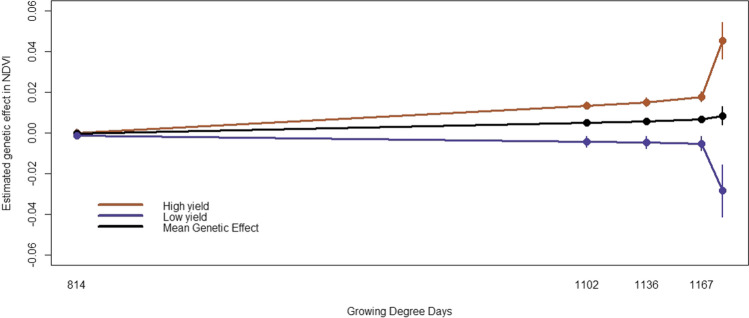
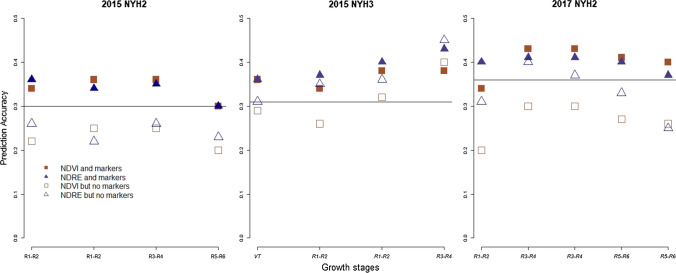
Heritable variation in phenotypes extracted from multi-spectral images (MSIs) and strong genetic correlations with end-of-season traits indicates the value of MSIs for crop improvement and modeling of plant growth curve. Vegetation indices (VIs) derived from multi-spectral imaging (MSI) platforms can be used to study properties of crop canopy, providing non-destructive phenotypes that could be used to better understand growth curves throughout the growing season. To investigate the amount of variation present in several VIs and their relationship with important end-of-season traits, genetic and residual (co)variances for VIs, grain yield and moisture were estimated using data collected from maize hybrid trials. The VIs considered were Normalized Difference Vegetation Index (NDVI), Green NDVI, Red Edge NDVI, Soil-Adjusted Vegetation Index, Enhanced Vegetation Index and simple Ratio of Near Infrared to Red (Red) reflectance. Genetic correlations of VIs with grain yield and moisture were used to fit multi-trait models for prediction of end-of-season traits and evaluated using within site/year cross-validation. To explore alternatives to fitting multiple phenotypes from MSI, random regression models with linear splines were fit using data collected in 2016 and 2017. Heritability estimates ranging from (0.10 to 0.82) were observed, indicating that there exists considerable amount of genetic variation in these VIs. Furthermore, strong genetic and residual correlations of the VIs, NDVI and NDRE, with grain yield and moisture were found. Considerable increases in prediction accuracy were observed from the multi-trait model when using NDVI and NDRE as a secondary trait. Finally, random regression with a linear spline function shows potential to be used as an alternative to mixed models to fit VIs from multiple time points.
从多光谱图像(MSI)中提取的表型的可遗传性变化以及与季节末性状的强遗传相关性表明,MSI 可用于作物改良和植物生长曲线建模。从多光谱成像(MSI)平台获得的植被指数(VI)可用于研究作物冠层特性,提供非破坏性的表型,可用于更好地理解整个生长季节的生长曲线。为了研究几个 VI 中存在的变化量及其与重要季节末性状的关系,使用从玉米杂交试验中收集的数据估计 VI、粒重和水分的遗传和剩余(协)方差。所考虑的 VI 包括归一化差异植被指数(NDVI)、绿色 NDVI、红色边缘 NDVI、土壤调整植被指数、增强植被指数和简单近红外与红(红)反射率的比值。VI 与粒重和水分的遗传相关性用于拟合多性状模型,以预测季节末性状,并使用站点/年份内交叉验证进行评估。为了探索从 MSI 拟合多个表型的替代方法,使用 2016 年和 2017 年收集的数据拟合了具有线性样条的随机回归模型。观察到遗传率估计值在(0.10 到 0.82)之间,表明这些 VI 存在相当大的遗传变异。此外,还发现 VI、NDVI 和 NDRE 与粒重和水分的遗传和剩余相关性很强。当将 NDVI 和 NDRE 用作次要性状时,多性状模型的预测准确性显著提高。最后,具有线性样条函数的随机回归显示出作为替代混合模型拟合多个时间点 VI 的潜力。