The PRO-CARE Group, Faculty of Health Sciences, Kristianstad University, 291 88, Kristianstad, Sweden.
Department of Neurology, Karolinska University Hospital, Stockholm, Sweden.
J Neurol. 2020 Nov;267(11):3411-3417. doi: 10.1007/s00415-020-10031-1. Epub 2020 Jul 1.
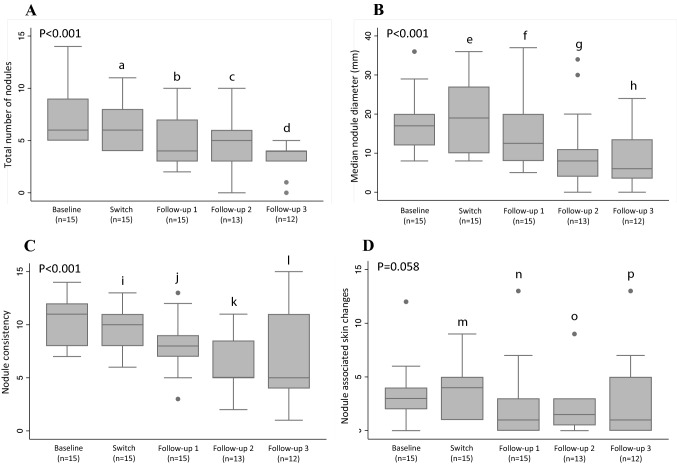
Continuous subcutaneous (s.c.) apomorphine infusion is an effective therapy for Parkinson's disease (PD), but a limitation is the formation of troublesome s.c. nodules. Various chemically non-identical apomorphine formulations are available. Anecdotal experiences have suggested that shifting from one of these (Apo-Go PumpFill; apoGPF) to another (Apomorphine PharmSwed; apoPS) may influence the occurrence and severity of s.c. nodules. We, therefore, followed 15 people with advanced PD (median PD-duration, 15 years; median "off"-phase Hoehn and Yahr, IV) on apoGPF and with troublesome s.c. nodules who were switched to apoPS. Data were collected at baseline, at the time of switching, and at a median of 1, 2.5, and 7.3 months post-switch. Total nodule numbers (P < 0.001), size (P < 0.001), consistency (P < 0.001), skin changes (P = 0.058), and pain (P ≤ 0.032) improved over the observation period. PD severity and dyskinesias tended to improve and increase, respectively. Apomorphine doses were stable, but levodopa doses increased by 100 mg/day. Patient-reported apomorphine efficacy tended to increase and all participants remained on apoPS throughout the observation period; with the main patient-reported reason being improved nodules. These observations suggest that patients with s.c. nodules caused by apoGPF may benefit from switching to apoPS in terms of s.c. nodule occurrence and severity. Alternatively, observed benefits may have been due to the switch itself. As nodule formation is a limiting factor in apomorphine treatment, a controlled prospective study comparing local tolerance with different formulations is warranted.
持续皮下(s.c.)阿扑吗啡输注是治疗帕金森病(PD)的有效方法,但存在一个局限性,即形成麻烦的 s.c. 结节。有各种化学上非同源的阿扑吗啡制剂可供选择。一些轶事经验表明,从其中一种(Apo-Go PumpFill;apoGPF)转换到另一种(Apomorphine PharmSwed;apoPS)可能会影响 s.c. 结节的发生和严重程度。因此,我们对 15 名患有晚期 PD(PD 病程中位数为 15 年;“关闭”期 Hoehn 和 Yahr,IV 中位数)且正在接受 apoGPF 治疗且出现麻烦 s.c. 结节的患者进行了随访,这些患者已转换为 apoPS。数据在基线、转换时以及转换后 1、2.5 和 7.3 个月时收集。总结节数量(P<0.001)、大小(P<0.001)、一致性(P<0.001)、皮肤变化(P=0.058)和疼痛(P≤0.032)在观察期间均得到改善。PD 严重程度和运动障碍分别趋于改善和增加。阿扑吗啡剂量保持稳定,但左旋多巴剂量增加 100mg/天。患者报告的阿扑吗啡疗效趋于增加,所有参与者在整个观察期间均继续使用 apoPS;主要的患者报告原因是结节改善。这些观察结果表明,因 apoGPF 引起 s.c. 结节的患者在 s.c. 结节的发生和严重程度方面可能从转换为 apoPS 中受益。或者,观察到的益处可能是由于转换本身。由于结节形成是阿扑吗啡治疗的一个限制因素,因此需要进行一项比较不同制剂局部耐受性的对照前瞻性研究。