Chinese Center for Disease Control and Prevention, Beijing, China.
Melbourne School of Population and Global Health, The University of Melbourne, Carlton, Victoria, Australia.
BMC Med. 2020 Jul 3;18(1):176. doi: 10.1186/s12916-020-01632-8.
Death registration completeness has never been assessed at the county level in China. Such analyses would provide critical intelligence to monitor the performance of the vital registration system and yield adjustment factors to correct death registration data, thereby increasing their policy utility.
We estimated the completeness of death registration for 31 provinces and 2844 counties of China in 2018 based on death data from the China Cause of Death Reporting System (CDRS) by using the empirical completeness method. We computed the root mean square difference (RMSD) of county-level completeness compared with provincial-level completeness to study intra-provincial variations. A two-level (province and county) logistic regression model was fitted to explore the association between county-level registration completeness and a set of covariates reflecting socioeconomic status, healthcare quality, and specific strategies and regulations designed to improve registration.
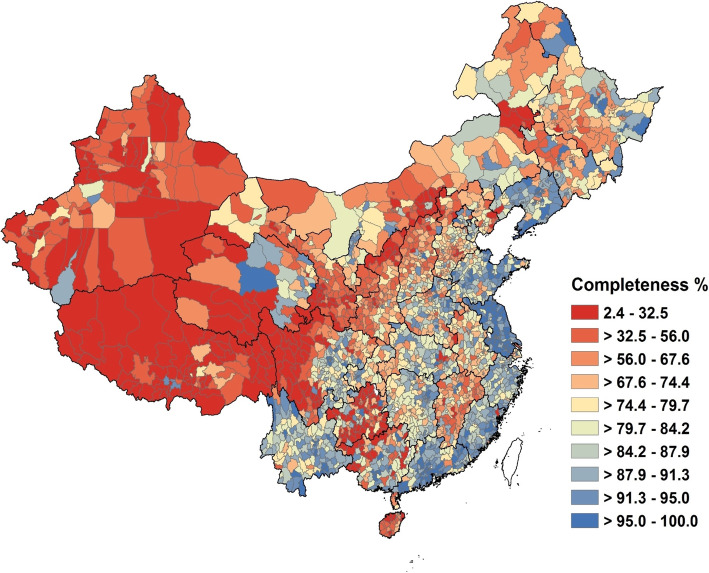
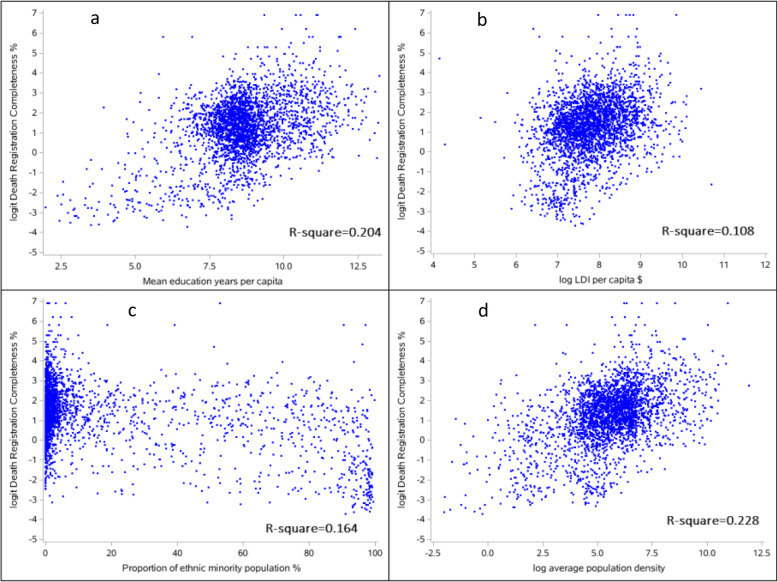
In 2018, the overall death registration completeness for the CDRS in China was 74.2% (95% uncertainty interval [UI] 66.2-80.4), with very little difference for males and females. Geographical differences in completeness were higher across counties than across provinces. The county-level completeness ranged from 2.4% (95% UI 1.0-5.0%) in Burang County, Tibet, to 100.0% (95% UI 99.9-100.0%) in Guandu District, Yunnan. The coastal provinces of Jiangsu, Guangdong, and Fujian, with higher overall completeness, contained counties with low completeness; conversely, the underdeveloped provinces of Guangxi and Guizhou, with lower overall completeness, included some counties with high completeness. GDP, education, population density, minority population, healthcare access, and registration strategies were important drivers of the geographical differences in registration completeness.
There are marked inequalities in registration completeness at the county level and within provinces in China. The socioeconomic condition, the implementation of specific registration-enhancing initiatives, and the availability and quality of medical care were the primary drivers of the observed geographical variation. A more strategic approach, with more research, is required to identify the main reasons for death under-reporting, especially in the poorer performing counties, to guide remedial action.
中国县级层面的死亡登记完整性从未进行过评估。这种分析将提供关键情报,以监测生命登记系统的绩效,并得出校正死亡登记数据的调整因素,从而提高其政策实用性。
我们根据中国死因报告系统(CDRS)中的死亡数据,采用实证完整性方法,估计了 2018 年中国 31 个省份和 2844 个县的死亡登记完整率。我们计算了县级完整性与省级完整性之间的均方根差(RMSD),以研究省内差异。拟合了一个两级(省和县级)逻辑回归模型,以探讨县级登记完整率与一组反映社会经济状况、医疗质量以及旨在提高登记的特定策略和规定的协变量之间的关联。
2018 年,中国 CDRS 的总体死亡登记完整率为 74.2%(95%置信区间[UI]66.2-80.4),男性和女性之间差异很小。完整性的地理差异在县级层面上高于省级层面。登记完整率从西藏的察隅县(2.4%[95%UI 1.0-5.0%])到云南的官渡区(100.0%[95%UI 99.9-100.0%])不等。整体完整性较高的沿海省份江苏、广东和福建包含完整性较低的县;相反,整体完整性较低的欠发达省份广西和贵州包含一些完整性较高的县。国内生产总值、教育、人口密度、少数民族人口、医疗保健可及性以及登记策略是登记完整率地理差异的重要驱动因素。
中国县级和省内的登记完整率存在显著差异。社会经济状况、特定登记增强举措的实施以及医疗保健的可及性和质量是观察到的地理差异的主要驱动因素。需要采取更具战略性的方法,进行更多的研究,以确定导致死亡漏报的主要原因,特别是在表现较差的县,以指导采取补救措施。