Research Institute for Microbial Diseases, Osaka University, Suita, Japan.
POCT Products Business Unit, TANAKA Kikinzoku Kogyo K.K, Hiratsuka, Japan.
Virol J. 2020 Jul 2;17(1):90. doi: 10.1186/s12985-020-01364-4.
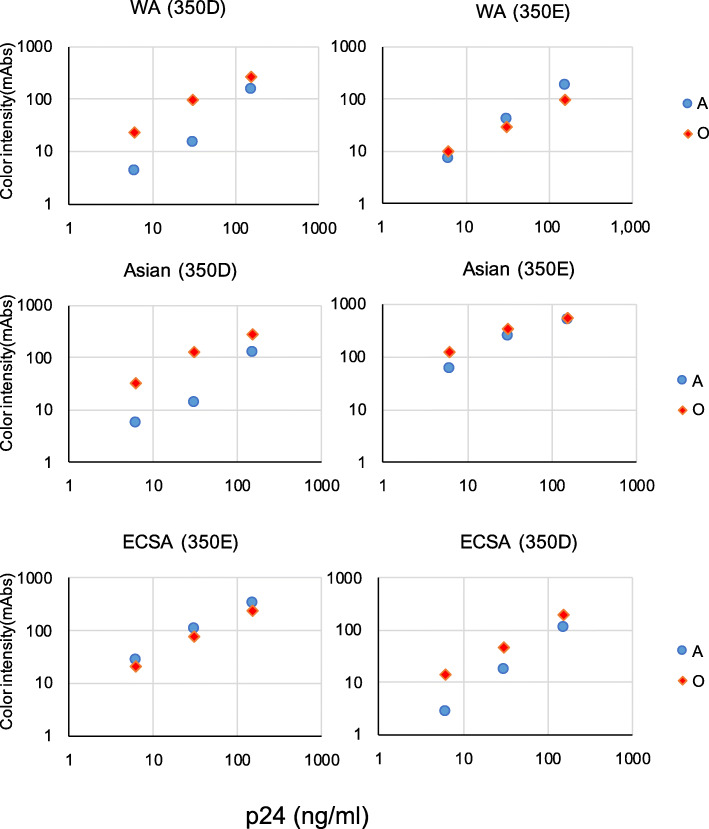
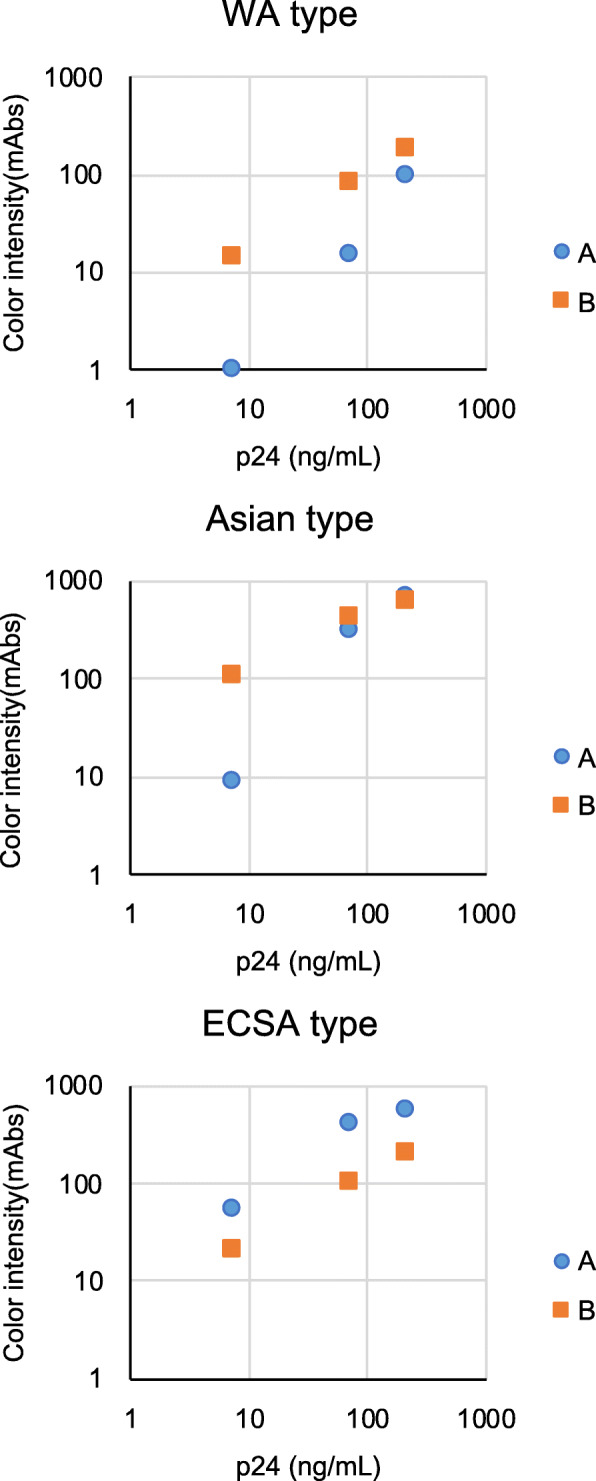
Three different genotypes of chikungunya virus (CHIKV) have been classified: East/Central/South African (ECSA), West African (WA), and Asian. Previously, a rapid immunochromatographic (IC) test detecting CHIKV E1-antigen showed high sensitivity for certain ECSA-genotype viruses, but this test showed poor performance against the Asian-genotype virus that is spreading in the American continents. We found that the reactivity of one monoclonal antibody (MAb) used in the IC rapid diagnostic test (RDT) is affected by a single amino acid substitution in E1. Therefore, we developed new MAbs that exhibited specific recognition of all three genotypes of CHIKV.
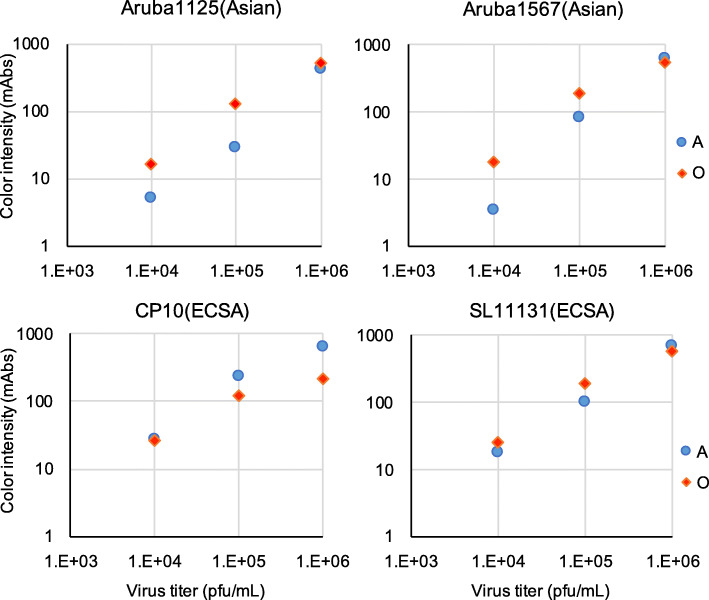
Using a combination of the newly generated MAbs, we developed a novel version of the IC RDT with improved sensitivity to Asian-genotype CHIKV. To evaluate the sensitivity, specificity, and cross-reactivity of the new version of the IC RDT, we first used CHIKV isolates and E1-pseudotyped lentiviral vectors. We then used clinical specimens obtained in Aruba in 2015 and in Bangladesh in 2017 for further evaluation of RDT sensitivity and specificity. Another alphavirus, sindbis virus (SINV), was used to test RDT cross-reactivity.
The new version of the RDT detected Asian-genotype CHIKV at titers as low as 10^4 plaque-forming units per mL, a concentration that was below the limit of detection of the old version. The new RDT had sensitivity to the ECSA genotype that was comparable with that of the old version, yielding 92% (92 out of 100) sensitivity (95% confidence interval 85.0-95.9) and 100% (100 out of 100) specificity against a panel of 100 CHIKV-positive and 100 CHIKV-negative patient sera obtained in the 2017 outbreak in Bangladesh.
Our newly developed CHIKV antigen-detecting RDT demonstrated high levels of sensitivity and lacked cross-reactivity against SINV. These results suggested that our new version of the CHIKV E1-antigen RDT is promising for use in areas in which the Asian and ECSA genotypes of CHIKV circulate. Further validation with large numbers of CHIKV-positive and -negative clinical samples is warranted. (323 words).
已对三种不同基因型的基孔肯雅病毒(CHIKV)进行了分类:东/中非/南非(ECSA)、西非(WA)和亚洲。先前,一种快速免疫层析(IC)检测 CHIKV E1 抗原的检测方法显示对某些 ECSA 基因型病毒具有高灵敏度,但该检测方法对在美洲大陆传播的亚洲基因型病毒的性能较差。我们发现,IC 快速诊断检测(RDT)中使用的一种单克隆抗体(MAb)的反应性受 E1 中单个氨基酸取代的影响。因此,我们开发了新的 MAb,它们表现出对所有三种基因型 CHIKV 的特异性识别。
我们使用新生成的 MAb 的组合,开发了一种新型的 IC RDT,对亚洲基因型 CHIKV 的灵敏度得到了提高。为了评估新版本的 IC RDT 的灵敏度、特异性和交叉反应性,我们首先使用了 CHIKV 分离株和 E1 假型慢病毒载体。然后,我们使用了 2015 年在阿鲁巴岛和 2017 年在孟加拉国获得的临床标本进一步评估 RDT 的灵敏度和特异性。另一种甲病毒,辛德毕斯病毒(SINV),用于测试 RDT 的交叉反应性。
新版本的 RDT 可检测到低至 10^4 噬菌斑形成单位/毫升的亚洲基因型 CHIKV,浓度低于旧版本的检测限。新版本的 RDT 对 ECSA 基因型的灵敏度与旧版本相当,对 2017 年孟加拉国爆发期间获得的 100 份 CHIKV 阳性和 100 份 CHIKV 阴性患者血清的检测灵敏度为 92%(92/100)(95%置信区间 85.0-95.9),特异性为 100%(100/100)。
我们新开发的 CHIKV 抗原检测 RDT 表现出高灵敏度,并且与 SINV 无交叉反应性。这些结果表明,我们新开发的 CHIKV E1 抗原 RDT 有望在亚洲和 ECSA 基因型 CHIKV 流行的地区使用。需要用大量的 CHIKV 阳性和阴性临床样本进行进一步验证。(323 个单词)