Department of Information Systems, College of Computer and Information Systems, Prince Sultan University, Riyadh, Kingdom of Saudi Arabia.
BMC Bioinformatics. 2020 Jul 2;21(1):278. doi: 10.1186/s12859-020-03626-y.
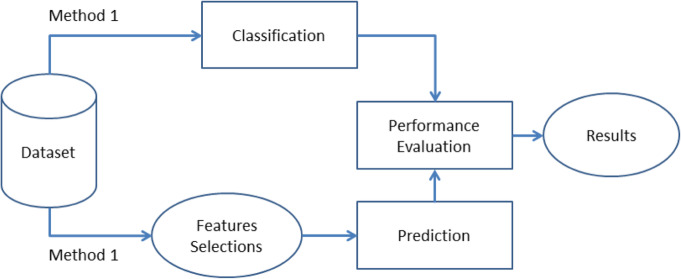
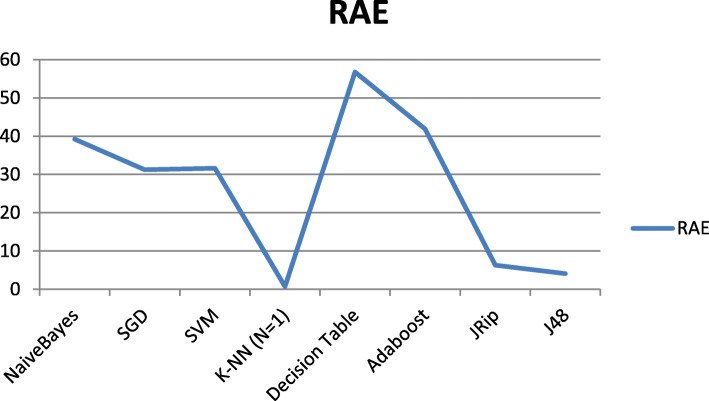
Heart disease (HD) is one of the most common diseases nowadays, and an early diagnosis of such a disease is a crucial task for many health care providers to prevent their patients for such a disease and to save lives. In this paper, a comparative analysis of different classifiers was performed for the classification of the Heart Disease dataset in order to correctly classify and or predict HD cases with minimal attributes. The set contains 76 attributes including the class attribute, for 1025 patients collected from Cleveland, Hungary, Switzerland, and Long Beach, but in this paper, only a subset of 14 attributes are used, and each attribute has a given set value. The algorithms used K- Nearest Neighbor (K-NN), Naive Bayes, Decision tree J48, JRip, SVM, Adaboost, Stochastic Gradient Decent (SGD) and Decision Table (DT) classifiers to show the performance of the selected classifications algorithms to best classify, and or predict, the HD cases.
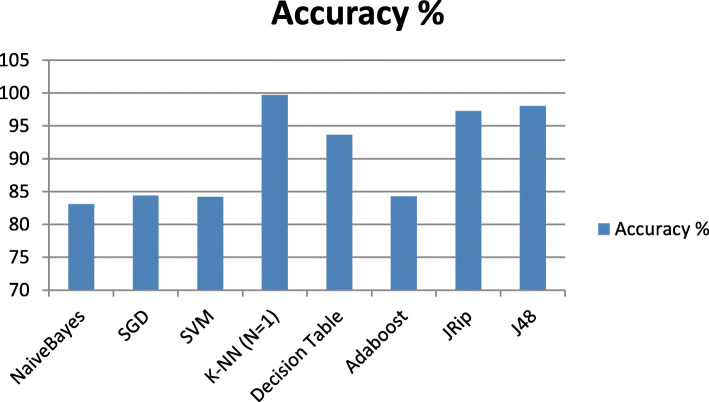
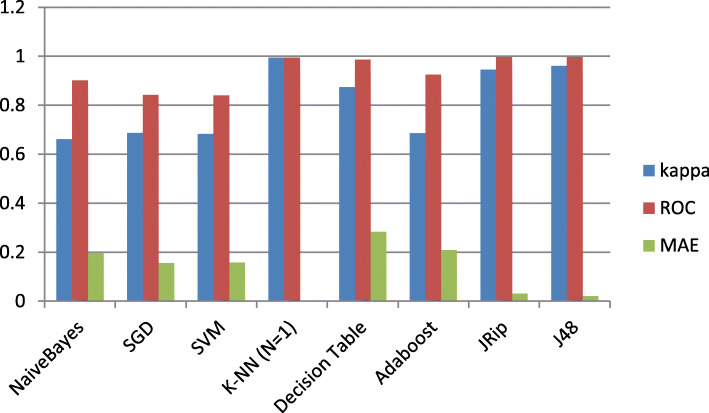
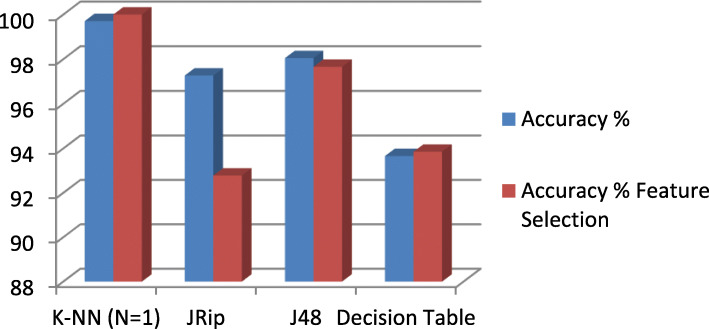
It was shown that using different classification algorithms for the classification of the HD dataset gives very promising results in term of the classification accuracy for the K-NN (K = 1), Decision tree J48 and JRip classifiers with accuracy of classification of 99.7073, 98.0488 and 97.2683% respectively. A feature extraction method was performed using Classifier Subset Evaluator on the HD dataset, and results show enhanced performance in term of the classification accuracy for K-NN (N = 1) and Decision Table classifiers to 100 and 93.8537% respectively after using the selected features by only applying a combination of up to 4 attributes instead of 13 attributes for the predication of the HD cases.
Different classifiers were used and compared to classify the HD dataset, and we concluded the benefit of having a reliable feature selection method for HD disease prediction with using minimal number of attributes instead of having to consider all available ones.
心脏病(HD)是当今最常见的疾病之一,许多医疗保健提供者的一项关键任务是对这种疾病进行早期诊断,以防止患者患病并拯救生命。在本文中,对不同的分类器进行了比较分析,以便在属性最少的情况下对心脏病数据集进行正确分类和/或预测。该数据集包含来自克利夫兰、匈牙利、瑞士和长滩的 1025 名患者的 76 个属性,包括类别属性,但本文仅使用了 14 个属性的子集,每个属性都有一组给定的值。使用的算法包括 K-近邻(K-NN)、朴素贝叶斯、决策树 J48、JRip、SVM、Adaboost、随机梯度下降(SGD)和决策表(DT)分类器,以展示所选分类算法的性能,以最好地对 HD 病例进行分类和/或预测。
结果表明,使用不同的分类算法对 HD 数据集进行分类,在 K-NN(K=1)、决策树 J48 和 JRip 分类器的分类准确性方面都给出了非常有希望的结果,准确率分别为 99.7073%、98.0488%和 97.2683%。在 HD 数据集上使用分类器子集评估器进行了特征提取方法,结果表明,在 K-NN(N=1)和决策表分类器的分类准确性方面,性能得到了增强,准确率分别提高到 100%和 93.8537%,仅使用 4 个属性的组合而不是 13 个属性进行 HD 病例预测。
使用不同的分类器对 HD 数据集进行了分类和比较,我们得出结论,使用最小数量的属性而不是考虑所有可用属性进行 HD 疾病预测,具有可靠的特征选择方法是有益的。