Li Jing, Han Li-Hong, Liu Xiao-Bin, Zhao Zhi-Wei, Yang Zhu L
CAS Key Laboratory for Plant Diversity and Biogeography of East Asia, Kunming Institute of Botany, Chinese Academy of Science, Kunming, 650201 Yunnan China.
Yunnan Key Laboratory for Fungal Diversity and Green Development, Kunming, 650201 Yunnan China.
IMA Fungus. 2020 Jun 8;11:10. doi: 10.1186/s43008-020-00031-1. eCollection 2020.
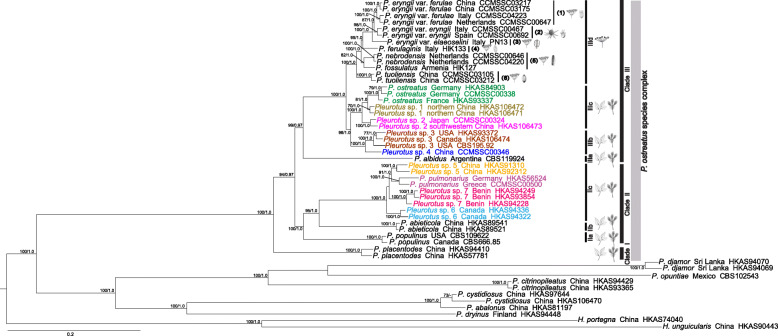
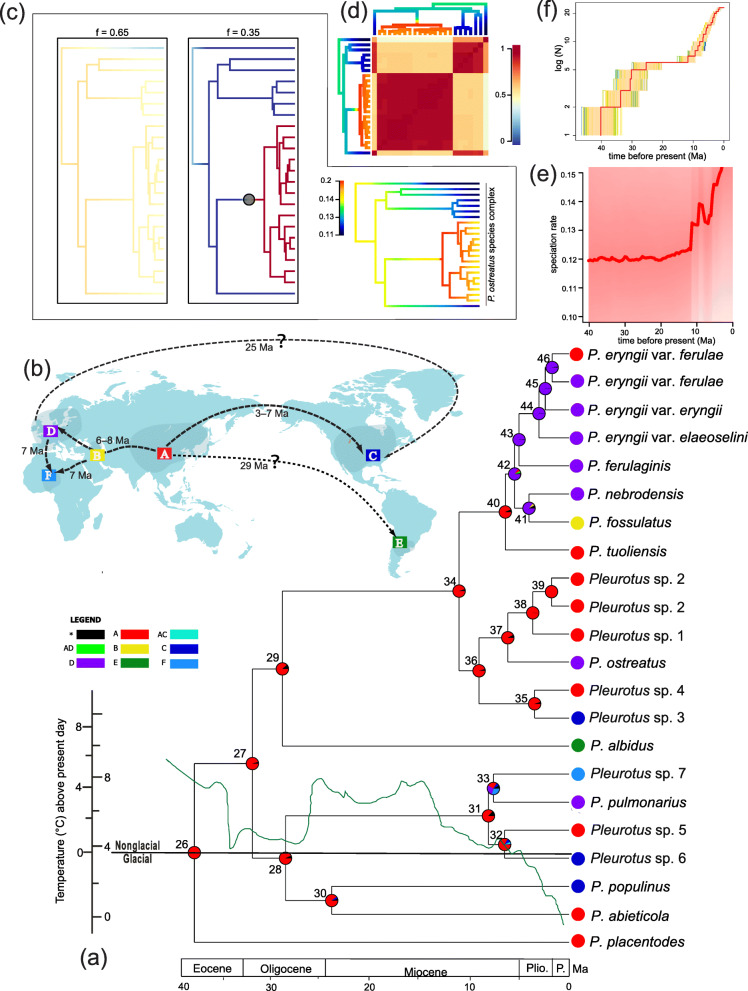
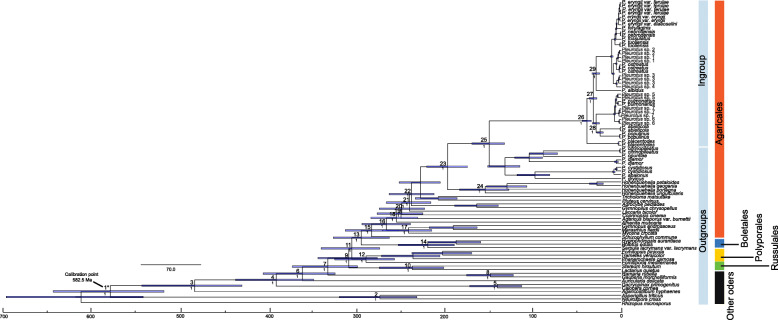
The species complex is saprotrophic and of significant economic and ecological importance. However, species delimitation has long been problematic because of phenotypic plasticity and morphological stasis. In addition, the evolutionary history is poorly understood due to limited sampling and insufficient gene fragments employed for phylogenetic analyses. Comprehensive sampling from Asia, Europe, North and South America and Africa was used to run phylogenetic analyses of the species complex based on 40 nuclear single-copy orthologous genes using maximum likelihood and Bayesian inference analyses. Here, we present a robust phylogeny of the species complex, fully resolved from the deepest nodes to species level. The species complex was strongly supported as monophyletic, and 20 phylogenetic species were recognized, with seven putatively new species. Data from our molecular clock analyses suggested that divergence of the genus probably occurred in the late Jurassic, while the most recent common ancestor of the species complex diversified about 39 Ma in East Asia. Species of the complex might migrate from the East Asia into North America across the North Atlantic Land Bridge or the Bering Land Bridge at different times during the late Oligocene, late Miocene and late Pliocene, and then diversified in the Old and New Worlds simultaneously through multiple dispersal and vicariance events. The dispersal from East Asia to South America in the middle Oligocene was probably achieved by a long-distance dispersal event. Intensification of aridity and climate cooling events in the late Miocene and Quaternary glacial cycling probably had a significant influence on diversification patterns of the complex. The disjunctions among East Asia, Europe, North America and Africa within Clade IIc are hypothesized to be a result of allopatric speciation. Substrate transitions to Apiaceae probably occurred no earlier than 6 Ma. Biogeographic analyses suggested that the global cooling of the late Eocene, intensification of aridity caused by rapid uplift of the QTP and retreat of the Tethys Sea in the late Miocene, climate cooling events in Quaternary glacial cycling, and substrate transitions have contributed jointly to diversification of the species complex.
该物种复合体是腐生的,具有重要的经济和生态意义。然而,由于表型可塑性和形态停滞,物种界定长期以来一直存在问题。此外,由于采样有限以及用于系统发育分析的基因片段不足,其进化历史仍知之甚少。本研究从亚洲、欧洲、南北美洲和非洲进行了全面采样,基于40个核单拷贝直系同源基因,采用最大似然法和贝叶斯推断分析对该物种复合体进行了系统发育分析。在此,我们展示了该物种复合体的一个稳健系统发育树,从最深节点到物种水平都得到了充分解析。该物种复合体被强烈支持为单系类群,共识别出20个系统发育物种,其中7个可能为新物种。我们分子钟分析的数据表明,该属的分化可能发生在侏罗纪晚期,而该物种复合体的最近共同祖先约在3900万年前在东亚分化。该复合体的物种可能在渐新世晚期、中新世晚期和上新世晚期的不同时间,通过北大西洋陆桥或白令陆桥从东亚迁移到北美,然后通过多次扩散和隔离事件在新旧世界同时分化。渐新世中期从东亚到南美的扩散可能是通过一次远距离扩散事件实现的。中新世晚期和第四纪冰川循环中的干旱加剧和气候变冷事件可能对该复合体的多样化模式产生了重大影响。推测分支IIc内东亚、欧洲、北美和非洲之间的间断分布是异域物种形成的结果。向伞形科的底物转变可能不早于600万年前发生。生物地理学分析表明,始新世晚期的全球变冷、青藏高原快速隆升和中新世晚期特提斯海退缩导致的干旱加剧、第四纪冰川循环中的气候变冷事件以及底物转变共同促成了该物种复合体的多样化。