• 文献检索
  • 文档翻译
  • 深度研究
  • 学术资讯
  • Suppr Zotero 插件Zotero 插件
  • 邀请有礼
  • 套餐&价格
  • 历史记录
应用&插件
Suppr Zotero 插件Zotero 插件浏览器插件Mac 客户端Windows 客户端微信小程序
定价
高级版会员购买积分包购买API积分包
服务
文献检索文档翻译深度研究API 文档MCP 服务
关于我们
关于 Suppr公司介绍联系我们用户协议隐私条款
关注我们

Suppr 超能文献

核心技术专利:CN118964589B侵权必究
粤ICP备2023148730 号-1Suppr @ 2026

文献检索

告别复杂PubMed语法,用中文像聊天一样搜索,搜遍4000万医学文献。AI智能推荐,让科研检索更轻松。

立即免费搜索

文件翻译

保留排版,准确专业,支持PDF/Word/PPT等文件格式,支持 12+语言互译。

免费翻译文档

深度研究

AI帮你快速写综述,25分钟生成高质量综述,智能提取关键信息,辅助科研写作。

立即免费体验

关于中国皮肤科医生对人工智能态度的基于网络的研究。

Web-based study on Chinese dermatologists' attitudes towards artificial intelligence.

作者信息

Shen Changbing, Li Chengxu, Xu Feng, Wang Ziyi, Shen Xue, Gao Jing, Ko Randy, Jing Yan, Tang Xiaofeng, Yu Ruixing, Guo Junhu, Xu Feng, Meng Rusong, Cui Yong

机构信息

Department of Dermatology, China-Japan Friendship Hospital, Beijing, China.

Graduate School, Peking Union Medical College and Chinese Academy of Medical Sciences, Beijing, China.

出版信息

Ann Transl Med. 2020 Jun;8(11):698. doi: 10.21037/atm.2019.12.102.

DOI:10.21037/atm.2019.12.102
PMID:32617318
原文链接:https://pmc.ncbi.nlm.nih.gov/articles/PMC7327314/
Abstract

BACKGROUND

Artificial intelligence (AI) has become a powerful tool and is attracting more attention in the field of medicine. There are a number of AI studies focusing on skin diseases, and there are many AI products that have been applied in dermatology. However, the attitudes of dermatologists, specifically those from China, towards AI, is not clear as few, if any studies have focused on this issue.

METHODS

A web-based questionnaire was designed by experts from the Chinese Skin Image Database (CSID) and published on the UMER Doctor platform (an online learning platform for dermatologists developed by the Shanghai Wheat Color Intelligent Technology Company, China). A total of 1,228 Chinese dermatologists were recruited and provided answers to the questionnaire online. The differences of dermatologists' attitudes towards AI among the different groups (stratified by age, gender, hospital level, education degree, professional title, and hospital ownership) were compared by using the Mann-Whitney U test and the Kruskal-Wallis H test. The correlations between stratified factors and dermatologists' attitudes towards AI were calculated by using the Spearman's rank correlation test. SPSS (version 22.0) was utilized for all analyses. A two-sided P value <0.05 was considered statistically significant in all analyses.

RESULTS

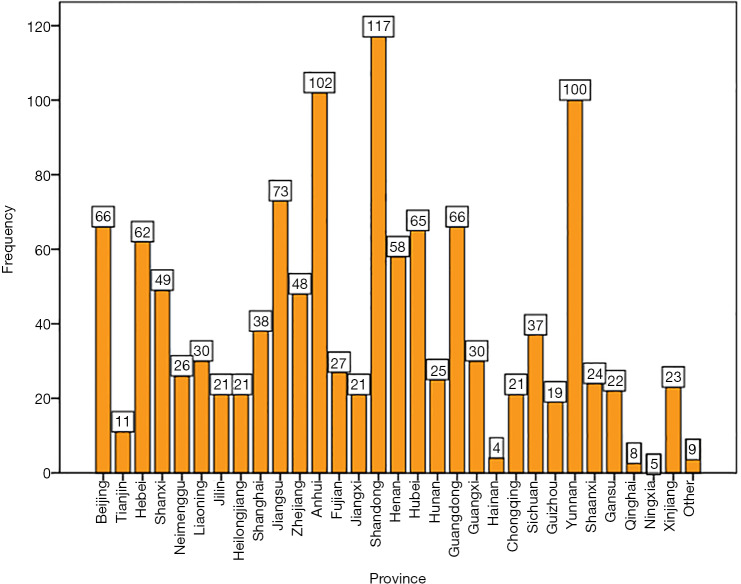
A total of 1,228 Chinese dermatologists from 30 provinces, autonomous regions, municipalities, and other regions (including Hong Kong, Macau, and Taiwan) participated in this survey. The dermatologists who participated acquired AI-related information mainly through the Internet, meetings or forums, and 70.51% of participated dermatologists acquired AI-related information by two or more approaches. In total, 99.51% of participated dermatologists pay attention (general, passive-active, and active attention) to information pertaining to AI. Stratified analyses revealed statistically significant differences in their attention levels (unconcerned, general, passive-active, and active attention) to AI-related information by gender, hospital level, education degree, and professional title (P values ≤1.79E-02). In total, 95.36% of the participated dermatologists thought the role of AI to be in "assisting the daily diagnosis and treatment activities for dermatologists". Stratified analyses about the thought of AI roles (unconcerned, useless, assist, and replace) showed that there was no statistically significant difference except for the hospital level (P value =4.09E-03). The correlations between stratified factors with attention levels and the opinions of AI roles showed extremely weak correlations. Furthermore, 64.17% of participated dermatologists thought secondary hospitals in China are in most need of the application AI, and 91.78% of participated dermatologists thought the priority implementation of AI should be in skin tumors.

CONCLUSIONS

The majority of Chinese dermatologists are interested in AI information and acquired information about AI through a variety of approaches. Nearly all dermatologists are attentive to information on AI and think the role of AI is in "assisting the daily diagnosis and treatment activities for dermatologists". Future AI implementation should be primarily focused on skin tumors and utilized in in secondary hospitals.

摘要

背景

人工智能(AI)已成为一种强大工具,在医学领域正吸引着更多关注。有许多关于皮肤病的人工智能研究,并且有许多人工智能产品已应用于皮肤科。然而,皮肤科医生,特别是来自中国的皮肤科医生,对人工智能的态度尚不清楚,因为很少有研究关注这一问题。

方法

由中国皮肤图像数据库(CSID)的专家设计了一份基于网络的问卷,并发布在UMER Doctor平台(由中国上海麦色智能科技公司开发的皮肤科医生在线学习平台)上。共招募了1228名中国皮肤科医生,并让他们在线回答问卷。使用曼-惠特尼U检验和克鲁斯卡尔-沃利斯H检验比较不同组(按年龄、性别、医院级别、教育程度、职称和医院所有制分层)的皮肤科医生对人工智能态度的差异。使用斯皮尔曼等级相关检验计算分层因素与皮肤科医生对人工智能态度之间的相关性。所有分析均使用SPSS(版本22.0)。在所有分析中,双侧P值<0.05被认为具有统计学意义。

结果

来自30个省、自治区、直辖市及其他地区(包括香港、澳门和台湾)的1228名中国皮肤科医生参与了本次调查。参与调查的皮肤科医生获取人工智能相关信息主要通过互联网、会议或论坛,70.51%的参与调查的皮肤科医生通过两种或更多途径获取人工智能相关信息。总共,99.51%的参与调查的皮肤科医生关注(一般关注、被动-主动关注和主动关注)与人工智能相关的信息。分层分析显示,不同性别、医院级别、教育程度和职称的皮肤科医生对人工智能相关信息的关注程度(不关注、一般关注、被动-主动关注和主动关注)存在统计学显著差异(P值≤1.79E-02)。总共,95.36%的参与调查的皮肤科医生认为人工智能的作用是“辅助皮肤科医生的日常诊疗活动”。关于人工智能作用的想法(不关注、无用、辅助和替代)的分层分析表明,除医院级别外没有统计学显著差异(P值=4.09E-03)。分层因素与关注程度及人工智能作用观点之间的相关性显示出极其微弱的相关性。此外,64.17%的参与调查的皮肤科医生认为中国的二级医院最需要应用人工智能,91.78%的参与调查的皮肤科医生认为人工智能的优先应用领域应该是皮肤肿瘤。

结论

大多数中国皮肤科医生对人工智能信息感兴趣,并通过多种途径获取有关人工智能的信息。几乎所有皮肤科医生都关注人工智能信息,并认为人工智能的作用是“辅助皮肤科医生的日常诊疗活动”。未来人工智能的应用应主要集中在皮肤肿瘤方面,并应用于二级医院。
https://cdn.ncbi.nlm.nih.gov/pmc/blobs/8dec/7327314/bb47de724cc1/atm-08-11-698-f1.jpg

相似文献

1
Web-based study on Chinese dermatologists' attitudes towards artificial intelligence.关于中国皮肤科医生对人工智能态度的基于网络的研究。
Ann Transl Med. 2020 Jun;8(11):698. doi: 10.21037/atm.2019.12.102.
2
Artificial Intelligence and Its Effect on Dermatologists' Accuracy in Dermoscopic Melanoma Image Classification: Web-Based Survey Study.人工智能及其对皮肤科医生在皮肤镜黑色素瘤图像分类中准确性的影响:基于网络的调查研究。
J Med Internet Res. 2020 Sep 11;22(9):e18091. doi: 10.2196/18091.
3
Attitudes Towards Artificial Intelligence Among Dermatologists Working in Saudi Arabia.沙特阿拉伯皮肤科医生对人工智能的态度
Dermatol Pract Concept. 2023 Jan 1;13(1):e2023035. doi: 10.5826/dpc.1301a35.
4
Towards successful implementation of artificial intelligence in skin cancer care: a qualitative study exploring the views of dermatologists and general practitioners.人工智能在皮肤癌护理中的成功实施:探索皮肤科医生和全科医生观点的定性研究。
Arch Dermatol Res. 2023 Jul;315(5):1187-1195. doi: 10.1007/s00403-022-02492-3. Epub 2022 Dec 7.
5
Multivariate Analysis and Prediction Model Construction for Dermatoscope Use by Chinese Dermatologists via an Online Survey.中文皮肤科医生通过在线调查使用皮肤镜的多变量分析和预测模型构建。
Skin Res Technol. 2024 Oct;30(10):e70087. doi: 10.1111/srt.70087.
6
Clinical Application of Artificial Intelligence for Non-melanoma Skin Cancer.人工智能在非黑色素瘤皮肤癌中的临床应用。
Curr Treat Options Oncol. 2023 Apr;24(4):373-379. doi: 10.1007/s11864-023-01065-4. Epub 2023 Mar 14.
7
The Classification of Six Common Skin Diseases Based on Xiangya-Derm: Development of a Chinese Database for Artificial Intelligence.基于湘雅皮肤影像库的六种常见皮肤病分类:人工智能用中文数据库的建立。
J Med Internet Res. 2021 Sep 21;23(9):e26025. doi: 10.2196/26025.
8
Attitudes of medical workers in China toward artificial intelligence in ophthalmology: a comparative survey.中国眼科医务人员对人工智能的态度:一项对比调查。
BMC Health Serv Res. 2021 Oct 9;21(1):1067. doi: 10.1186/s12913-021-07044-5.
9
Patient and dermatologists' perspectives on augmented intelligence for melanoma screening: A prospective study.患者和皮肤科医生对用于黑色素瘤筛查的人工智能的看法:一项前瞻性研究。
J Eur Acad Dermatol Venereol. 2024 Dec;38(12):2240-2249. doi: 10.1111/jdv.19905. Epub 2024 Feb 27.
10
Physicians' attitudes and knowledge toward artificial intelligence in medicine: Benefits and drawbacks.医生对医学人工智能的态度和知识:益处与弊端。
Heliyon. 2023 Mar 23;9(4):e14744. doi: 10.1016/j.heliyon.2023.e14744. eCollection 2023 Apr.

引用本文的文献

1
Advancements and challenges of artificial intelligence in dermatology: a review of applications and perspectives in China.人工智能在皮肤病学中的进展与挑战:中国应用与前景综述
Front Digit Health. 2025 Aug 13;7:1544520. doi: 10.3389/fdgth.2025.1544520. eCollection 2025.
2
Attitudes Towards the Use of Artificial Intelligence in Dermatology: A Survey of Australian Dermatologists.澳大利亚皮肤科医生对人工智能在皮肤科应用的态度:一项调查
Australas J Dermatol. 2025 Aug;66(5):e279-e286. doi: 10.1111/ajd.14524. Epub 2025 May 14.
3
Exploring the Views of Dermatologists, General Practitioners, and Melanographers on the Use of AI Tools in the Context of Good Decision-Making When Detecting Melanoma: Qualitative Interview Study.

本文引用的文献

1
Impact of artificial intelligence on radiology: a EuroAIM survey among members of the European Society of Radiology.人工智能对放射学的影响:欧洲放射学会成员的一项欧洲人工智能医学影像项目(EuroAIM)调查。
Insights Imaging. 2019 Oct 31;10(1):105. doi: 10.1186/s13244-019-0798-3.
2
Perceptions of using herbal medicines for managing menopausal symptoms: a web-based survey of Korean medicine doctors.关于使用草药治疗更年期症状的认知:一项针对韩医的网络调查
Integr Med Res. 2019 Dec;8(4):229-233. doi: 10.1016/j.imr.2019.08.004. Epub 2019 Aug 29.
3
Acceptability of artificial intelligence (AI)-led chatbot services in healthcare: A mixed-methods study.
探索皮肤科医生、全科医生和黑色素瘤成像专家对在检测黑色素瘤时做出明智决策的背景下使用人工智能工具的看法:定性访谈研究。
JMIR Dermatol. 2025 Mar 24;8:e63923. doi: 10.2196/63923.
4
Chinese colposcopists' attitudes toward the colposcopic artificial intelligence auxiliary diagnostic system (CAIADS): A nation-wide, multi-center survey.中国阴道镜医师对阴道镜人工智能辅助诊断系统(CAIADS)的态度:一项全国性、多中心调查。
Digit Health. 2024 Sep 5;10:20552076241279952. doi: 10.1177/20552076241279952. eCollection 2024 Jan-Dec.
5
Adaptation and Psychometric Properties of an Attitude toward Artificial Intelligence Scale (AIAS-4) among Peruvian Nurses.秘鲁护士对人工智能态度量表(AIAS - 4)的适应性及心理测量特性
Behav Sci (Basel). 2024 May 23;14(6):437. doi: 10.3390/bs14060437.
6
Radiology Residents' Perceptions of Artificial Intelligence: Nationwide Cross-Sectional Survey Study.放射科住院医师对人工智能的看法:全国横断面调查研究。
J Med Internet Res. 2023 Oct 19;25:e48249. doi: 10.2196/48249.
7
Experiences Regarding Use and Implementation of Artificial Intelligence-Supported Follow-Up of Atypical Moles at a Dermatological Outpatient Clinic: Qualitative Study.皮肤科门诊人工智能辅助非典型痣随访应用与实施的经验:定性研究
JMIR Dermatol. 2023 Jun 23;6:e44913. doi: 10.2196/44913.
8
Surveying Public Perceptions of Artificial Intelligence in Health Care in the United States: Systematic Review.美国公众对医疗保健领域人工智能认知的调查:系统综述。
J Med Internet Res. 2023 Apr 4;25:e40337. doi: 10.2196/40337.
9
AI-Powered Diagnosis of Skin Cancer: A Contemporary Review, Open Challenges and Future Research Directions.人工智能助力的皮肤癌诊断:当代综述、开放挑战与未来研究方向
Cancers (Basel). 2023 Feb 13;15(4):1183. doi: 10.3390/cancers15041183.
10
Towards successful implementation of artificial intelligence in skin cancer care: a qualitative study exploring the views of dermatologists and general practitioners.人工智能在皮肤癌护理中的成功实施:探索皮肤科医生和全科医生观点的定性研究。
Arch Dermatol Res. 2023 Jul;315(5):1187-1195. doi: 10.1007/s00403-022-02492-3. Epub 2022 Dec 7.
人工智能(AI)主导的聊天机器人服务在医疗保健中的可接受性:一项混合方法研究。
Digit Health. 2019 Aug 21;5:2055207619871808. doi: 10.1177/2055207619871808. eCollection 2019 Jan-Dec.
4
Assessing the effectiveness of artificial intelligence methods for melanoma: A retrospective review.评估人工智能方法在黑色素瘤中的有效性:一项回顾性研究。
J Am Acad Dermatol. 2019 Nov;81(5):1176-1180. doi: 10.1016/j.jaad.2019.06.042. Epub 2019 Jun 27.
5
Comparison of the accuracy of human readers versus machine-learning algorithms for pigmented skin lesion classification: an open, web-based, international, diagnostic study.比较人类读者和机器学习算法在色素性皮肤病变分类中的准确性:一项开放的、基于网络的、国际性的、诊断性研究。
Lancet Oncol. 2019 Jul;20(7):938-947. doi: 10.1016/S1470-2045(19)30333-X. Epub 2019 Jun 12.
6
The proof of the pudding: in praise of a culture of real-world validation for medical artificial intelligence.实践出真知:赞医学人工智能的现实世界验证文化
Ann Transl Med. 2019 Apr;7(8):161. doi: 10.21037/atm.2019.04.07.
7
Pathologist-level classification of histopathological melanoma images with deep neural networks.基于深度神经网络的组织病理学黑色素瘤图像病理学家级分类。
Eur J Cancer. 2019 Jul;115:79-83. doi: 10.1016/j.ejca.2019.04.021. Epub 2019 May 23.
8
Artificial intelligence and dermatology: opportunities, challenges, and future directions.人工智能与皮肤病学:机遇、挑战及未来方向。
Semin Cutan Med Surg. 2019 Mar 1;38(1):E31-37. doi: 10.12788/j.sder.2019..
9
Patient centered care for prostate cancer-how can artificial intelligence and machine learning help make the right decision for the right patient?以患者为中心的前列腺癌护理——人工智能和机器学习如何帮助为合适的患者做出正确的决策?
Ann Transl Med. 2019 Mar;7(Suppl 1):S1. doi: 10.21037/atm.2019.01.13.
10
Artificial Intelligence in Clinical Decision Support: Challenges for Evaluating AI and Practical Implications.临床决策支持中的人工智能:评估人工智能的挑战及实际意义
Yearb Med Inform. 2019 Aug;28(1):128-134. doi: 10.1055/s-0039-1677903. Epub 2019 Apr 25.